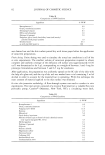
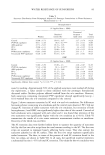
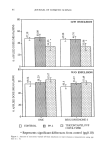
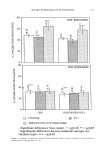
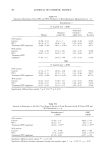
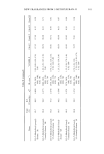
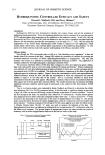
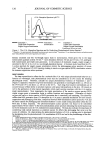
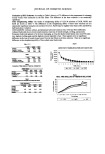
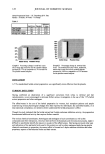
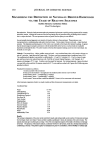
128 JOURNAL OF COSMETIC SCIENCE Herbal Preparation Study - J.H. Greenberg & M. Katz Results - 24 males 40 weeks - % Change Table I Wilcoxon HairPrime Placebo P Value Total Number +77 +3 0.003 Total Wei0ht +49 +20 0.125 •Terminal Hair Count +169 +34 0.010 Average Hair Length +30 +22 0.322 •0% 40%. 2O% 0% ..... Active Group Placebo C•oup Graph I Percentage change in total hair cotrot. The average hair count for actively treated subjects increased by 77% as compared to a 3% increase for The placebo treated subjects. 180% 160% 140%• 120% 100% 80% 60% 4O% 2O% Active Group Placebo Group Graph II Percentage change in terminal hair count. The terminal hair (non-vellus, melanized, mature hair) count for actively treated subjects increased by 169% as compared to a 33% increase for the placebo treated subjects. CONCLUSION A 7 5% standardized herbal extract preparation, was significantly more effective than the placebo. CURRENT DISCUSSION Having confirmed an observation of a significant conversion from veilus to terminal and hair remelanization, we are encouraged to advocate further serious investigation in the use of this 7.5% herbal extract preparation and other analogues. The effectiveness in the use of the herbal preparation by women, hair transplant patients and people experiencing various physiological changes have been reported by individuals but controlled studies, or at least statistical compilation, are needed to better understand the herbal preparation's effect. Though the study indicated that the herbal extract had 5-alpha reductase inhibition activity, the preparation demonstrated additional activity that requires further research. The various chemical constituents, homologues and analogues of such constituents as well as the compounds and their interactions, which are derived from the botanicals and the extraction process, make it difficult to specifically identify the reason or cause(s) of the effectiveness. But having reviewed other uses and indications of the particular herbs used in this extract, as well as other analogous herbs having similar chemical constituents or properties, the current effort is focused on 5-alpha reductase inhibition and other proprietary aspects of the botanical herbs and their extract.

PREPRINTS OF THE 1999 ANNUAL SCIENTIFIC SEMINAR 129 REFERENCES: tHarris, DH, Katz, M. Internal data on file, Universal Biologics, San Rafael, CA 94903. 2Hamilton JB, Patterned loss of hah' in man: types and incidence. An•t NYAcas $ci (19•1) 53: 708-28. •Internal data on hah' loss estimates. American Hah' Loss Council, Chicago, IL, 1996. 4Barth JH, k4easurement of hair gro•M•. C'/ht Exp Dermatol(1986) 11: 127-38. SBarman Jk4, Pecotaro V, Astore l, •Vlethod, technique and computations in the stud). of the trophic state of human scalp harL .•lnv•t Dermatol (1964) 42:421-5 6Bouhanna P, The phototrichogrank a macrophotographic study of the scalp. Bioeng $kbt (1985) 3: 263. •Price VH, Androgenetic alopecia and hair growth promotion. State of the art: present and future. Clan Dermato! (1988) 6(4): 218-27. SDevillez RL, Jacobs d-P, Androgenetic alopecia in the female. Arch Dermato! (1994) 130: 303-7. 9Pl'ice VH, k4enefee E, Quantitative estimation of hah' growth. .•ln•,•t Derma•! (1990) 95: 683-7.
Purchased for the exclusive use of nofirst nolast (unknown)
From: SCC Media Library & Resource Center (library.scconline.org)