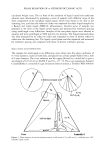
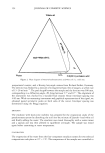
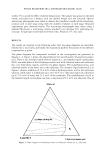
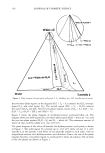
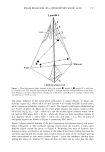
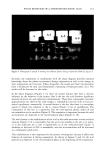
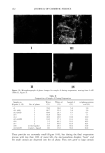
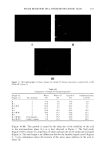
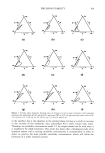
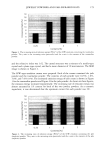
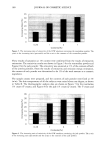
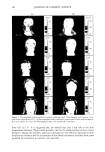
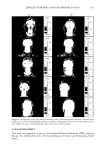
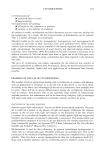
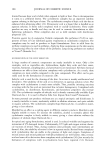
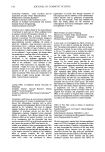
PHASE BEHAVIOR OF o•-HYDROXYOCTANOIC ACID 161 Figure 9. Photograph of sample A showing the different phases during evaporation (Table II, Figure 5). Secondly, the evaporation in combination with the phase diagram provides essential knowledge about the phases encountered during evaporation as well as the change in their composition and structure. Taken altogether, the results and their interpretation form a foundation for skin care formulations containing o•-hydroxyoctanoic acid. The results will be discussed in this order. In the phase diagrams (Figures 1-5), there are several features that have a decisive influence on the behavior of the system. One is the fact the acid dissolves significant amounts of water, oil, and surfactant simultaneously. These three compounds constitute approximately one third of the total weight, a remarkable structure with at least po- tential significance cosmetically. A second feature is the fact that there is a two-phase region in which two solutions in the L 2 region (Figure 4) are in equilibrium. The consequence of this fact is a separation into two non-aqueous phases called oil and microemulsion in the emulsion (Figure 9). This separation is important because the solid acid particles are dispersed in the microemulsion phase (Figures 9, 10). The third feature is the solubilization of the acid in the surfactant/water inverse miceliar solution (Figure 1). It is noteworthy that the acid is not soluble in the oil, or in water, or in the surfactant _per se, but is significantly so in the surfactant/water liquid. A solubility at the level of 20% is remarkable, and this microemulsion will be discussed in a subsequent publication. This solubilization is also important for the present investigation, because it affects the behavior of emulsion A during evaporation. As shown in Figures 9 and 10, the acid particles are dispersed in the microemulsion phase at the beginning of the evaporation.

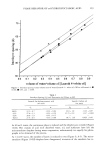
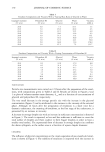
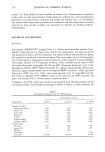
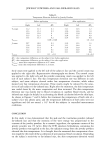
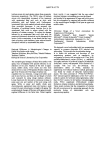
162 JOURNAL OF COSMETIC SCIENCE I III II IV Figure 10. Microphotographs of phase changes for sample A during evaporation, starting from P-IV (Table II, Figure 5). Table II Composition of Sample A During Evaporation Sample no. Water White oil Laureth 4 ½x-hydroxyoctanoic (Figures 9, 10) No. of phases (%) (%) (%) acid (%) A 3 70.0 20.0 5.0 5.0 A-1 (A-l) 3 66.7 22.2 5.6 5.6 A-2 (A-II) 3 60.0 26.7 6.7 6.7 A-3 3 53.8 30.8 7.7 7.7 A-4 3 40.0 40.0 10.0 10.0 A-5 (A-Ill) 2 14.0 57.1 14.3 14.3 A-6 2 3.2 64.5 16.1 16.2 A-7 2 1.6 65.6 16.4 16.4 A-8 2 (two liquids) 0.5 29.5 35.0 35.0 A-9 (A-IV) 2 (solid + liquid) 0.0 35.0 35.0 30.0 These particles are extremely small (Figure 10-I), but during the final evaporation process with less than 30% of water left, the microemulsion droplets "burst" and the small crystals are dispersed into the oil phase. They now grow to large crystals
Purchased for the exclusive use of nofirst nolast (unknown)
From: SCC Media Library & Resource Center (library.scconline.org)