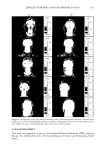
ABSTRACTS 197 hairless mouse skin and calsein release from ceramides liposomes respectively. The TEWL value of hairless mouse skin immediately increased of the treatment with unsaturated fatty acid such as oleic acid, palmitoleic acid, and linoleic acid. Furthermore, unsaturated fatty acids marked induced caNein release from ceramides liposomes. It was assumed that disruption of epidermal barrier function due to the unsaturated fatty acids in sebum related with the alteration of stratum comeum. To reduce the damage induced by an unsaturated fatty acid, oleic acid, we examined cholesterol derivatives on the disrupted skin barrier. In this examination, it was found that the long- chain ct-hydroxy acid cholesteryl ester reduced barrier disruption induced by unsaturated fatty acids. Regional Difference in Morphological Changes in Facial Skin Surface with Aging Takafumi Nishijima, Hiroyuki Ohsu, Takashi Kitahara, Yoshinori Takema Biological Science Laboratories, Kao Corporation The morphological changes of facial skin surface with aging were investigated with special reference to an alteration of the pore. Replica of the skin at upper cheek, middle cheek, lower cheek and chin were obtained from a total of 98 Japanese females ranging in age 18 to 78 years old. The image of replica was classified into two elements, 1) large and hollow pore and 2) skin furrows, and then size and length of which were measured by using image analysis software. Lower cheek and chin showed a continuous increase in mean pore size and number of the pore along with aging. While at upper and •niddle cheek pore discontinuously augmented mean size having a peak around 40 years old and grew in length with aging. The morphological changes of the pore with aging revealed regional difference in the facial skin. Taken together these results, it was suggested that the age related structural changes surrounding pore was developed and resulted in an appearance of large and hollow pore, but skin elongation by sagging had possible influence on the morphological changes of the pore at upper and middle cheek. Molecular Design of a Novel Antioxidant for Suppression of Photoaging Manabu Kitazawa*, Keiji Iwasaki*, Yukiko Ishitsuka**, Misako Kobayashi**, Kumi Arakane** AminoScience Laboratories, Ajinomoto Co., Inc.*, Fundamental Research Laboratories, KOSE Corporation** We designed a novel antioxidant with iron sequestering capacity to suppress ultraviolet (UV) induced skin photoaging. The principle for the molecular design is to mimic the structures and functions of iron sequestering proteins, such as transferrin, by conjugating a vitamin with an amino acid. Thus, N-(4~ pyridoxylmethylene)-L-serine (PYSer), a stabilized conjugate molecule ofpyridoxal (vitamin B6 aidehyde form) and L-serine, was prepared. PYSer formed a 2:1 complex with iron ions (Fe'(PYSer)2. The antioxidative ability of PYSer, mediated by suppressing iron-induced hydroxyl radical generation, was found by means of salicylate hydroxylation assays. The redox potential of PYSer-Fe3+/PYSer- Fe2+ showed superior stabilization of the Fe3+ active catalytic species for hydroxyl radical generation, rather than the Fe2+ species. In the hairless mice photoaging study, PYSer suppressed UVB-induced wrinkle formation, striation reduction, and derreal hypertrophy. These results indicate that the conjugation of vitamin B6 with an amino acid is a promising approach for the molecular design of antioxidants with iron sequestering capacity.
Purchased for the exclusive use of nofirst nolast (unknown)
From: SCC Media Library & Resource Center (library.scconline.org)