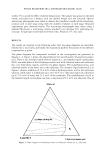
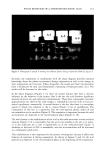
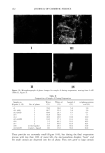
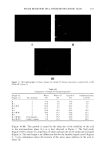
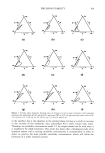
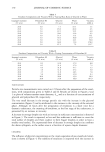
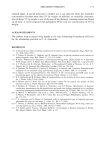
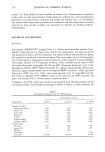
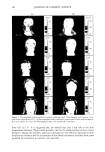
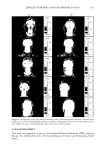
PHASE BEHAVIOR OF c•-HYDROXYOCTANOIC ACID 163 I II III Figure 11. Microphotographs of phase changes for sample B during evaporation, starting from I--III (Table III, Figure 5). Table III Composition of Sample B During Evaporation Sample no. Water White oil Laureth 4 tx-hydroxyoctanoic (Figure 11) No. of phases (%) (%) (%) acid (%) B 3 75.0 5.0 15.0 5.0 B-1 3 70.6 5.9 17.6 5.9 B-2 (B-I) 3 66.6 6.7 20.0 6.7 B-3 3 61.5 7.7 23.1 7.7 B-4 3 50.0 10.0 30.0 10.0 B-5 (B-II) 2 28.6 14.3 42.8 14.3 B-6 2 3.8 19.2 57.8 19.2 B-7 (B-III) 2 (two liquids) 1.0 35.0 29.0 35.0 B-8 (B-IV) 2 (solid + liquid) 0.0 35.0 35.0 30.0 (Figure 10-III). This growth is caused by the reduction of the solubility of the acid in the microemulsion phase (L2) , as is best observed in Figure 1. The final result (Figure 10-IV) consists of a dispersion of solids and particles in the surfactant/oil liquid (Figure 3). The small-angle x-ray diffraction data for the lameliar liquid crystal (Figures 6, 7) give information about the location of the water upon addition of the acid or white oil.

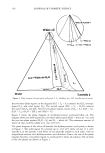
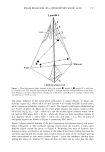
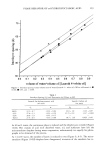
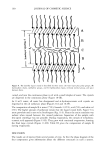
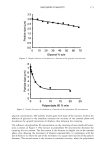
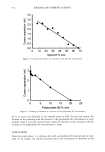
164 JOURNAL OF COSMETIC SCIENCE The increase in interlayer spacing with water content is determined by equation 1: d = do(1 + R)/(1 + otR) (1) in which d is the interlayer spacing, d o is interlayer spacing extrapolated to zero water content, R is the volume ratio of water to surfactant, and ot is the volume fraction of added water penetrating from layer A to layer B (Figure 8). In the same manner, the hydrocarbon is partitioned between zones C and B. R, d, and d o are all known, and may be calculated for each R value. However, the d o value remains constant, and ot is, hence, changing for different values of R. The limiting value for R -- 0 is a more useful value for characterizing the water penetration. Algebraic manipulations and neglecting second order terms in R give a simple expression for (x = 1 - (0d/0R)R_•o/d o (2) This equation leads to d = d o for ot = 1 (complete penetration) and d = do(1 + R) for ot = 0 (water localized to the space between the polar group A). The values (Tables I and II) are used to find the location and activity of the addition of acid and white oil. Addition of acid caused a reduction of the d o value, the thickness of the lipid layer, A + B, which means that acid is located in layer B of LLC white oil, which is insoluble in water, increased d o and hence is localized in layer C (the space between the terminal methyl group of the surfactant). In addition, adding the acid reduced ot to negative values. At first, these values may seem surprising a negative ot value means that the interlayer spacing increases more than that which corresponds to the added water. The explanation for such a response lies with the interaction with the other compounds present. The acid is located in zone B and moved to zone C by addition of water such a modification of the behavior will formally give a negative ot value for water. For the white oil, no negative value of ot shows that water is located in A and B and that added white oil is located in zone C. REFERENCES (1) I. Effendy, C. Kwangsukstith, J. Y. Lee, and H. I. Maibach, Functional changes in human starturn comeurn induced by topical glycolic acid: Comparison with all trans retinoic acid, Acta Derm. Venereol. (Stockh.), 75,455-458 (1995). (2) J. R/Sding and C. Artmann, The salts of hydroxycarboxylic acids--Non irritant, potent active sub- stances,J. SOFW, 121, 1018-1021 (1995). (3) B. Langlois and S. E. Friberg, Evaporation from a complex emulsion system,.]. Soc. Cosmet. Chem., 44, 23-34 (1993). (4) R.Y. Lochhead and C.J. Rulison, An investigation of the mechanism by which hydrophobically- modified hydrophilic polymers act as primary emulsifiers for oil-in-water emulsions, Colloids Surf, 88, 27-30 (1994). (5) T. Moaddel and S. E. Friberg, Phase equilibria and evaporation rates in a four components emulsion, J. Disp. Sci. Techn., 16, 69-97 (1995). (6) S.E. Friberg, T. Huang, and P. A. Aikens, Phase changes during evaporation from a vegetable oil emulsion stabilized by a polyoxyethylene{20} sorbitan oleate, Tween © 80, Colloids Surg. (in press). (7) S. E. Friberg, T. Young, R. Mackay, J. Oliver, and M. Breton, Evaporation from a microemulsion in the water aerosol OT-cyclohexanone system, Colloids Surf, 100, 83-92 (1995). (8) S. E. Friberg, T. Moaddel, and A. J. Brin, Interfacial transfer of vitamin E acetate during evaporation of its emulsion, J. Soc. Cosmet. Chem., 46, 255-260 (1995).
Purchased for the exclusive use of nofirst nolast (unknown)
From: SCC Media Library & Resource Center (library.scconline.org)