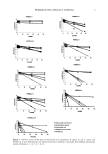
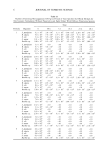
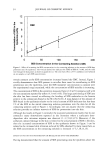
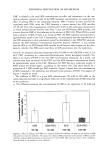
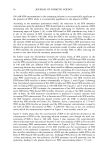
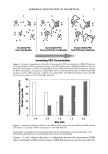
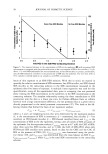
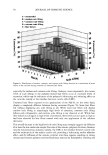
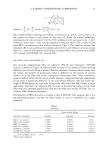
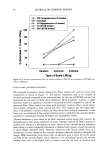
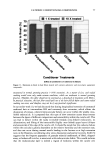
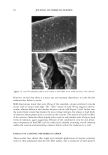
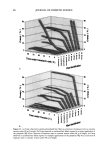
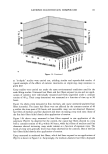
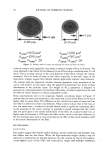
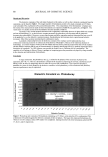
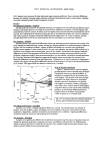
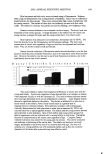
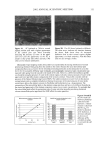
82 JOURNAL OF COSMETIC SCIENCE Aco.½x=3632 pm 2 Aco.½x =1256 pm 2 Acuticl½=1395 pm 2 Acuticl½=707 2 Acuticl e/Acortex = .38 Acuticl e/Acortex = .56 Figure 15. Relative areas of cortex and cuticula for coarse and fine hair fibers. either no creep or only negligible creep under a constant weight of 40 g in 96 hours. The creep observed in hair fibers of fine diameter levels off and stops completely after 24-48 hours. This is in sharp contrast to the creep behavior of hair fibers without the cationic treatment. The low levels of creep in fine fibers, especially in the early stages of the experiment, strongly suggest that multiple cationic applications improve creep resistance The cationic-induced, improved cuticular cohesion apparently stops movement of the cuticle cells relative to each other when the applied load generates low levels of shear deformation in the cuticular layers. The weight of 40 g apparently is adequate to generate the creep phenomenon in fine fibers. Obviously, increased weight has to be used for fibers of coarse diameter to obtain comparable results. Stress concentrations seem to be important. Sample calculations shown in Figure 15 indicate that the stress concentrations in the cortex and cuticle of fine fibers can be much higher than in coarse fibers. The difference in the cuticle/cortex ratio of coarse and fine hair fibers is reflected in their creep behavior. These studies indicate that in fine hair, at very low strain rates, a reinforced cuticular sheath exerts a significant restraining effect on the extension of the cortex, contrary to generally accepted concepts that the cuticle does not participate in the tensile deformation of the fiber. In a typical tensile test, at higher rates of extension (-50%/min), the effect of the cuticle is not seen. However, at the low extension rates used in creep experiments, the effect of the cuticle manifests itself in the tensile deformation of the fiber. CONCLUSIONS SCALE LIFTING Our studies suggest that besides surface binding, cationic surfactants and polymers may also diffuse into the hair fibers. While the high-molecular-weight cationics may be restricted to penetration for limited distances into the cuticula by way of the nonkera- tinous regions •such as•the CMC"and endocudcie), longer a-nct muit•ie treat•n•ntS

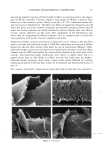
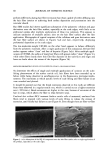
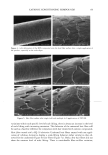
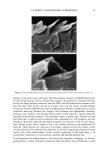
CATIONIC CONDITIONING COMPOUNDS 83 conceivably may include penetration of especially the lower-molecular-weight ones, into the intermacrofibrillar regions of the cortical cells. The three conditioners investigated appear to behave quite differently. Both high- molecular-weight cationics deposit at the scale edges and on the scale faces after only one application, and additional deposition after multiple applications does not appear to be significant. The low-molecular-weight CETAB, on the other hand, shows no significant deposits after a single application and after multiple applications. Fibers display "clean" surface cuticles, except for occasional light deposits. The decrease in the scale-lifting phenomenon during extension suggests improved cu- ticular cohesion. Whenever the high levels of scale lifting cannot occur in response to the stresses of extension, alternate paths are found to dissipate the stress. Most often, severe scale cracking is observed as the alternate mechanism of stress release. However, this scale cracking generally occurs at very high levels of extension. Hair fiber failure at rather high extension levels and the infrequency of the high levels of scale lifting (extreme and common scale lifting) indicate cationic-induced reinforce- ment of the cuticula, specifically in the weakly cross-linked, nonkeratinous regions. For example, cationic-induced, increased cohesion of the CMC may well glue the surface cuticles down and thus prevent high levels of scale lifting during extension, eventually resulting in stress release through cracking at higher extension. Increased cohesion in the endocuticle of the surface cuticle cell, on the other hand, may prevent endocuticular failure during fiber extension and result in lifting of the intact surface cuticle cell, whenever it can occur. CREEP Repeated applications of the polymeric cellulose derivative significantly change the creep behavior of hair fibers in comparison to controls. Low levels of overall creep, under constant stress, and the fact that only fine diameter fibers show an initial creep, suggest that multiple treatments with cationic quaternary compounds reinforce the cuticula. It appears that in fine fibers at low strain rates, such reinforcement of the cuticula has a direct bearing on the deformation behavior of the cortex. Cationic-induced creep resis- tance further supports the cuticle-reinforcing effect of the cationics studied in this work. ACKNOWLEDGMENTS This study was carried within the framework of the TRI Core Technology Project "Analysis and Quantification of Hair Damage," sponsored by companies in the inter- national cosmetics industry. The authors would like to thank the sponsors for their financial support. REFERENCES (1) S. B. Ruetsch and H.-D. Weigmann, Mechanism of tensile stress release in the keratin fiber cuticle. I.J. Soc Cosmet. Chem., 47, 13-26 (1996). (2) C. R. Robbins, Chemical a,d Physical Behavior of Huma, Hair (Springer-Verlag, New York, 1988), p. 199. (3) C. R. Robbins, ibid., p. 202. (4) R. E. Walpole and R. H. Myers, Probability a,d Statistics for Engi,eers a,d Scie,tists (Macmillan, New York, 1972), p. 261. (5) J. A. Swift, I,t. J. Cosmet. Sci., 13, 143 (1991).
Purchased for the exclusive use of nofirst nolast (unknown)
From: SCC Media Library & Resource Center (library.scconline.org)