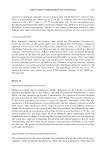
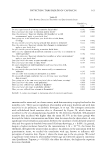
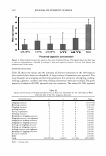
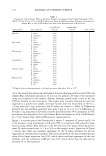
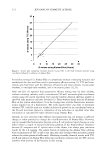
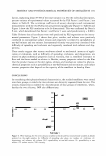
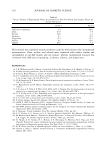
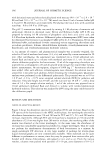
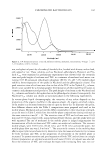
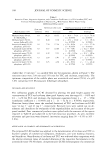
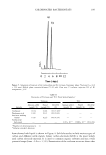
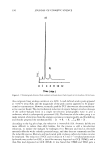
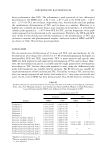
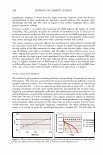
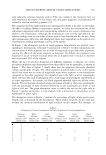
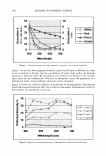
162 JOURNAL OF COSMETIC SCIENCE 42 40 l 38 ca CD CD 36 ca 34 CD 32 30 3,16.10-6% 1.10""% 3,16.10 ... % None Perceived capsaicin concentration Figure 3. Relationship between the capsaicin detection threshold and age. This figure shows the mean age in the six subpopulations classified according to detected capsaicin solution. Vertical bars denote one standard error of the mean. REPORTED SENSATION Table III shows the nature and the intensity of detected sensations in the 109 subjects who reached their detection threshold. A large variety of sensations was reported. The most frequent were stinging and burning sensations, but sensations of tingling, itching, tickling, tightness, coolness, and even a feeling of presence, were also recorded. The great majority of subjects (89.0%) reported only one sensation. The others (11.0%) reported Table III Nature and Intensity of the Reported Sensations at Detection Thresholds for the 109 Subjects Who Detected One of the Five Capsaicin Solutions N ature/ln tensity Stinging sensation Burning sensation Tingling sensation Itching sensation Feeling of presence Tickling sensation Burning and stinging sensation Stinging sensation and tightness Stinging and tickling sensation Stinging and tingling sensation Itching and tingling sensation Itching and stinging sensation Itching sensation and tightness Burning and tingling sensation Feeling of coolness M.D. Total M.D. = missing data. 2 37 24 8 7 6 5 4 2 1 2 102 (93.6%) 3 4 0 1 0 0 0 0 0 0 0 0 0 0 0 0 0 5 (4.6%) M.D. Total 0 41 (37.6%) 1 25 (22.9%) 0 9 (8.3%) 0 7 (6.4%) 0 6 (5.5%) 0 5 (4.6%) 5 (4.6%) 0 2 (1.8%) 0 1 (0.9%) 0 1 (0.9%) 0 1 (0.9%) 0 1 (0.9%) 0 1 (0.9%) 0 1 (0.9%) 0 1 (0.9%) 0 2(1.8%) 2 (1.8%) 109 (100%)

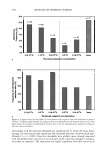
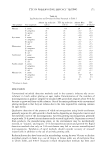
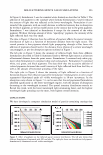
DETECTION THRESHOLDS OF CAPSAICIN 163 sensations (e.g., burning and stinging sensations). All the sensations were considered as slightly (intensity 2 = 93 .6%) or moderately (intensity 3 = 4.6%) perceptible. They were never reported as strongly perceptible (intensity 4) or painful (intensity 5 ). In the course of the experiment, the time of onset of sensation at the detection threshold was recorded in 7 4 of the 109 subjects in order to check that the three-minute interval between applications was long enough. The mean time was 80 seconds +/-17 s. The shortest time was 60 s and the longest 120 s. On the other hand, a total of 61 subjects reported some sensations before the detection threshold. These sensations appeared on the vehicle side or on the capsaicin side, but they lasted less than 30 seconds in the latter case. These sensations were qualitatively similar to those at the detection threshold described above and concerned the vehicle side as often as the capsaicin side. DISCUSSION This study describes a new test for the assessment of skin neurosensitivity on a large cohort. This test consists of applying capsaicin solutions with geometrically increasing concentrations to determine the individual capsaicin detection threshold. In comparison with the other psychophysical tests using chemical probes (18, 19), the test is painless. As expected from topically applied capsaicin (23 ), a large variety of sensations at the detection threshold were reported. However, all of these sensations were considered as only slightly or moderately perceptible, even in volunteers with the most sensitive skin. The absence of pain is highly advantageous and confirms the right choice of the starting concentration and of the concentration gradient. This psychophysical test implies a simultaneous, split-face, single-blind application of capsaicin and vehicle solutions. This bilateral procedure, with the simultaneous presen- tation of the vehicle on the controlateral side as control, helps volunteers to differentiate background cutaneous sensations from those specifically caused by capsaicin (13 ), and thus avoids false-positive results (24). The single-blinded approach also helps to avoid false-positive results. The test based on the existence of a sensation or not on the capsaicin side is easy to explain to the volunteers, and thus far more reliable than those commonly used involving the highly variable individual pain scale. We observed a large distribution of this random adult female population according to capsaicin detection thresholds (Figure 2a). The lowest capsaicin concentration was de- tected by 23.3% of the panelists, whereas almost the same proportion (27.3%) did not perceive even the highest concentration, which is one hundred times more concentrated. This range of at least two log units, which looked sizeable, is in agreement with previous results obtained on the arm (23). A more striking feature about the distribution of the population according to the capsaicin detection threshold was its non-unimodal shape. It suggests the existence of (at least) two population groups. Individuals with an inter- mediate detection threshold account for a low proportion compared to those with either a low or a high detection threshold. Whatever this splitting may mean in terms of "sensitive skin," it appears that, in the tested population, two clearly separated pheno- types are seen with regard to the reactivity to capsaicin through neuron-mediated response. Considering the pattern of Figures 2a and 26, a segmentation of the population between two sub-populations could be proposed (see vertical line in Figure 2): women
Purchased for the exclusive use of nofirst nolast (unknown)
From: SCC Media Library & Resource Center (library.scconline.org)