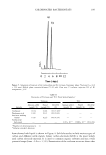
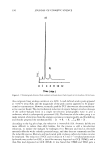
206 JOURNAL OF COSMETIC SCIENCE were synthesized using computer-graphics techniques, and 15 female volunteers selected the most beautiful skin from among those simulated faces. For calculating the specular component of the facial images, 6 bidirectional reflectance distribution functions ( BRDFs ) were generated from the goniophotometric spectra of two foundation membranes that differed in reflectivity from each other. Results of the image evaluations on dark, normal or bright skin are shown. In addition, evaluation of images in which the specular component was shifted to blue caused by blue pearl pigments is shown. Determination of2-Aminoethanol in 2,2' ,2' '-Nitrilotriethanol by Reversed-Phase HPLC-UV Using o-Phthalaldehyde as a Pre-Column Derivatizing Reagent Kazuki Kageshima, Kenji Okada, Hiroshi Saito, Toshiyuki Shimizu Hachiohji Laboratory, Utena Co., Ltd. A measurement method for determination of 2-aminoethanol in 2,2 ' ,2 ' ' -nitrilotriethanol by reversed-phase high-performance liquid chromatography (HPLC) with an ultraviolet detector has been developed using o-phthalaldehyde as a pre-column derivatizing reagent. As a result, the calibration curve of 2-aminoethanol standard solutions was linear over the range of l.0xl0-5-5.0xl0-3 mol/L with a correlation coefficient of 0.996 and the detection limit, defined as SIN= 3, was 7.5xl0-7 mol/L. The relative standard deviation at 5.0xl0-5 mol/L of 2-aminoethanol standard solution was 6.0% (n = 6) . This measurement method was applied to the determination of 2-aminoethanol in several commercial 2,2' ,2' '-nitrilotriethanol samples and it was found that both the calibration curve method and the standard addition method based on the peak height are available for the determination of 2-aminoethanol. These results suggest that the method reported here will be useful for determination of 2-aminoethanol in 2,2' ,2' '-nitrilotriethanol. Key words:2-aminoethanol, 2,2' ,2' '-nitrilotriethanol, HPLC, determination, o-phthalaldehyde, spectrophotometric detection, pre-column derivatizing reagent, cosmetic ingredients, monoethanolamine, triethanolamine

J. Cosrnet. Sci.J 56, 207-210 (May/June 2005) Abstracts International Journal of Cosmetic Science Vol. 27, No. 1, 2005* Eco-friendly methodologies for the synthesis of some (PTSA). The comparisons of yields and thennal profiles aromatic esters, well known cosmetic ingredients under either microwave or conventional heating were studied and reported. Villa c•, Baldassari s.•, Gambaro R 0 ., Mariani E.", Loupy A# 0 Dipartimento di Scienze Farmaceutiche dell'Universita, Viale Benedetto XV, 3 - 16132 Genova - Italy and Sensitive skin: mechanisms and diagnosis #Laboratoire des Reactions Selectives sur Supports - ICMMO - Universite Paris-Sud CNRS, UMR 8615, Primavera G, Berardesca E batiment 410-91405 Orsay Cedex -France Solid-liquid solvent free phase transfer catalysis (PTC) and acidic catalysis in dry media were applied, with noticeable improvement and simplification over classical procedures in a Green Chemistry context, to the synthesis of some aromatic esters useful as cosmetic ingredients: 3- methyl butyl 4-methoxycinnamate, 2-ethylhexyl 4- methoxycinnamate, 2-ethylhexyl 4- ( dimethylamino )benzoate and 2-ethylhexyl salicylate, well known UVB sunscreen filters 4-isopropylbenzyl salicylate, UV asbsorber and cutaneous antilipoperoxidant propyl 4-hydroxybenzoate and butyl 4-hydroxybenzoate (parabens), antimicrobial agents. The reaction were performed under microwave activation and conventional heating. The best results for the synthesis of cinnamic, salicylic and 4-(dimethylamino)benzoic esters were achieved by in situ preformed carboxylates alkylation with alkyl bromides using PTC. The 4-hydroxybenzoates were obtained in good yields by classical esterification of the acid with alcohols using a simple heterogeneous mixture of reagents with catalytic amounts of p-toluenesulfonic acid San Gallicano Dermatological Institute, Rome, Italy Sensitive skin is a condition of subjective cutaneous hyperreactivity to environmental factors. Subjects experiencing this condition report exaggerated reactions when their skin is in contact with cosmetics, soaps and sunscreens, and they often report worsening after exposure to dry and cold climate. Though no sign of irritation is commonly detected, itching, burning, stinging and a tight sensation are constantly present. Generally substances that are not commonly considered irritants are involved in this abnormal response. They include many ingredients of cosmetics such as: dimethyl sulfoxide, benzoyl peroxide preparations, salicylic acid, propylene glycol, amyldimethylaminobenzoic acid and 2-ethoxyethyl methoxycinnamate. Sensitive skin and subjective irritation are widespread but still far from being completely defined and understood. The aim of this paper is to summarize the relevant literature in order to elucidate the underlying mechanisms of sensitive skin and the best testing methodologies for investigation of sensitive skin. * These abstracts appear as they were originally published. They have not been edited by the Journal of Cosmetic Science. 207
Purchased for the exclusive use of nofirst nolast (unknown)
From: SCC Media Library & Resource Center (library.scconline.org)