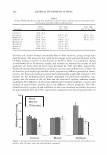
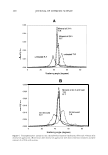
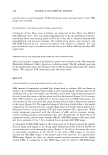
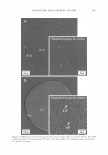
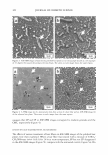
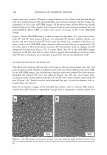
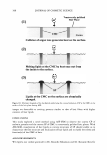
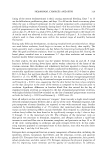
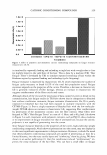
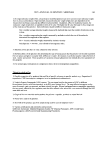
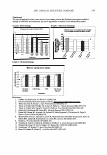
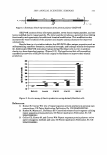
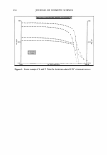
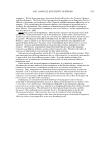
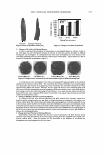
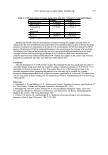
- a) a ::J u u 1.le+S 1.4e+5 1.2e+5 1.0e+S 8.0e+4 8.0e+4 4.0e+4 2.0e+4 0.0 CATIONIC CONDITIONING COMPOUNDS Untreated 1xPQ-10 10xPQ-10 1xCETAB 10xCETAB Treatment 329 Figure 5. Effect of polymeric and monomeric cationic conditioning compounds on fatigue resistance (characteristic life, 8). is simulated by repeatedly loading and unloading a single hair with a weight that is close (or slightly lower) to the yield force of the hair. This is done by a machine (TRI "Hair Fatigue Tester") developed by TRI to simulate repeated stretching of hair within the Hookean region by repeated loading and unloading (cyclic fatiguing). Fatigue resistance is expressed by characteristic life, 0, which represents the number of fatigue cycles necessary to break 63.2% of the total hair population tested. Fatigue resistance depends on the properties of the cortex. Therefore, a decrease in characteristic life is generally indicative of fiber damage, whereas an increase in characteristic life suggests reinforcement of the fiber cuticle and cortex. Although details of the test and the processing of data cannot be given in detail in this communication, hair fatigue studies at TRI have shown that in comparison to bleached hair without conditioner treatment, fatigue resistance (characteristic life, 0) is greatly improved in bleached hair that had been exposed to multiple treatments with the CETAB (Figure 5 ). Even a single treatment of bleached hair with the low-molecular weight CETAB shows an increase in characteristic life, suggesting fiber reinforcement by penetration of the monomeric cationic into the fiber interior. (Hair fibers were fatigued in TRI's "Hair Fatigue Tester" at a rate of -1 Hertz and a 40 g load.) As shown in Figure 5 as well, treatments with polymeric cationics, such as PQ-10, show moderate or no improvement in fatigue resistance over that of untreated hair, because the cationic polymeric is not capable of penetrating into the cortex. Since fatigue resistance depends on the properties of the cortex, high-molecular-weight conditioning compounds, which show no penetration into the cortex, may not display (as in this case) significant improvements in fatigue resistance. However, it should be noted that these polymeric conditioning compounds are capable of penetrating, at least for a limited distance, into the outer cuticle layers and "reinforcing" them by gluing. We have shown in an earlier publication (1) that this conditioner-induced "reinforcement" im proves the creep resistance of the hair fiber. This can have a small effect on fatigue

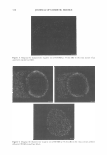
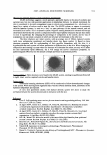
330 JOURNAL OF COSMETIC SCIENCE measurement. Although cuticle reinforcement may not affect the tensile strength of the fiber, it can reinforce the cuticula, which in turn can affect fiber surface properties as well as the tactile and optical properties of the hair assembly. CONCLUSIONS Ion spectra and images clearly identified CETAB within the hair-fiber cross section and on the hair-fiber surface. The penetration of CETAB ranges in depth from 10 µm to penetration of the entire hair-fiber cross section. This is clearly demonstrated by map ping both positive (C 3 H 8 N + at 58 m/z and C 19 H 42 N+ at 284 m/z) as well as negative (9Br-) ions. The higher-molecular-weight compounds are more difficult to ionize. Therefore, one has to look for their low-molecular-weight fragments, which in the case of PQ-10 may not be suitable for mapping because these fragments are not unique to PQ-10-treated hair, since they are also found in untreated hair. The fact that CE TAB is able to penetrate into the hair fiber while PQ-10 is not, manifests itself in improved fatigue resistance of CETAB-treated hair. The greatly extended fatigue life of CETAB-treated hair versus PQ-10-treated hair is, without doubt, due to the ability of the low-molecular-weight CETAB to penetrate into the hair fiber, while PQ-10 is restricted to deposition on the hair surface. ACKNOWLEDGMENTS This study was carried out in context with our research project "Characterization and Quantification of Hair Damage" and is supported by our sponsors in the international hair-care industry. We thank our sponsors for their support. The authors also thank Sidney Hornby for the fatigue measurements. REFERENCES (1) S. B. Ruetsch, Y. K. Karnath, and H.-D. Weigmann, The role of cationic conditioning compounds in reinforcement of the cuticula, J. Cosmet. Sci., 54, 63-83 (2003). (2) J. A. Faucher and E. D. Goddard,]. Colloid Interface Sci., 55, 313 (1976). (3) C. D. Chow, Interaction between polyethylenimine and human hair, Textile Res. ]., 41, 593-603 (197 2). (4) J. Woodard, Aziridine chemistry-Applications for Cosmetics, J. Soc. Cosmet. Chem., 23, 593-603 (1972). (5) S. B. Ruetsch, Y. K. Karnath, A. S. Rele, and R. Mohile, Secondary ion mass spectrophotometric investigation of penetration of coconut and mineral oils into human hair,]. Cosmet. Sci., 52, 169-184 (2001).
Purchased for the exclusive use of nofirst nolast (unknown)
From: SCC Media Library & Resource Center (library.scconline.org)