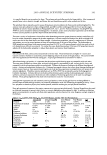
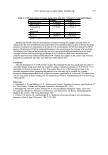
338 JOURNAL OF COSMETIC SCIENCE HAIR STYLING & FIXATIVE OVERVIEW Colleen M. Rocafort Ciba Specialty Chemicals Corporation, 4090 Premier Drive, High Point, NC 27265 Introduction Polymers provide many of the attributes during the styling process, as well as the holding and texture characteristics of the hair. However, the total formulation determines the functionality such as the ease of application, the distribution of polymer on the hair, absence from flaking, added shine, longevity of hold, restylability, and removability from the hair. The product performance and efficacy is rarely a function of only one active ingredient. The entire formulation and package and the delivery mechanism also contribute to the final characteristic effects developed on the hair. The final hairstyle and styling technique will also determine the type and level of polymers needed in styling and fixative products. Hair Styling and Fixative products have moved away from products with specific "Hold" properties i.e. soft/flexible, medium, and hard/ultra hold and are now addressing specific hairstyle solutions. Current worldwide fashion trends, the desire by consumers for healthy hair and style control, and the regulatory environment drive this market. This presentation will define the Hair Styling and Fixative market, review it's growth over the last 4 years, define what is driving this market segment, review polymer requirements for styling and fixing hair and the polymer product arsenal that formulators have to play with, and lastly review new styling and fixative products introduced in 2004. Global Styling & Fixative Market Overview: The global hair styling & fixative market is valued at $7 .84 Billion for 2004 and is the 3'd largest market segment behind Shampoos and Hair Colorants. 1 This market segment had a growth rate of25 .5% over the years of2001-2004 due to worldwide fashion trends, changes in the regulatory environment, and the development of new product forms to address specific hair styling issues which have changed the landscape of the whole styling & fixative market segment. Table I shows the retail value (rsp) in US $ dollars of the Hair Styling & Fixative global market segment versus the Total Hair Care category Table I: Retail Value rsp- US$ Mn % Global 2001 2002 2003 2004 Growth Market 2001- Se�ment 2004 Hair 6,268.6 6,526.5 7,244.1 7,864.3 25.45 Styling& Fixative Total Hair 37,885.9 38,914 42,816.7 46,987.7 24.02 Care Ref: Euromomtor International- 2005 This market growth was driven by: current worldwide fashion trends such as "ready to wear hair", "big hair", and the trend towards healthy looking, manageable hair, whether it is curly or straight.' When we look deeper into the market category, we see that the trend towards more natural looking, touchable hair has had the most impact on the Hair Fixative Industry. Hair spray sales continue to decline for the past several years with increased sales in the styling segment in particular the gel/cream/wax market. The hair fixative market continues to be split between stiff-feel and flexible, natural hold. Products that offer multifunctional properties have made the most impact in the marketplace. When we examine the new product introductions we see that many new product forms of styling mousses and gels are emerging. ' The styling gel and the mousse markets have been growing globally at a range of 4 -6% a year with some regions having seen growth up to 10%. Products for the Ethnic - Specific Hair Care Segment, predominantly African- American and multicultural consumers have also been expanded. The directed marketing towards teens, children, and men has been successful with many new innovative products introduced to the marketplace. These products are expected to continue. If we look specifically at regional growth, we observe that in Asia, the men's grooming market is outpacing women's products. Male grooming products represent about 10% of this market. 4 Gels and mousse products are the most popular. Both flexible and stiff feel are required to meet the needs of this region. High humidity hold is also an important parameter due to the environmental conditions (high heat and high humidity) The leading market drivers for this region are products that provide multi functional benefits, such as shine, conditioning, smoothing, volume and control, protection, long lasting style, anti-frizz, and moisturizing effects. Market Leaders: Based on Euromonitor International 2005 data, 'the top 12 customers who are leading the market are as follows: L'Oreal is the number I market leader with 20 .3% market share, P&G is second with 16 .1%, Unilever is third with 8.7%, Henkel KgaA is fourth with 7 .7%, Mandom Corp is fifth with 5.2%, Shiseido Co. Ltd is sixth with 4 .7%, Alberto Culver is seventh with 4.0%, Kao Corp is eight with 3 . 6%, Private Label Brands is ninth with 3 .3%, Colgate Palmolive is tenth with 1.6%, Beiersdorf AG is eleventh at 1 .3% , and Sara Lee Corp is twelfth with 0.8% market share. These 12 companies represent $6 .09 Billion dollars or 77.4% of the whole styling & fixative market. Looking further at the brands, we observe that the Studio Line Brand is in the top position followed by Pantene Pro-V. Table 2 lists the top 25 brands. Table 2: The Brand Share Rankim! of the top Global brands Brand Brand Name Brand Brand Name Share Share Ranking Ranking I Studio Line- L'Oreal 13 Gamier Grafic- L'Oreal 2 Pantene Pro-V- P&G 14 Clairol Herbal Essences- P&G 3 Taft/Drei Wetter- 15 Geraid- Shiseido Henkel KGaA 4 Gamier Fruitis - 16 Salon Selectives- L'Oreal Unilever 5 Elnett-L'Oreal I7 Nivea Hair Care- Beiersdorf 6 Alberto Culver VOS 18 Shiseido- Shiseido 7 John Freida- Kao 19 Lucido -Mandom Colll 8 Wellaflex- P&G 20 Vivelle-L'Oreal 9 Gatsby- Mandom 21 Gard --Colgate Corp Palmolive 10 Suave- Unilever 22 Brylcream- Alberto Culver 11 Shock Waves -P&G 2 3 Rave -Unilever 12 Auslese- Shiseido 24 Uno- Shiseido 25 Sunsilk- Unilever Ref: Euromomtor International- 2005 Novel Product Forms: Hair Styling and Fixative products are now addressing style specific hairstyle solutions. Consumers want style versatility. Products are designed to help: straighten, define curls, smooth unruly hair, reduce or eliminate frizz, add volume, be weightless- not build-up, infuse moisture, cover thinning hair, protect from thermal damage, achieve funky hairstyles, achieve multi functional effects i.e. hold the hair in place and condition it. The landscape of styling products now includes: tonics, balms, gel of all types, putty/gum type products, mousses, waxes, creams, serums, pomades, elixirs, gel mousses, and lotions and sprays. Consumer Drivers: Consumers prefer not to be locked into one style, they want style flexibility. In focus groups, consumers have stated that they want the following attributes for their styling and fixative products: 6 ► Improved Hair Style Hold ► Conditioning ► No Flaking when Brushed or Combed ► Increased Hair Body and Hair Volume ► Good Hair Feel ► Detangling/ Easy Combing

2005 ANNUAL SCIENTIFIC SEMINAR 339 ► Good Hair Gloss/Shine ► Stiffness or No Excessive Stiffness ► Easy Application on Wet Hair/ No Clumping ► More flexibility or movement of styled hair ► No Sticky Feel ► Quiek Drying ► Good Stability ► Smoothness ► To Control Frizz ► To Define the Curl Polymer Requirements for Styling & Fixing:7 Typically the polymer provides many of the attributes during styling, as well as the holding and texture characteristics. However the total formulation determines the functionality such as ease of application, distribution of polymer, absence from flaking, shine, longevity of hold, restylability, and removability. This will be discussed further in the program by several of the other speakers today. In designing a new styling product there are speci fie polymer attributes that are desired. You may require a product with a particular spreading or distribution characteristic (rheology), in order for it to distribute it through the hair. The degree of tackiness or wetness needs to be optimized so that it is not too tacky or wet. The stiffness, crispness, or slip can also be tailored by choosing a polymer with a specific molecular weight. Typically 500M- l .5MM) MW is a good starting point. Sprayability will also need to be controlled especially for low VOC products where a low MW polymer in the range of (I 0M-200M) may need to be utilized. Or a host of other effects that will require the addition of other additives for the required feel, shine or hold specified by the consumer's need. As stated previously, the product performance and efficacy is rarely a function of only one active ingredient. Polymer Properties That Affect Hold ► Molecular Weight ► Glass Transition Temperature, Tg ► Particle Size of Spray ► Spreadability ► Cohesive/Adhesive Balance ► Hydrophobicity ► Ability to Form Strong "Spot Welds" ► Concentration of Active Polymer There are many polymers to choose from in developing your formulation. The key is to understand the polymer profile characteristics and use conditions to achieve a successful styling and fixative product. Polymer Offerings Prior to voe Reformulation:• NON IONICS (PYP) (VP/VA Copolymers) ANIONICS (Esters of PYM/MA) (Acetates) POL YQUATERNIUMS (Polyquatemium-4, 10, and 11) CATIONICS (Cationic VP Copolymers and terpo\ymers) AMPHOTERICS (Acrylate Copolymers) Polymer Offerings After voe Reformulation' ANIONICS (Low MW Esters of PVM/MA) (Low MW Acetates) (Maleimide Copolymers) CATIONICS (Cationic VP Copolymers and Terpolymers) AMPHOTERICS (Low MW Acrylate Copolymers) POLYESTERS POLYURETHANES ACRYLAMIDE COPOLYMERS POLYVINYLCAPROLACTAMS POL YQU A TERNIUMS (PQ-4, -10, -1 l, -16, -28, -39, - 44, -55) POLYAMIDES RHEOLOGY MODIFIERS: New Product forms have changed the whole styling segment category with respect to thickening agents. Besides thickening the product, rheology modifiers create body, prevent dripping, and provide texture to the gel/cream product. Crystal clear, water white gels are still sought but new products are requiring the need for new thickeners to achieve the desired results i.e. sheer thinning, suspension. Traditional Thickeners: Anionic Polycarboxylates Carbomer Cellulose Derivatives Hydroxyethyl Cellulose Gums Hydroxypropyl Guar Expanded Product Range to Address New Rheology Market Needs: Carbomer Hydroxyethyl Cellulose Hydroxypropyl Guar Acrylates Copolymers Anionic Liquid Dispersion Polymers (LDP's) Sodium Polyacrylates and various carriers Cationic Liquid Dispersion Polymers (LDP's) Polyquatemium -32 (and) Mineral Oil (and) PPG-I Trideceth-6 Polyquatemium-37 (and) Mineral Oil (and) PPG-! Trideceth-6 Polyquatemium-37 (and) Propylene Glycol Dicaprylate/ Dicaprate (and) PPG-l Trideceth-6 Acknowledgement: The author acknowledges Ellen Werner for identifying new product trends for 2004 based on a market search of new styling products introduced in 2004. Rererences 1 2005 Euromonitor International, Styling Agents Segment- Company Data 2 Claire Briney, Hair Care Stays on Too. GCI, December 2004 3 GNPD Mintel International Data Base, Jan 2005 4 Ciba Specialty Chemicals Brochure, Asian Hair Care, 2003 5 2005 Euromonitor International, Styling Agents Segment- Brand Data 6 C. Rocafort and J. Dalla], National SCC CEP Course: Hair Styling & Fixatives, (2005) 7 C. Rocafort and J. Dalla!, Hair and Hair Care, edited by Dale H. Johnson, Marcel Dekker, Inc. NY, l 997, chapter 5. 8 Lochhead, Robert and Fron, William, 1993 "Encyclopedia of Polymers and Thickeners for Cosmetics", Cosmetics & Toiletries, !08:95-!38. '2002 "Encyclopedia of Polymers and Thickeners", Cosmetics & Toiletries, Vol I I 7, No. 12/December 2002.
Purchased for the exclusive use of nofirst nolast (unknown)
From: SCC Media Library & Resource Center (library.scconline.org)