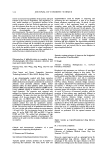
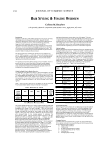
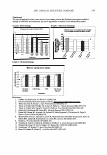
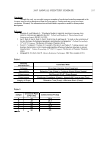
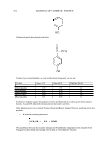
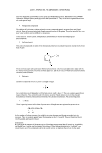
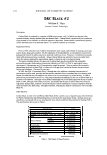
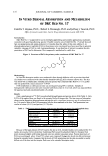
370 Description: JOURNAL OF COSMETIC SCIENCE D&C BLACK #2 William F. Thys Sensient Cosmetic Technologies Carbon Black is produced by a number of different processes, only 2 of which are relevant to the cosmetic industry, namely channel black and furnace black. Channel black is produced by the combustion of gas burned in iron channels, in which the pigment is deposited. Furnace black is produced by injecting oil into the flame zone of an enclosed reactor. It is used in cosmetics as a colorant. Regulation History: Prior to 1960, when the Color Additive Amendments were issued, carbon black of varying sources was used in foods, drugs and cosmetics. By the stipulation of the amendments, a color additive could only be permanently listed if its safety was proven under all conditions of use. However, it could be provisionally listed while testing was being conducted. All-gas channel black was selected to be provisionally listed while the industry gathered the required data, based on chemical and toxicological testing. The major stumbling block to the approval of carbon black was the possibility that extractable polynuclear aromatic hydrocarbons (commonly referred to as PAH's or PNA's), particularly known carcinogens 3,4-benzpyrene and 1,2-benzantracine, might be present. Since no method for accurately determining the levels of these PNA's, at least not to the ppb level, existed at the time, the provisional listing was withdrawn. That was 29 years ago. In 1982, the FDA "Constituents Policy" allowed that color additives containing trace amounts of carcinogens could be used, provided that the specific materials did not contribute and color function, and further provided that the color additive was shown to be non-carcinogenic by animal testing. In 1986, a petition was put forward by the CTF A, citing improved analytical methods, for the use of carbon black as a cosmetic color additive. Although various delays stalled approval, FDA finally approved the use of carbon black in 2004, although with certain provisions, specifically that the type of carbon black was limited to high purity furnace black, and that it should be subject to FDA certification to ensure compliance with the limits set forth in the final ruling. The approved name, reflecting the need for certification, was to be D&C Black #2. D&C Black #2: Carbon black, in order to be certified as D&C Black #2 for cosmetic use, is required to pass limit level tests for PAH's (benzpyrene and dibenzanthracene), as well as for the usual heavy metals. Surface area is also specified to correspond with a very small particle size, which would limit the potential for binding PAH's. The specifications are as seen in Table 1. Specification Limit Surface Area (Nitrogen BET) 200 - 260 m2/gm. Weight Loss on Heatiniz (950C for 7-min.) 2%max. Ash 0.15% max. Lead IO-ppm max. Heavy Metals: Arsenic 3-oom max. Mercury 1-ppm max. Total Sulfur 0.65% max. Total PAH's 500-ppb max. Benzoovrene 5-ppb max. Dibenzantracene 5-ppb max. Total Color (as Carbon) 95%min. Table 1. D&C Black #2 Specifications

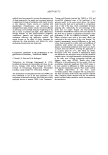
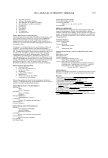
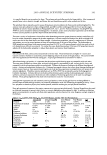
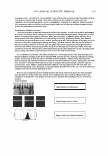
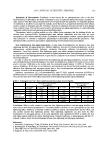
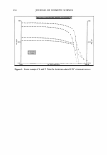
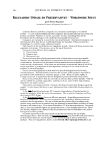
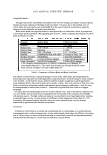
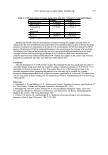
2005 ANNUAL SCIENTIFIC SEMINAR 371 Using D&C Black 2 The approved uses for carbon black for eyeliner, brush-on brow makeup, eye shadow, mascara, lipstick, blushers and rouge, makeup and foundation and nail enamel. Of course, due to the jet-black color of carbon black, the most popular uses will probably be in the area of mascaras and eyeliners, where the intensity of color obtainable will make it most desirable. When carbon black was originally delisted, it was replaced by iron oxide black, which, by comparison, is less intense and less jet-black, often appearing gray or brown. Table 2 compares the properties of carbon black and black iron oxide: I Property I Carbon Black I Black Iron Oxide Formula C Fe· FeO2 ~20-30 nm ~ 300 nm * The Chemistry and Manufacture of Cosmetics, M deNavarre, ed, Wheaton, Ill: Allured publishing ( 1971 ). This value, from 30 years ago was specifically for carbon black, and may not apply in the case ofD&C Black #2. Table 2. Comparison of Carbon Black and Black Iron Oxide The stability of carbon black is a great advantage over iron oxide. Often times, the heat generated by processing alone, especially in powder applications, using micronizers, would be enough to cause oxidation to the red form. Aside from the obvious aesthetic problem of shade, enough heat could be generated to cause cardboard drums, often used for pack-out, to smolder or bum. Due to its reactivity to heat, iron oxide black is classified as a hazardous material, and demands special shipping considerations. And, of course, the tinting strength of carbon black, at least 2 - 3 times that of typical black iron oxides is its biggest advantage. Of course, there are disadvantages to the use of carbon black as well. Due to the fineness of particle size, it is very "fluffy" and can easily become suspended in the environment of the workplace if not handled with extreme caution. The high surface area makes it very adsorbent in most liquid applications, resulting in relatively high viscosity. In most carriers, it is difficult to obtain dispersions of more than 20-25%. Fortunately, the increased intensity allows for lower use levels, minimizing the viscosity increase experienced in applications like mascaras and eyeliners. Conclusion If interest in carbon black as a colorant can be maintained due to its advantages, it is possible that new wetting agents and/or surface treatments may, in time, be developed which reduce the difficulty of working with it. In any event, it is nice to see that the relisting of carbon black, even with the imposed restrictions, indicates that the delisting of a colorant may not mean that it is gone forever.
Purchased for the exclusive use of nofirst nolast (unknown)
From: SCC Media Library & Resource Center (library.scconline.org)