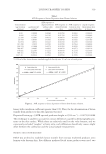
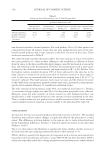
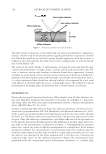
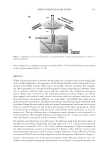
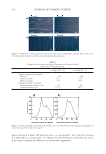
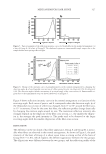
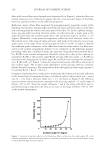
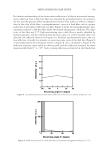
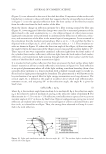
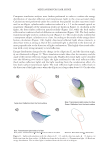
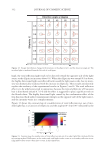
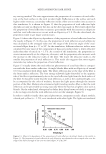
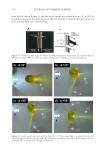
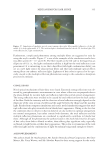
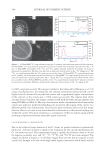
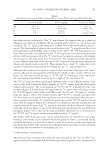
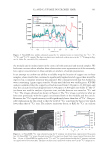
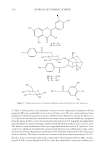
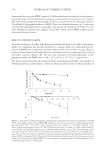
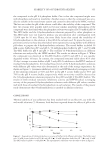
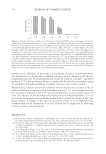
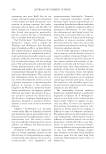
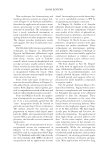
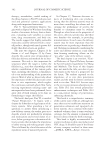
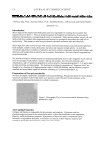
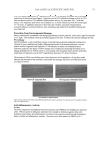
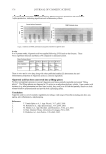
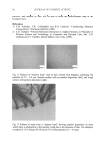
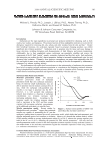
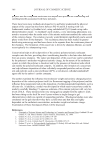
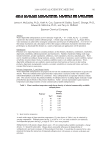
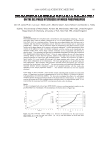
MECHANISM FOR HAIR SHINE 325 was irradiated in a coplanar manner to the hair fi ber (-45°) and the detector was moved in the coplanar plane from 0° to 90°. RESULTS When a blonde hair fi ber is observed by the naked eye, irradiated under directional light with a dark background, the appearance of the blonde hair fi ber varies drastically by po- sitional relationship with the light source, the sample, and the viewpoint. For example, the shiny appearance of a blonde hair fi ber greatly changes depending on whether a fi ber axis is coplanar with the light source and the viewpoint (the irradiation-observation plane) (Figure 2b) or vertical to the irradiation-observation plane (Figure 2a). While fi bers appear to be similar in their shine to each other under the coplanar conditions, each fi ber was found to look quite different, i.e., some shine very brightly but others do not under the normal conditions. The fi bers with intense shine (Group A) and the fi bers with less shine (Group B) were judged under the normal arrangement conditions and set apart from one another. Figures 3a and 3b show photographs of the fi bers mounted on a black board obtained according to the positional relationships shown in Figures 2a and 2b, respectively. The two different types of appearance were confi rmed to exist generally in blonde panelists. The averaged diameters and ellipticities (E = minor axis/major axis) of these hair fi bers in Groups A and B are shown in Table I. For all hairs in both Groups A and B tested, the refl ection peak from the front surface of the fi ber was observed at around the receiving angle of θ = 40°, and that from the back surface was at around θ = 50° to 60° in the coplanar arrangement. Typical examples of the refl ection intensity curves are demonstrated in Figure 4. The difference between the maximum peak intensities and the average integral intensities of the refl ections of these two groups (Table I) were not big enough to explain the apparent differences in Figure 3. Figure 5 demonstrates one of the typical examples of the refl ection intensity curve ob- tained in the normal arrangement measurement. As in Figure 5a, the peak intensity of a Figure 2. Defi nition of optical arrangements in goniophotometry: (a) the normal arrangement (b) the co- planar arrangement.

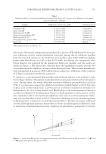
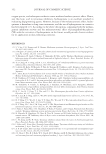
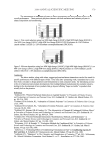
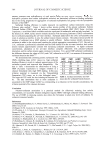
JOURNAL OF COSMETIC SCIENCE 326 fi ber in Group A is about 580 (arbitrary unit, a.u.) at around θ = 80°, and that in Group B is about 80 (a.u.) at around θ = 25° (Figure 5b). The difference in the refl ection inten- sities seems to explain the difference in the hair fi ber appearance. Figure 3. Difference in fi ber appearance due to the direction of sample fi bers. Sample fi bers were set (a) vertically and (b) parallel to the direction of incident light irradiation. Figure 4. Typical examples of the refl ection intensity curve of a blonde fi ber in the coplanar arrangement: (a) a hair of Group A (b) a hair of Group B. Table I Comparison of Structure and Optical Parameters of Groups A and B Measured by Goniophotometry Group A (N = 9) Group B (N = 7) Structure parameters (averaged) Elliticity 0.61 0.84 Major axis (μm) 93.1 63.4 Minor axis (μm) 52.0 45.5 Optical parameters (averaged) Maximum peak intensity (a.u.) 227 203 Integral intensity (a.u.) 17212 18677
Purchased for the exclusive use of nofirst nolast (unknown)
From: SCC Media Library & Resource Center (library.scconline.org)