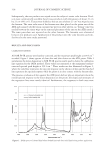
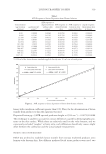
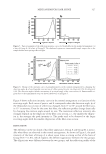
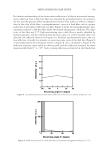
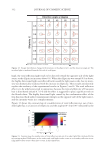
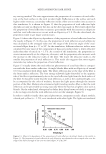
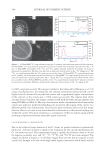
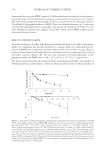
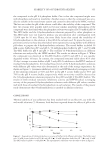
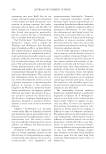
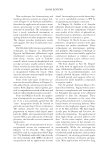
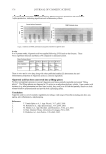
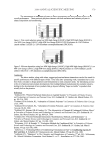
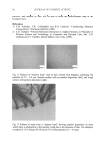
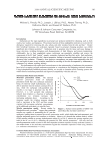
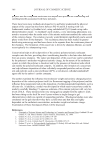
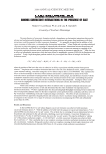
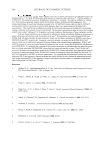
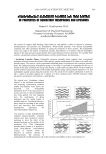
MECHANISM FOR HAIR SHINE 327 Figure 6 shows refl ection intensity curves in the normal arrangement as a function of the receiving angle. Each curve of parts a and b corresponds when the direction angle, φ, of the ellipsoidal cross section of a fi ber was changed, from 0° to 60° around the fi ber axis, in 15° increments. Even for the same hair fi ber, the refl ection profi les change drastically by changing the rotation angle around its axis. The maximum refl ection intensity also strongly depends on the ellipticity of the fi ber cross section, i.e., the smaller the elliptic- ity is, the stronger the peak intensity is. The peaks tend to be observed at the larger receiving angles with the smaller ellipticities of the fi ber cross section. DISCUSSION The difference in the two kinds of hair fi ber appearance, Group A and Group B, is notice- able when fi bers are observed in the normal arrangement. As shown in Figure 5, the peak intensity of the hairs of Group A is about seven times as strong as that of the hairs of Group B (577 vs 83), which explains the different appearance between the two groups. The ellipticities were different between the two groups, and the refl ection profi les of the Figure 5. Typical examples of the refl ection intensity curve of a blonde fi ber in the normal arrangement: (a) a hair of Group A (b) a hair of Group B. The shadowed regions are immeasurable angle ranges due to the sample holder intercepting refl ected light. Figure 6. Change of the intensity curve of goniophotometry in the normal arrangement by changing the direction angle, φ, of an ellipsoidal cross section of a fi ber around its axis: (a) ellipticity 0.56 (b) ellipticity 0.90. The direction angles include uncertainty of an initial angle of the cross section, α. Immeasurable re- gions due to the experimental setup are shown shadowed, as in Figure 5.

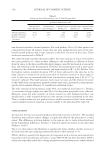
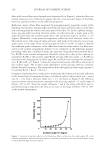
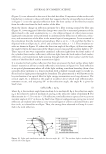
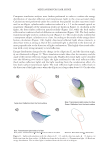
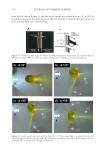
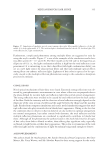
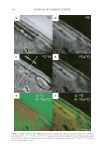
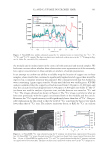
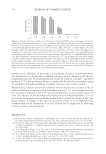
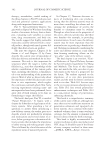
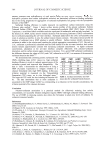
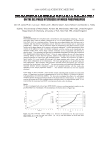
JOURNAL OF COSMETIC SCIENCE 328 fi ber with lower ellipticities changed more dramatically in Figure 6, when the fi ber was rotated around its axis. These facts suggest that the cross-sectional shapes of the fi bers have very signifi cant effects on the refl ection properties. Refl ection curves of hair fi ber measured by goniophotometry generally consist of the following two features: specular refl ections from the front and back surfaces of the fi ber and scattering from the surface and inner parts of the fi ber (5). In the coplanar arrange- ment, specular refl ection from the front surface of a fi ber provides a single peak at the angle deviated from the incident angle due to the inclination angle of cuticles, ca. 2.5 degrees. Meanwhile, in the normal arrangement, refl ections from the front surface of a fi ber radiate over a wide range of angles and never yield peaks in the intensity-vs-receiving- angle curves in the range of the receiving angle, θ, from 0° to 90°. In order to identify the unknown peaks, intensities of the refl ections from the front surface of a fi ber mea- sured in the normal arrangement (Figure 5) are estimated in the following manner: providing a fi ber has a cylindrical shape, the intensity of specular refl ection from the fi - ber, R⊥(Φ) in the normal arrangement should be identical to that in the coplanar ar- rangement, R//(Φ), at the incident angle Φ (the specular refl ection angle) = 0. R//(Φ) was measured with changing the incident angle, Φ, and R⊥(0) was estimated by extrapola- tion, R//(Φ) as Φ → 0. Figure 7 shows the experimental results of R//(Φ) as a function of the incident angle. The incident angle dependence of the specular refl ection intensity follows Fresnel’s equations. The extrapolation from the higher incident angle regions to 0° provides R//(0) ≈ R⊥(0) ≈ 20 (a.u.). Computer simulations were conducted to understand the behavior of specular refl ection in the normal optical arrangement from a cylindrical surface (where minor axis = major axis, E = 1.0), with a refractive index of n ≈ 1.5. As shown in Figure 8, the refl ection intensity shows a broad maximum centered on the receiving angle θ = 0° in the range of θ from -90° to 90°. From the results of Figures 7 and 8, the value of R⊥(θ) in our ex- perimental setup is expected to be 20 (a.u.), at most, in the range of θ from -90° to +90° in the normal arrangement. Figure 7. Intensity of specular refl ection of a blonde hair fi ber as a function of incident angles, Φ, in the coplanar arrangement. Specular refl ection angles of a hair fi ber generally deviate from incident angles owing to the inclination angle of cuticle surfaces.
Purchased for the exclusive use of nofirst nolast (unknown)
From: SCC Media Library & Resource Center (library.scconline.org)