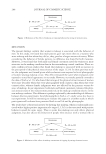
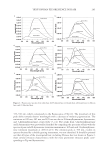
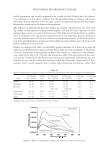
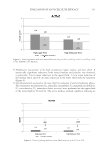
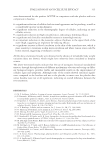
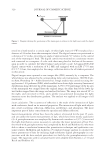
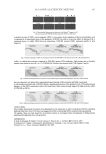
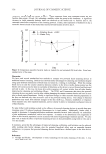
JOURNAL OF COSMETIC SCIENCE 302 amino acid side-chain groups, such as those corresponding to aspartate, glutamate, lysine, aspargine, and glutamine, can also quench Trp fl uorescence if located within 10 Å from the residue. This may also lead to decreases in Trp fl uorescence in hair containing a net- work of unreduced disulfi de bonds. EFFECT OF WATER CONTENT Figure 7 shows the fl uorescence spectra of brown hair with different levels of hydration. Completely dry hair, immediately after hair dryer application and cooled down to room temperature, displayed the lowest intensity of Trp emission at 5.9⋅105 cps at 336 nm. For completely wet hair the maximum emission was red-shifted to 343 nm and the intensity increased to 9.7⋅105 cps. For hair equilibrated at 50% RH, the observed emission posi- tion and its intensity were intermediate between dry and wet hair. It should also be pointed out that while the position and emission intensity of Trp fl uorescence is signifi - cantly affected by the content of water in hair, the peaks corresponding to kynurenines are not sensitive to such changes in the hydration of hair. This is evident from the fl uores- cence spectra shown in Figure 5 (excited at 290 nm) and was also confi rmed by spectra obtained by excitation at 320 nm, which showed no signifi cant change with a variation in the content of water. In addition, we also examined spectra of other types of hair, such as Piedmont and bleached, obtained at various levels of hair hydration. Qualitatively, the observed spectral changes were similar to those discussed above for brown hair. The effect of water on Trp emission in hair can be explained by hydrogen bond breaking during hydration involving Trp residues, similar to the effect of protein melting that leads to denaturation of cutinase by temperature increase (23). In this case the disulfi de bridges remain intact however, elimination of hydrogen bonds softens the keratin structure and/or helps to release Trp from the vicinity of cystine residues and induces the disrup- tion of Trp-disulfi de bridge complexes. Such structural transformations result in increased fl uorescence intensity in hair with high water content. Figure 7. Effect of water content on the fl uorescence spectra of brown hair.

TRYPTOPHAN FLUORESCENCE IN HAIR 303 CONCLUSIONS The following conclusions can be drawn based on the fi ndings presented above: (1) The fl uorescence data obtained at several excitation wavelengths and for different types of hair, including white, Piedmont, bleached, blonde, brown, curly black, and Chinese, revealed major evidence for the presence of three major chromophores includ- ing Trp and its three photo-oxidation products: N-formylkynurenine, kynurenine, and 3-hydroxykynurenine. (2) While melanin itself does not seem to contribute signifi cantly to hair fl uorescence, the presence of melanin in pigmented hair was shown to reduce the fl uorescence intensity of other keratin chromophores. (3) Photo and thermal exposure of hair was shown to decompose protein chromophores and reduce fl uorescence intensity of Trp and, to a lesser extent, kynurenines. The data also point to a photoprotective infl uence of melanin on kynurenines. Externally applied mela- nin was also shown to exert a photoprotective effect for other hair chromophores. (4) Chemical reduction of hair by thioglycolates was shown to increase Trp fl uorescence. It was proposed that the effect is caused by softening of the keratin matrix accompanied by an increase in the mobility of protein chains and a consequent decrease in Trp quenching by di- sulfi des. Re-oxidation of thiol groups into disulfi des by hydrogen peroxide was demonstrated to decrease Trp fl uorescence to prereduction levels. A similar effect is produced by hair hydra- tion, with the magnitude of Trp fl uorescence reversibly increasing with water content. REFERENCES (1) J. Strassburger and M. M. Breuer, Quantitative Fourier transform infrared spectroscopy of oxidized hair, J. Soc. Cosmet. Chem., 36, 61–74 (1985). (2) C. Pande and J. Jachowicz, Hair photodamage—Measurement and prevention, J. Soc. Cosmet. Chem., 44, 109–122 (1993). (3) C. Pande, FT-Raman spectroscopy—Applications in hair research, J. Soc. Cosmet. Chem., 45, 257–268 (1994). (4) C. R. Robbins and S. K. Bahl, Analysis of hair by electron spectroscopy for chemical analysis, J. Soc. Cosmet. Chem., 35, 379–390 (1984). (5) J. R. Lakowicz, Principles of Fluorescence Spectroscopy (Plenum Press, New York, 1983), pp. 496. (6) C. R. Robbins, Chemical and Physical Behavior of Human Hair (Springer-Verlag, New York, 1994). (7) R. S. Asquith, L. Hirst, and D. E. Rivett, Effects of ultraviolet radiation as related to the photoyellowing of wool, Appl. Polym. Symp., 18, 333–335 (1971). (8) F. G. Lennox, M. G. King, I. H. Leaver, G. C. Ramsay, and W. E. Savige, Mechanisms of prevention and correction of wool photoyellowing, Appl. Polym. Symp., 18, 353–369 (1971). (9) Z. Yoshida and M. Kato, On the photooxidation products of tryptophan, J. Am. Chem. Soc., 76, 311–312 (1954). (10) P. Walrant and R. Santus, Ultraviolet and N-formyl-kynurenine-sensitized photoinactivation of bovine carbonic anhydrase: An internal photodynamic effect, Photochem. Photobiol., 20, 455–460 (1974). (11) R. K. Borkman, Ultraviolet action spectrum for tryptophan destruction in aqueous solution, Photochem. Photobiol., 26, 163–166 (1977). (12) A. Pirie and K. J. Dilley, Photo-oxidation of N-formylkynurenine and tryptophan peptides by sunlight or simulated sunlight, Photochem. Photobiol., 19, 115–118 (1974). (13) T. B. Truong, Charge transfer to a solvent state. 5. Effect of solute-solvent interaction on the ionization potential of the solute. Mechanism for photoionization, J. Phys. Chem., 84, 964–970 (1980). (14) S. Daly, R. Bianchini, T. Polefka, L. Jumbelic, and J. Jachowicz, Fluorescence and coloration of grey hair, Int. J. Cosmet. Sci., 31, 347–359 (2009).
Purchased for the exclusive use of nofirst nolast (unknown)
From: SCC Media Library & Resource Center (library.scconline.org)