JOURNAL OF COSMETIC SCIENCE 526 applying a refreshing agent to the skin or the mucous membranes depend on the con- centration of the agent. At low concentrations menthol might cause a fresh sensation, whereas at higher concentrations (2–5%) it might lead to irritation or local anesthe- sia, and at concentrations between 5% and 10% it could cause burning sensations (6). For this reason, dementholated peppermint oil (which has a lower concentration of menthol) could be an alternative to generate immediate freshness without uncomfort- able sensations. The use of dementholated peppermint oil has been also claimed to be cheaper. Despite the fact that dementholation is an extra processing step, this oil is usually sold at a lower price in Buenos Aires because of added value of the extracted pure menthol. In general terms, the freshness sensation on the skin depends on the refreshing agent, its concentration, and its ability to migrate from the product to the skin and to penetrate the stratum corneum (7). Therefore, the freshness sensation of a cosmetic cream depends both on the refreshing agent and the composition of the medium in which it is included. Peppermint oil is a lypophylic component and therefore is soluble in the oil phase of emulsions. When used in cosmetic emulsions, peppermint oil needs to be liberated from it in order to penetrate the skin. For this reason, a low solubility of peppermint oil in the oily phase or a low proportion of apolar components in the emulsion could enhance this process (6,8) and increase the freshness perception. In the last decade, sensory evaluation has become one of the most important tools in the substantiation of claims related to human perception of the characteristics of cosmetic products when applied to the skin. Sensory profi ling of cosmetic products is a powerful tool for the cosmetic industry as it provides relevant information for the development and marketing of new products, the reformulation of existing products, and the optimization of manufacturing processes (9,10). Traditionally, this methodology has been performed with a group of trained assessors who objectively provide a quantitative description of the sensory characteristics of products (9). In particular, Quantitative Descriptive Analysis with trained assessors has been widely used to study the sensory characteristics of cosmet- ics and cosmetic ingredients (11–15). On the other hand, consumer studies provide information about the consumers’ needs, expectations, and perceptions of product (11,16–21). For decades, consumers have been considered capable only of hedonic judgments (9,10). However, in order to assure the success of their products in the market, cosmetic companies also need information on how consumers perceive the sensory characteristics of their products. For this reason, descrip- tive analysis with consumers, i.e., asking consumers to rate the intensity of different sensory attributes, has received increasing attention in recent years and has been re- ported to be a good alternative to classical sensory profi les provided by trained assessors (22,23). Consumers’ perception is infl uenced by cultural and sociodemographic variables. Thus, cross-cultural studies could be extremely important and useful when devoloping cosmetic products for different international markets. The aims of the present work were to study: (a) the infl uence of emulsion composition and two types of peppermint oil (common and dementholated) on the freshness perception of refreshing creams as evaluated by trained assessors (n=6) and two separate consumer panels (n = 50+50), and (b) the infl uence of freshness on consumers’ liking of refreshing creams.

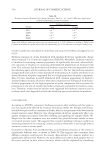
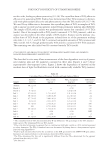
FRESHNESS EVALUATION OF REFRESHING CREAMS 527 MATERIAL AND METHODS REFRESHING AGENTS Commercial samples of peppermint oil were used in the study (Aromática S.A., Buenos Aires, Argentina). Two types of peppermint oil were considered: common peppermint oil (PO) and dementholated peppermint oil (DPO). The menthol content was determined by GC. Common peppermint oil had 50% menthol, whereas dementholated peppermint oil had 30%. SAMPLES Both agents were added to base emulsions in a concentration of 1%. This concentration was selected after considering the supplier’s recommendations and previous studies. Two emulsions were formulated with high (emulsion A) and low (emulsion B) concentration of apolar components. Emulsion A was formulated with a high concentration of mineral oil and triethanolamine stearate as an emulsifi er, whereas emulsion B was formulated with a low proportion of apolar components. The formulation of the emulsions is shown in Table I. Both refreshing agents were incorporated in the two base emulsions, giving as a result four samples of refreshing creams: APO (base A with common peppermint oil), ADPO (base A with dementholated peppermint oil), BPO (base B with common pep- permint oil), and BDPO (base B with dementholated peppermint oil). Emulsions were prepared in 5-kg batches, following different manufacturing procedures depending on their formulation. In the case of emulsion A, water was fi rst heated to 70°C. Then the components of the oily phase (stearic acid, glycerol monostearate, and mineral oil) were mixed, heated to 70°C, and added to the water with mechanical agitation at 200 rpm with a helix agitator. The emulsion was agitated for 5 min and then triethanolamine was added. After cooling the emulsion to 40°C, peppermint oil was incorporated. For emulsion B, the manufacturing procedure was the following: polyacrylamide, isopar- affi n, and laureth-7 were dispersed in water with gentle agitation at room temperature, Table I Formulation of the Emulsions Used in the Study Formulation Emulsion APO ADPO BPO BDPO Stearic acid 3.00 3.00 — — Triethanolamine 0.06 0.60 — — Glycerol monostearate 0.40 0.40 — — Mineral oil 30.0 30.0 — — Polyacrylamide, isoparaffi n, laureth-7 — — 3.00 3.00 Peppermint oil (PO) 1.00 — 1.00 — Peppermint dementholated (DPO) — 1.00 — 1.00 Aqua c.s.p. 100 100 100 100 APO: Base A with common peppermint oil ADPO: Base A with dementholated peppermint oil BPO: Base B with common peppermint oil BDPO: Base B with dementholated peppermint oil.
Purchased for the exclusive use of nofirst nolast (unknown)
From: SCC Media Library & Resource Center (library.scconline.org)