HAIR BREAKAGE 581 consumers using their own combing devices than by Caucasians or Asians. Furthermore, these scientists found 13% of the fi bers from two African subjects had knots that they concluded lead to hair breakage. Robbins (3) later demonstrated that hair fi bers with knots break under impact more easily than hair fi bers without knots and that when break- age occurs it is at the knot. The conclusion is that breakage occurs at knots because of severe bending deformations analogous to severe bending at fi ber loops in tangles as sug- gested by Brown and Swift (2), causing the fi bers to break more easily by impact or by breaking through the tangle. Apart from knot formation, in very curly hair with high ellipticity torsional deformation can make a signifi cant contribution to hair breakage, because such fi bers have suffered signifi cant damage during normal daily grooming in the regions of twist. These regions are further stressed by the torsional deformations that occur when the hair passes through the teeth of the comb. These fi bers can fail by a combination of torsional stresses working in tandem with relatively low tensile loads. Such effects are unlikely to be of much importance in the case of fi bers that are straight or have only a slight curvature. TREATMENTS AND WEATHERING: CHEMICAL DAMAGE INCREASES BREAKAGE AND CONDITIONERS DECREASE BREAKAGE Chemical damage by perms (5), bleaches (6), permanent dyes (7), straighteners (8), and sunlight exposure (9) weaken hair and increase interfi ber friction and abrasive damage, leading to more tangle formation and to more hair breakage. Straighteners do decrease curvature and in that manner decrease tangles, but they often weaken hair to the extent that they make the hair brittle. On the other hand, surface treatments such as condition- ers, which make hair combing and brushing easier, have been shown to produce less breakage (10). RELATIVE HUMIDITY OR WATER CONTENT OF THE HAIR Relative humidity or the amount of water in the fi bers can also affect hair combing forces and hair breakage (10). Epps and Wolfram (11) demonstrated that the work of combing highly coiled African hair is lower when the hair is wet than when it is dry, while the reverse holds for wavy-to-straight Caucasians hair (10,11). But this is true for all highly coiled hair versus straight-to-wavy hair (15). For example, highly coiled hair, such as from a permanent wave or highly coiled African, Caucasian, or even Asian hair, provides signifi cantly higher combing (11,15) or brushing forces in the dry state than in the wet state and more dry-state than wet-state breakage. This effect occurs because water breaks some of the hydrogen bonds and salt linkages, resulting in relaxation of the curl, which reduces tangles. On the other hand, straight-to-wavy Caucasian or Asian hair produces higher midlength combing forces in the wet rather than the dry state (3), but a higher end peak force at moderate-to-low relative humidity, explaining why this type of hair provides more long- segment breaks when wet (9), but more short segment breaks when dry (10). Therefore, when we consider the total number of grooming strokes during the day, we must consider three states of relative humidity. The fi rst state considers the number of grooming strokes

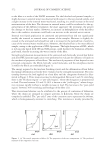
JOURNAL OF COSMETIC SCIENCE 582 in the wet state if one blow dries the hair, we must consider the transition from the wet to the dry state and the number of grooming strokes, and fi nally we must consider the number of grooming strokes in the dry state. Therefore, to simply assign a number of grooming strokes per day without considering the state of the water content and the hair type is too simplistic. PHYSICAL DAMAGE OR WEAR BY ABRASION FROM SPECIFIC GROOMING DEVICES SUCH AS COMBS, PICKS, OR BRUSHES, AND FATIGUING OR PULLING THROUGH A TANGLE WITHOUT BREAKAGE Wear by abrasion occurs over the entire fi ber but more near the fi ber tip end because of a longer residence time, but even more so by high end peak forces when dry (3), as evi- denced by examination of many of the smaller fragments of short segment breaks (3,10). Combs or brushes with more space between the teeth or bristles can lead to fewer and less complex tangles and therefore to lower combing forces, less abrasion, less fatiguing, and fewer broken hairs some brushes provide more long segment breaks and fewer short seg- ment breaks than combs (18). Fatiguing occurs primarily between the root section of the fi ber and the brush or comb where the combing device encounters a snag, but only on the fi bers that are under tension at the snag, which generally is a very low percentage of the fi bers in the area being combed or in the brush. Therefore, fatiguing and impacting are related, but impact breakage is produced by a single impact however, fatiguing can produce breakage only by hundreds to thousands of impacts over the same section of the same fi ber. Therefore, for the same section of the same fi ber to be impacted suffi ciently thousands of times and each time to cause fatigue damage is a much lower probability occurrence than for a sin- gle hair under high tension to be impacted once and broken. The recent paper by Evans and Park (1) on hair breakage suggests that fatiguing is the primary reason for hair breakage and raises some important questions about hair break- age. Evans and Park used the combing wheel to brush hair repeatedly at a certain fre- quency, at 60% RH only, and collected the broken fi bers as a function of the number of brushing strokes up to 10,000 strokes. In Figure 4 of their paper, as expected of a good conditioner, we see a nearly 60% reduction in breakage. Then they proceeded to apply Weibull statistics to hair breakage data in Table I, assuming that combing or brushing amounts to fatiguing hair, eventually leading to catastrophic failure. It is true that in the past a signifi cant amount of work has been done on the mechanisms of the weakening of fi bers by fatiguing and the mechanism of protection of hair fi bers by conditioners using Weibull statistics (18). However, whether this approach can be used to interpret hair breakage in combing or brushing is questionable. The authors calculated the shape parameter and the characteristic life for virgin and bleached damaged hair, and for hair treated with conditioners. The defi nition of the characteristic life for hair breakage is the number of brushing strokes necessary for breaking 63.2% of the fi bers. For virgin hair, the characteristic life is given as 55.2 million brush strokes, and for the same hair after con- ditioning it increases to 1.04 billion brush strokes. But the data for these huge numbers are based on only 10,000 brush strokes and only 1.6% of the fi bers broken (326 of 20,000) as compared to 12,640 fi bers corresponding to the defi nition of characteristic life. These characteristic life values are so large relative to the actual data that they are of ques- tionable reliability. For example, assuming brushing at the rate of 1 stroke/s (the authors
Purchased for the exclusive use of nofirst nolast (unknown)
From: SCC Media Library & Resource Center (library.scconline.org)