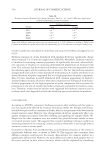
FRESHNESS EVALUATION OF REFRESHING CREAMS 527 MATERIAL AND METHODS REFRESHING AGENTS Commercial samples of peppermint oil were used in the study (Aromática S.A., Buenos Aires, Argentina). Two types of peppermint oil were considered: common peppermint oil (PO) and dementholated peppermint oil (DPO). The menthol content was determined by GC. Common peppermint oil had 50% menthol, whereas dementholated peppermint oil had 30%. SAMPLES Both agents were added to base emulsions in a concentration of 1%. This concentration was selected after considering the supplier’s recommendations and previous studies. Two emulsions were formulated with high (emulsion A) and low (emulsion B) concentration of apolar components. Emulsion A was formulated with a high concentration of mineral oil and triethanolamine stearate as an emulsifi er, whereas emulsion B was formulated with a low proportion of apolar components. The formulation of the emulsions is shown in Table I. Both refreshing agents were incorporated in the two base emulsions, giving as a result four samples of refreshing creams: APO (base A with common peppermint oil), ADPO (base A with dementholated peppermint oil), BPO (base B with common pep- permint oil), and BDPO (base B with dementholated peppermint oil). Emulsions were prepared in 5-kg batches, following different manufacturing procedures depending on their formulation. In the case of emulsion A, water was fi rst heated to 70°C. Then the components of the oily phase (stearic acid, glycerol monostearate, and mineral oil) were mixed, heated to 70°C, and added to the water with mechanical agitation at 200 rpm with a helix agitator. The emulsion was agitated for 5 min and then triethanolamine was added. After cooling the emulsion to 40°C, peppermint oil was incorporated. For emulsion B, the manufacturing procedure was the following: polyacrylamide, isopar- affi n, and laureth-7 were dispersed in water with gentle agitation at room temperature, Table I Formulation of the Emulsions Used in the Study Formulation Emulsion APO ADPO BPO BDPO Stearic acid 3.00 3.00 — — Triethanolamine 0.06 0.60 — — Glycerol monostearate 0.40 0.40 — — Mineral oil 30.0 30.0 — — Polyacrylamide, isoparaffi n, laureth-7 — — 3.00 3.00 Peppermint oil (PO) 1.00 — 1.00 — Peppermint dementholated (DPO) — 1.00 — 1.00 Aqua c.s.p. 100 100 100 100 APO: Base A with common peppermint oil ADPO: Base A with dementholated peppermint oil BPO: Base B with common peppermint oil BDPO: Base B with dementholated peppermint oil.

JOURNAL OF COSMETIC SCIENCE 528 heated to 40°C, and agitated for 5 min at 200 rpm with a helix agitator. Then, pepper- mint oil was added to the emulsions. In order to study the emulsions’ stability, centrifugation was used. After being centri- fuged at 3000 rpm for 15 min, no phase separation was observed in the emulsions, even after 6 months of storage at 25°C. SENSORY PANEL A sensory panel consisting of six trained assessors with previous experience in the evalu- ation of cosmetic products evaluated the freshness of the refreshing creams. Before the test, a mixture of isopropyl alcohol and water (45:55) was applied to the forearms of the asses- sors in order to clean the zone, and it was allowed to dry for 5 min. Then, 4-cm-diameter circles were drawn on the internal side of the non-dominant forearms of the assessors. Assessors were asked to place a controlled preweighted amount of the emulsion (0.05 g) in the center of one of the circles. The assessors rubbed the sample with their fi ngers within the circle in a circular way 30 times at a rate of two times per second. Freshness was evaluated 5 and 10 min after application using a structured 11-point scale anchored by 0 (no freshness) and 10 (burning sensation). In this scale, a rating of 8 corresponded to the description “very fresh.” Samples were presented using white polyethylene containers labeled with three-digit random numbers. Two sessions were held over two consecutive days for duplicate evalua- tion of the samples. In the two sessions, the four samples were presented following a randomized balanced rotation (multiple orthogonal Latin square) in monadic sequence. The tests were carried out in a sensory laboratory designed in accordance with ISO 8589 (24). The evaluations were performed under artifi cial daylight-type illumination, tem- perature control (between 22° and 24°C), and air circulation. CONSUMER STUDIES Two studies were carried out in two different cities: one in Buenos Aires (Argentina), and the other in Montevideo (Uruguay). In each city fi fty female consumers of refreshing creams, ages ranging from 20 to 60, evaluated the four samples. A preweighted amount of each emulsion (0.3 g) was presented to consumers in plastic containers. Samples were presented following a randomized balanced rotation in monadic sequence, as in the trained assessors’ panel evaluations. In this case, consumers evaluated each sample only once. First, consumers were asked to smell the samples and to score the freshness sensation of each and their odor liking, using a structured ten-point scale (1–10). Then, consumers applied the samples on their forearms, and 5 min after application they were asked to evaluate their freshness sensation and their liking using a structured ten-point scale. DATA ANALYSIS In order to establish differences between the freshness sensation of the evaluated creams, an analysis of variance (ANOVA) was carried out on trained assessors’ data, consider- ing type of peppermint oil, emulsion formulation, time, assessor, repetition, and the
Purchased for the exclusive use of nofirst nolast (unknown)
From: SCC Media Library & Resource Center (library.scconline.org)