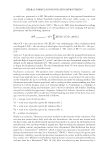
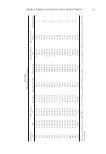
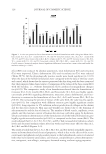
NEW METHOD FOR MEASUREMENT OF FIBER TORSION 91 CONCLUSION The aim of this study was to assess the advantages of a new automated method for the measurement of the shear modulus of hair fi bers relative to a manual pendulum-based method. It has been observed that the methods show similar measured values for the shear modulus of nylon and hair fi bers. Reduced variability between runs has been shown for the automated method for both fi ber types. It has also been determined that the operator time required for the automated method is reduced by a factor of 6 relative to the conventional manual method. The automated FTT950 method therefore provides signifi cant advantage over the pendulum method, showing improved run-to-run reproducibility in addition to increased sample throughput and experimental fl exibility. ACKNOWLEDGMENTS The authors thank M. Leray for measurements made contributing to the data set. REFERENCES (1) C. R. Robbins, Chemical and Physical Behavior of Human Hair, 2nd Ed. (Springer-Verlag, New York, 1988), p. 226. (2) R. Robbins and R. Crawford Cuticle damage and the tensile properties of human hair, J. Soc. Cosmet. Chem, 42, 59 (1991). (3) H. D. Weigmann, Analysis and quantifi cation of hair damage, Progress Report No. 2, TRI Princeton, Princeton, NJ (1991). (4) W. J. Simpson, A comparison of methods of measurement of Young’s modulus for keratin fi bers, J. Textile Inst., 51T, 675 (1965). (5) P. Huck and C. Baddiel, The mechanical properties of virgin and treated human hair fi bers: A study by means of the oscillating beam method, J. Soc. Cosmet. Chem., 22, 401–410 (1971). (6) G. H. Henderson, et al., Fractography of human hair, J. Soc. Cosmet. Chem., 29, 449–467 (1978). (7) J. Menkart, Caucasian hair, Negro hair, and wool: Similarities and differences, J. Soc. Cosmet. Chem., 17, 769–787 (1966). (8) M. M. Breuer, The binding of small molecules to hair—l: The hydration of hair and the effect of water on the mechanical properties of hair, J. Soc. Cosmet. Chem., 23, 447–470 (1972). (9) P. Zuidema, L. E. Govaert, F. P. T. Baaijens, P. A. J. Ackermans, and S. Asvadi, The infl uence of humidity on the viscoelastic behaviour of human hair, Biorheology, 40, 413–439 (2003). (10) F. Baltenneck, A. Franbourg, F. Leroy, M. Mandon, and C. Vayssie, A new approach to the bending properties of hair fi bers, J. Cosmet. Sci., 52, 355–368 (2001). (11) F. I. Bell, R. Skinner, I. M. Tucker, Y. Leray, T. E. Lyons, K. Devine, P. Pudney, and T. Oikawa, Biophysical and mechanical response of keratinous fi bers to changes in temperature and humidity, J. Cosmet. Sci., 55(Suppl.), S19–S24 (2004). (12) D. Persaud and Y. Kamath, Torsional method for evaluating hair damage and performance of hair care ingredients, J. Cosmet. Sci., 55(Suppl.), S65–S77 (2004). (13) S. B. Reutsch and H-D. Weigmann, Mechanism of tensile stress release in the keratin fi ber cuticle, J. Soc. Cosmet. Chem., 4, 13–26 (1996). (14) R. Beyak, C. F. Meyer, and G. S. Kass, Elasticity and tensile properties of human hair. I. Single fi ber test method, J. Soc. Cosmet. Chem., 20, 615–626 (1969). (15) H. Bogaty. Torsional properties of hair in relation to permanent waving and setting, J. Soc. Cosmet. Chem., 18, 575–589 (1967). (16) A. Elliot, The α-β transformation in stretched hair, Textile Res. J., 22, 783 (1952).

JOURNAL OF COSMETIC SCIENCE 92 (17) A. N. Parbhu, W. G. Bryson, and R. Lal, Disulfi de bonds in the outer layers of keratin fi bers confer higher mechanical rigidity: Correlative nano-indentation and elasticity measurements with an AFM, Biochemistry, 38, 11755–11761 (1999). (18) J. A. Swift, The cuticle controls bending stiffness of hair, J. Cosmet. Sci., 51(1), 37–38 (2000). (19) F. I. Bell and S. Watson, “Analytical Modelling of the Mechanical Properties of Single Hair Fibres,” 11th International Wool Conference, Leeds, 2005. (20) R. M. Khayatt and N. H. Chamberlain, The bending modulus of animal fi bers, J. Text. Inst., 39, 185–197 (1948). (21) H. M. Elder, The tensile, compressive and bending moduli of some monofi lament materials, J. Text. Inst., 57, T8–T14 (1966). (22) G. V. Scott and C. R. Robbins, Stiffi ness of human hair fi ber, J. Soc. Cosmet. Chem., 29, 469–485 (1978). (23) J. D. Owen, The application of Searle’s single and double pendulum method to single fi ber rigidity measurements, J. Text. Inst., 56, 329–339 (1965). (24) J.-C. Garson, M. Vidalis, P. Roussopoulos, and J.-L. Leveque, Les propereties vibratoires transversales des fi bres de keratine. Infl uence de l’eau et d’autres, Int. J. Cosmet. Sci., 2, 231–241 (1980). (25) D. Persaud and Y. Kamath, Torsional method for evaluating hair damage and performance of hair care ingredients, J. Cosmet. Sci., 55 (Suppl.), S65–S77 (2004). (26) L. J. Wolfram and L. Albrecht, Torsional behavior of human hair, J. Soc. Cosmet. Chem., 36, 87–99 (1985). (27) S. Ratnapandian, S. B. Warner, and Y. K. Kamath Photodegradation of human hair, J. Cosmet. Sci., 49, 309–320 (1998). (28) E. U. Condon and H. Odishaw, Handbook of Physics, B2/31–2 (1958). (29) J. Case, L. Chilver, and C. T. F. Ross, Strength of Materials and Structures, (Butterworth-Heinemann, 1999), Ch. 20. (30) K. W. Lee, Torsional analysis of fi bers with a generalized elliptical cross-section, Text. Res. J., 75, 377 (2005). (31) G. Raumann, The anisotropy of the shear moduli of drawn polyethylene, Proc. Phys. Soc., 79, 1221–1233 (1962).
Purchased for the exclusive use of nofirst nolast (unknown)
From: SCC Media Library & Resource Center (library.scconline.org)