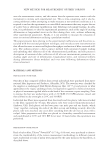
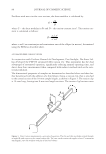
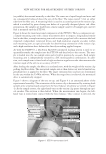
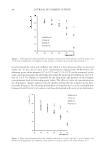
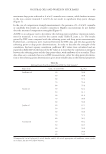
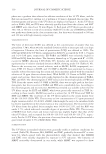
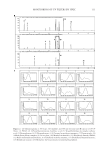
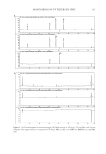
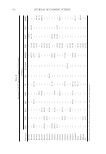
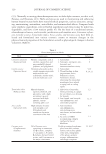
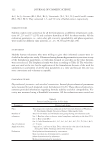
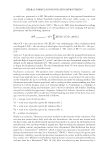
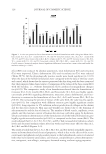
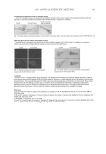
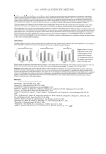
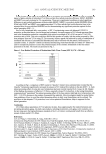
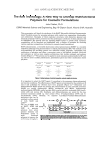
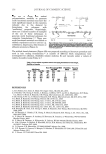
NEW METHOD FOR MEASUREMENT OF FIBER TORSION 89 average value obtained over two runs for each fi ber. These are shown in Figures 6 and 7, for nylon and hair, respectively. Nylon fi bers show a similar average modulus as measured on manual and automated instruments, measured as 0.418±0.017 GPa and 0.422±0.025 GPa, respectively. The average absolute difference between run 1 and run 2 (Figure 8) was larger for the manual technique (1.45%) than for the automated technique (1.04%). This difference was found to be statistically signifi cant when comparing the data sets in a paired t-test (p=0.03). Figure 6. Plot of normalized change in shear modulus of nylon fi bers between runs 1 and 2 versus average of both runs. Black dots show data from manual instrument white dots show data from automated instrument. Figure 7. Plot of normalized change in shear modulus of hair fi bers between runs 1 and 2 versus average of both runs. Black dots show data from manual instrument white dots show data from automated instrument.

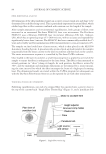
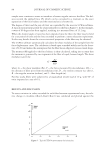
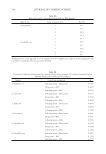
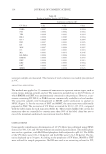
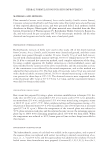
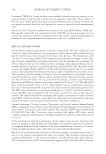
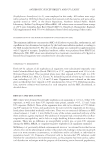
JOURNAL OF COSMETIC SCIENCE 90 Hair showed more fi ber–fi ber variability than the polymeric fi bers, with an average modulus measured using the manual and automated techniques of 1.39±0.22 GPa and 1.58±0.20 GPa, respectively. The difference can be explained by the higher tensile force applied to the fi ber (10 g versus 6.5 g) during the automated method leading to tension- torsion coupling (31) in the smaller-diameter hair fi bers, though further studies would be required to confi rm this. The average difference between runs (Figure 8) was larger for the manual technique than for the automated technique, with average absolute differ- ences of 3.30% and 2.19%, respectively. These differences were statistically signifi cant (p=0.03). The results obtained indicate that while the torsional pendulum method and direct con- tact method provide consistent, reproducible measurement of the shear modulus, the direct contact method appears to offer improved repeatability, with run-to-run variabil- ity reduced by 28% when measuring nylon fi bers and by 34% when measuring hair fi bers. In spite of experiments being run under controlled conditions, hair fi bers were found to display a fi ber-to-fi ber variability much larger than that of nylon, with a standard devia- tion in the torsional modulus of 0.224 GPa (16%) and 0.199 GPa (12%) for manual and automated techniques in hair, compared to 0.0172 GPa (4%) and 0.0255 GPa (6%) for nylon. This is understandable as nylon was chosen as a model fi ber with a high degree of homogeneity, while hair fi ber is a natural substrate. The approximate amount of operator time taken to measure samples was also recorded. It was found that it took on average of 120 minutes of operator time to measure 40 fi bers using the pendulum method, while it took 20 minutes of operator time to measure the same fi bers using the automated method, including the additional time required to add the extra torsion clip required for the direct-contact method. The automated nature of the FTT950 allowed placement of the instrument in a humidity chamber to control conditions. This avoided the need for experiments to be made using a glove box, or with climate control for the whole room, something that would be required with the manual system. Figure 8. Plot of average run-run variability for each of the sample sets calculated on a fi ber-by-fi ber basis. Error bars show 95% confi dence limits.
Purchased for the exclusive use of nofirst nolast (unknown)
From: SCC Media Library & Resource Center (library.scconline.org)