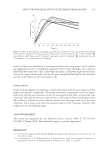
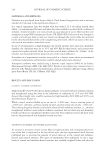
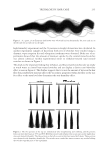
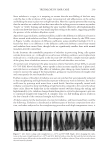
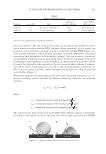
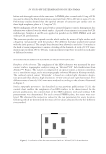
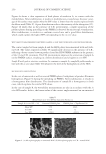
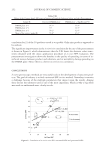
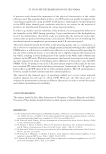
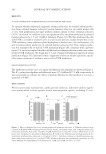
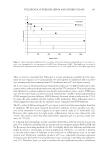
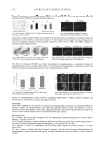
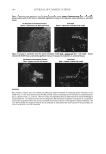
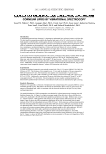
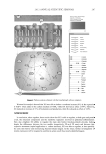
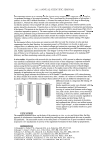
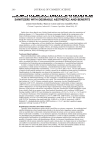
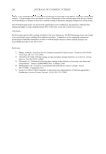
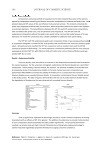
JOURNAL OF COSMETIC SCIENCE 238 CLIMATIC ROOM EXPERIMENTS The fi nding above suggests an important testable concept, i.e., for anti-humidity action to take effect trehalose must be in an anhydrous or glassy form below 50% RH. To test this, experiments were performed under controlled conditions of 30% RH and ~20°C and 60% RH and ~20°C. Control hair switches (those “treated” only with water) and hair switches treated with trehalose were styled using straightening irons at the two conditions given above in a climatic room. Subsequently the humidity and temperature in the testing area were increased to a fi nal state of 80% RH and ~30°C. The switches continued to remain in the climatic room while the conditions were being changed. The results are given in Figures 6 and 7. In both experiments, control (i.e., water-treated only) switches are the fi rst and the last switches and fl ank the six trehalose-treated switches in between. It can be seen that trehalose-treated switches styled at lower %RH show anti-humidity benefi ts (Figure 6, right) while those styled at higher %RH do not (Figure 7, right). It is proposed that in the latter case, as the conditions were being changed to high-humidity conditions, any glassy material formed during the styling phase would have converted to the crystal form even before the high-humidity conditions of 80% set in and thus would not have shown anti-humidity benefi ts. Clearly Figures 6 and 7 offer compelling evidence that the anti-humidity benefi t obtained from trehalose and heat is intimately related to the starting styling conditions. Trehalose- treated and hot-iron straight-styled switches at lower relative humidity conditions show noticeable anti-humidity benefi ts. Thus if one assumes that the use of hot irons (~200°C) in the straightening process converts the trehalose to a glassy form in situ, this suggests that the ability of the trehalose glassy form to pick up water below 50% RH and convert to a stable dihydrate crystal above 50% RH is linked to the anti-humidity activity observed. DISCUSSION ON MECHANISM OF ACTION OF TREHALOSE Here we have presented evidence for trehalose- and heat-treated switches showing anti- humidity benefi ts compared to the control. Evidence has also been presented that glassy forms of trehalose can pick up water compared to the crystal form and that hair treated with trehalose and heat has similar overall water-uptake properties compared to the control. Finally, it has been shown that if the starting condition during style creation is at low relative humid- ity, only then is the anti-humidity benefi t seen. Here we summarize the mechanism of action of trehalose to give anti-humidity benefi ts. Figure 6. Left: after styling with straighteners at ~20°C and 30% RH. Right: After changing the condi- tions in the room to high humidity at ~30°C and 80% RH. In both pictures the fi rst and the last switches are control (treated with water) and fl uff up at high humidity, i.e., do not show the anti-humidity benefi t. All switches in the middle are treated with 2% trehalose solution and show the anti-humidity benefi t.

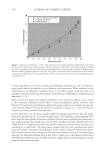
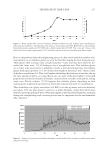
TREHALOSE IN HAIR CARE 239 Since trehalose is a sugar, it is tempting to assume that the non-fl uffi ng of the hair array could be due to the stickiness of the sugar, increasing tack and adhesiveness on the surface and holding the array in place even at high humidity. Here this is partly prevented by ensuring that the switches are combed at least fi ve times after the styling process to remove any surface “bonds” or “welds” forming and holding the array together. Moreover, after high-humidity, tactile tests show that there is a very small crisp/dry coating on the surface, suggesting possibly the presence of the trehalose dihydrate crystal. Apart from sugar stickiness, another possibility could be the difference in diffusion of water in fi bers treated with trehalose and heat. The adsorption isotherms shown by the DVS curves in Figure 3 enable calculation of diffusion coeffi cients using simplifi ed methods (19). It is found that there is no difference in the diffusion coeffi cients between control heat-treated and trehalose heat-treated hair, though both are signifi cantly smaller than with normal (non-heat-treated) control hair. In the literature the remarkable properties of trehalose in protecting living cells against extreme desiccation, etc., is thought to occur because trehalose works as a water replacement molecule or is a vitrifi cation agent in the dry state (20–28). Here a simple moisture uptake of the glassy form of trehalose seems to correlate well with the effect seen in hair. At normal room temperature the glass transition relative humidity of hair (RHg) is around 65–70% RH. Above this RHg, water uptake in hair increases rapidly, hair is plasticized, and style loss is accelerated. The effect of trehalose glass taking up water, however small, seems to increase the aging of the hair polymer, giving rise to preservation of straight style and consequently the anti-humidity benefi t. Further evidence of the effect of trehalose was seen on switches that were repeatedly subjected to heat straightening and high-humidity exposure without any wash in between, but with a mild rinse by spritzing with water from a wash bottle. Switches originally treated with trehalose continued to show low fl uffi ng at high humidity compared to the control for about three cycles. Here we think that in the trehalose-treated switches during the styling and high-humidity cycle, trehalose changes forms from glass to crystal to glass again to give rise to continued straight style longevity. A complete rinse or a full washing process results in the loss of much of the continued straight style benefi ts. A likely scenario for the mechanism of action for trehalose- and heat-treated hair could be the following. Trehalose is distributed at different parts of the hair composite from solu- tion, and when subjected to the straightening procedure with high-temperature irons, it Figure 7. Left: After styling with straighteners at ~20°C and 60% RH. Right: After changing the condi- tions in the room to high humidity at ~30°C and 80% RH. In both pictures the fi rst and the last switches are treated with water. All switches in the middle are treated with 2% trehalose solution. None of the switches shows the anti-humidity benefi t.
Purchased for the exclusive use of nofirst nolast (unknown)
From: SCC Media Library & Resource Center (library.scconline.org)