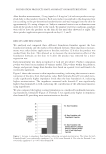
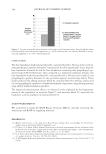
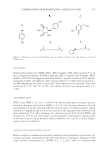
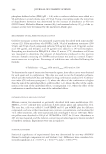
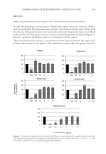
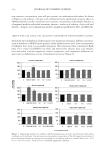
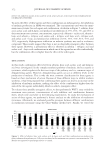
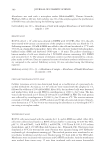
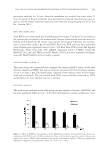
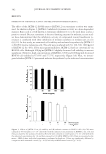
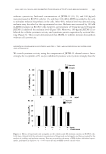
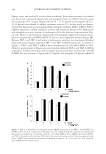
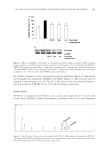
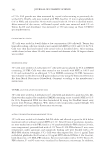
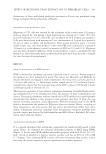
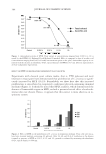
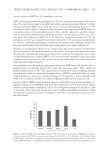
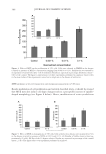
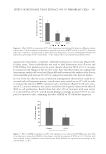
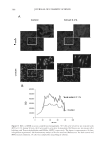
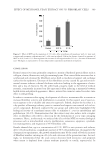
NELUMBO NUCIFERA AND INHIBITED TYROSINASE ACTIVITY AND MELANOGENESIS 385 the cellular tyrosinase activity and tyrosinase protein expression (Figure 6). Hyperoside and astragalin were identifi ed in JKTM-12 by HPLC (Figure 7). The retention times of hyperoside and astragalin were 20.519 and 22.902 min and the concentration of hypero- side and astragalin in JKTM-12 was 5.41 and 49.02 μg/g, respectively. DISCUSSION JKTM-12 is composed of the fl owers, roots, seeds, and receptacles of N. nucifera (the sacred lotus). JKTM-12 inhibited mushroom tyrosinase activity in a dose-dependent Figure 6. Effects of JKTM-12, hyperoside, and astragalin on the (A) cellular tyrosinase and (B) tyrosinase protein expression in B16F10 cells. Cells were incubated in 6-well plates (2 × 10⁵ cells/well) with JKTM-12 (JKTM, 100 μg/ml), hyperoside (Hyp., 10 μg/ml), or astragalin (Ast., 10 μg/ml) for 1 h and then exposed to 100 nM α-MSH for 48 h. Data are presented as the mean ± SEM of three individual experiments, performed in duplicate. *p 0.05 versus the only α-MSH treated control values. Figure 7. Identifi cation of hyperoside and astragalin in JKTM-12. Hyperoside and astragalin in JKTM-12 were identifi ed by HPCL following the protocols in the experimental section. The retention times of hypero- side and astragalin were 20.519 and 22.902 min, respectively.

JOURNAL OF COSMETIC SCIENCE 386 manner. When B16F10 murine melanoma cells were cultured with JKTM-12, it sup- pressed melanin production, cellular tyrosinase activity, and tyrosinase protein level. We identifi ed two compounds (hyperoside and astragalin) and tested the activity in the B16F10 cells stimulated by α-MSH. Hyperoside, quercetin-3-O-β-D-galactoside pyra- nose, is a fl avonoid compound identifi ed from various plants such as Hypericum perforatum (14), Launaea procumbens (15), Zanthoxylum bungeanum (16), and Rhododendron ponticum (17). There are evidences that hyperoside has remarkable anti-infl ammatory properties (18,19) as well as anti-oxidative effects (17,20–22). Astragalin is extracted from many herbs such as Morrus alba (23), Allium ampeloprasum var. porrum (24), Fuzhuan brick tea (25), and Cassia alata (26). Astragalin has antioxidant activity (23,24) and anti-infl ammatory ef- fects (27). Hyperoside and astragalin were also isolated from the leaves of N. nucifera by high-speed counter-current chromatography (28). Ohkoshi et al. (29) reported that a 50% EtOH extract from the leaves of N. nucifera stimulated lipolysis in the white adipose tissue of mice, and they identifi ed various fl avonoids including rutin, (+)-catechin, hype- roside, isoquercitrin, quercetin, and astragalin. Nakamura et al. reported that a MeOH extract of the fl ower buds and leaves of N. nucifera inhibited melanogenesis in B16 mela- noma 4A5 cells. They also showed that 100 μg/ml fl ower buds of N. nucifera inhibited melanogenesis by 91 ± 1.8%. This research team found that the inhibitory effect of me- lanogenesis by the stamen and seeds of N. nucifera was lower than that by the fl ower buds and leaves of this plant (30). In the other report, hyperoside isolated from receptaculum nelumbinis showed obvious DPPH radical scavenging activity and ABTS radical scav- enging activity (31). According to this fi nding, we isolated hyperoside and astragalin from receptaculum nelumbinis and investigated its anti-tyrosinase activity (13). Even though components of JKTM-12 display different activities on melanogenesis in B16F10 cells, JKTM-12 inhibited tyrosinase activity and melanin biosynthesis overexpressed by α-MSH in B16F10 cells. These results were partly caused by hyperoside and astragalin that inhibit tyrosinase activity, melanogensis, TRP-1 mRNA, TRP-2 mRNA expression, cellular tyrosinase, and tyrosinase protein level. Thus, our results indicate that JKTM-12 containing hyperoside and astragalin may prove useful in the development of cosmetic source for preventing hyperpigmentation. However, it needs further studies on normal human melanocytes. ACKNOWLEDGMENTS This work was supported by Ministry of Health & Welfare “The Traditional Korean Medicine Industry Development Product R&D Program (C100001).” REFERENCES (1) M. Tsatmali, J. Ancans, and A. J. Thody, Melanocyte function and its control by melanocortin peptides, J. Histochem. Cytochem., 50, 125–133 (2002). (2) A. L. Kadekaro, R. J. Kavanagh, K. Wakamatsu, S. Ito, M. A. Pipitone, and Z. A Abdel-Malek, Cutane- ous photobiology. The melanocyte vs. the sun: who will win the fi nal round? Pigment. Cell. Res., 16, 434–447 (2003). (3) G. E. Orchard and E. Calonje, The effect of melanin bleaching on immunohistochemical staining in heavily pigmented melanocytic neoplasms, Am. J. Dermatopathol., 20, 357–361 (1998).
Purchased for the exclusive use of nofirst nolast (unknown)
From: SCC Media Library & Resource Center (library.scconline.org)