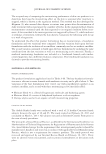
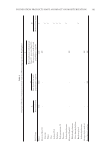
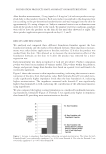
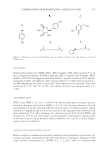
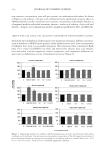
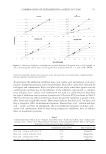
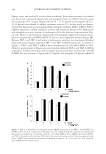
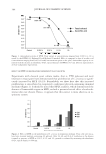
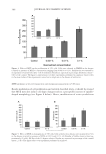
COMBINATION OF DEPIGMENTING AGENTS IN VITRO 371 EFFECT OF ARBUTIN, KOJIC ACID, AZELAIC ACID, AND α-LIPOIC ACID AND THEIR COMBINATIONS ON MUSHROOM TYROSINASE ACTIVITY To investigate the inhibition of arbutin, kojic acid, azelaic acid, and α-lipoic acid on ty- rosinase, mushroom tyrosinase assay was performed. Dose/effect curves were obtained for each agent and combination. Kojic acid plus each one of the other three agents were the combinations used here due to the difference in the inhibition type (mixed vs. competi- tive). α-Lipoic acid + azelaic acid combination was used as a control because they share the type of inhibition over tyrosinase (competitive). CIs at the IC50 are shown in Table I. The CI at this fraction affected (50%) was chosen because the variability is greater at low- effect levels and at high-effect levels. These results indicate that kojic acid + α-lipoic acid have a synergistic effect on mushroom tyrosinase, whereas kojic acid + arbutin and kojic acid + azelaic acid have an antagonistic effect on mushroom tyrosinase. α-Lipoic acid + azelaic acid combination, both of them being competitive inhibitors, have an additive effect on mushroom tyrosinase. Figure 4. Lineweaver–Burk plots of mushroom tyrosinase. Arbutin (500 μg/ml), kojic acid (10 μg/ml), az- elaic acid (100 μg/ml), and α- lipoic acid (50 μg/ml) were incubated with 0.5, 1, 2, and 3 mM L -DOPA. Table I Combination Index of Kojic Acid + α-Lipoic Acid, Kojic Acid + Azelaic Acid, Kojic Acid + Arbutin and α-Lipoic Acid + Azelaic Acid, Obtained from the Output of the CompuSyn software. Next to the Names Is the Ratio of Concentration for Each Combination Combination index (IC50) Type of interaction Kojic acid + α-lipoic acid (ratio 1:5) 0.70 Synergism Kojic acid + azelaic acid (ratio 1:10) 1.33 Antagonism Kojic acid + arbutin (ratio 1:50) 1.29 Antagonism α-Lipoic acid + azelaic acid (ratio 1:2) 1.12 Additive

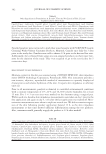
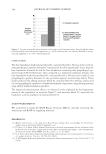
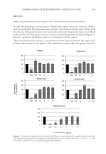
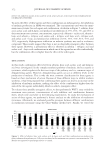
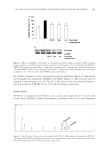
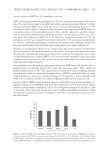
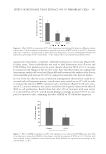
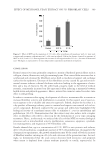
JOURNAL OF COSMETIC SCIENCE 372 EFFECT OF ARBUTIN, KOJIC ACID, α-LIPOIC ACID, AND AZELAIC ACID AND THEIR COMBINATIONS ON MELANIN SYNTHESIS To assess the effect of these agents and their combinations on melanogenesis, the inhibition of melanin production in HSMs was examined. The concentrations used were the maxi- mum non-cytotoxic for each agent and combination. As shown in Figure 5, arbutin, kojic acid, azelaic acid, and α-lipoic acid produced an inhibition of 27%, 16%, 3%, and 46% at their maximum non-cytotoxic concentrations, respectively. Arbutin + azelaic acid, arbutin + kojic acid, arbutin + α-lipoic acid, azelaic acid + α-lipoic acid, kojic acid + α-lipoic acid, and azelaic acid + kojic acid produced an inhibition of 25%, 33%, 35%, 41%, 47%, and 22%, respectively. Hydroquinone inhibition on melanin synthesis was used as a reference compound. These results suggest that there is not an observable synergistic effect between these agents. However, a potentiation effect is observed in arbutin + α-lipoic acid and azelaic acid + kojic acid combinations in which one of the agents has no effect individually, but the combination effect is higher than the effect of the other agent. DISCUSSION In this study, combination effects between arbutin, kojic acid, azelaic acid, and α-lipoic acid were investigated. In the complex synthesis pathway of melanin, the key enzyme is tyrosinase, which regulates the fi rst two steps of the pathway and is a common target of depigmenting agents. However, depigmenting agents can act at different levels in the production of melanin. This is why the most common classifi cation for these agents is based on their mechanism of action. Because of these different ways to inhibit melanin synthesis, it has been proposed that combining these agents can lead to an increase in the inhibition of melanin synthesis, making the effect of the combination higher than the sum of the two agents individually, which is called a synergistic effect. To evaluate these possible synergistic effects, we fi rst performed a WST-1 assay to fi nd the maximum non-cytotoxic concentrations of each inhibitor and combination between them, which were used after in the following experiments. To study the mechanism of action of these agents, we performed a kinetic analysis on the inhibition of mushroom tyrosinase. Afterwards, we evaluated possible synergies between different combinations in mushroom tyrosinase using the Chou–Talalay method (23). Finally, we tested the Figure 5. Effect of arbutin, kojic acid, azelaic acid, α-lipoic acid, and their combinations on melanin syn- thesis in human skin melanocytes. Cells were incubated at the maximum non-cytotoxic concentrations for 72 h. Results are expressed as percentage relative to control.
Purchased for the exclusive use of nofirst nolast (unknown)
From: SCC Media Library & Resource Center (library.scconline.org)