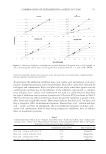
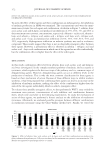
NO-LYE NOT BETTER THAN LYE RELAXERS 405 Finally, the authors(1) make conclusions that are not substantiated by the data presented. If anything, the results suggest the contrary, that no-lye are more damaging to hair than lye relaxers. However, even without the methodological issues discussed in this letter, with only 5 subjects it is diffi cult to reliably answer research questions. Mamabolo and co-authors are to be commended for a relevant contribution that is the fi rst to assess both biochemical and cosmetic effects of relaxers. Collaborations between academic centers would improve study quality, infl uence policy to reduce cosmetic adverse effects, and help protect the public. REFERENCES (1) T. Mamabolo, N. M. Agyei, and B. Summers, Cosmetic and amino acid analysis of the effects of lye and no-lye relaxer treatment on adult black female South African hair, J. Cosmet. Sci., 64, 287–296 (2013). (2) D. Nair, N. Shetty, and V. Shetty, Chemical hair relaxers have adverse effects a myth or reality, Int. J. Trichology, 5, 26–28 (2013). (3) O. A. Olasode, Chemical hair relaxation and adverse outcomes among Negroid women in South West Nigeria. JPAD, 19, 203–207 (2009). (4) B. A. Etemesi, Impact of hair relaxers in women in Nakuru, Kenya. Int. J. Dermatol., 46, 23–25 (2007). (5) Y. Lee, Y. Kim, L. Pi, S. Y. Lee, H. Hong, and W. Lee, Comparison of hair shaft damage after chemical treatment in Asian, White European, and African hair, Int. J. Dermatol., 53, 1103–1110 (2014). (6) N. Khumalo, R. Dawber, and D. Ferguson, Apparent fragility of African hair is unrelated to the cysteine- rich protein distribution: A cytochemical electron microscopic study, Exp. Dermatol., 14, 311–314 (2005). (7) H. Bryant, C. Porter, and G. Yang, Curly hair: Measured differences and contributions to breakage, Int. J. Dermatol., 51, 8–11 (2012). (8) N. P. Khumalo, J. Stone, F. Gumedze, E. McGrath, M. R. Ngwanya, and D. de Berker, ‘Relaxers’ dam- age hair: Evidence from amino acid analysis. J. Am. Acad. Dermatol., 62, 402–408 (2010). (9) N. Khumalo and F. Gumedze, African hair length in a school population: A clue to disease pathogene- sis? J. Cosmet. Dermatol., 6, 144–151 (2007). (10) N. Khumalo, K. Pillay, and R. Ngwanya, Acute ‘relaxer’-associated scarring alopecia: A report of fi ve cases, Br. J. Dermatol., 156, 1394–1396 (2007). (11) A. G. Nicholson, C. C. Harland, R. H. Bull, P. S. Mortimer, and M. G. Cook, Chemically induced cosmetic alopecia, Br. J. Dermatol., 128, 537–541 (1993). (12) N. P. Khumalo, S. Jessop, F. Gumedze, and R. Ehrlich, Determinants of marginal traction alopecia in African girls and women, J. Am. Acad. Dermatol., 59, 432–438 (2008).
Purchased for the exclusive use of nofirst nolast (unknown)
From: SCC Media Library & Resource Center (library.scconline.org)