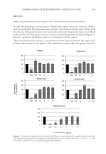
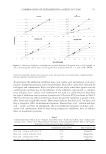
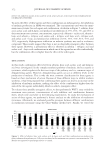
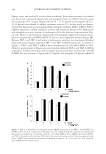
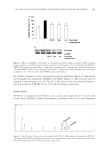
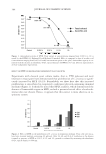
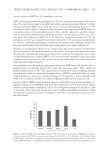
COMBINATION OF DEPIGMENTING AGENTS IN VITRO 373 inhibition of melanin production of these agents and combinations in human melano- cytes to detect possible synergistic or increased effects. In the WST-1 assay, we saw that arbutin, kojic acid, azelaic acid, and α-lipoic acid were not cytotoxic up to 1000, 100, 100, and 10 μg/ml, respectively. As observed, all these agents are less cytotoxic than hydroquinone, as it has been previously described (1,2,30). Moreover, we observed that arbutin (1000 μg/ml), kojic acid (100 μg/ml), and α-lipoic acid (10 μg ml) showed a very signifi cant increase in cell viability (p 0,001), and azelaic acid was also but with less signifi cance (p 0.05). A cytoprotective and antioxidant activ- ity of arbutin has been reported by Seyfi zadeh et al. and Takebayashi et al. (25,26), al- though they used liver cells and fi broblasts, respectively, instead of melanocytes. Antioxidant effect of kojic acid, azelaic acid, and α-lipoic acid has also been reported (10,12,19,20). So, it might explain this proliferative effect (25). This effect is also seen in some of the combinations between agents. Regarding the combinations tested, hydroqui- none was not included because as mentioned in the introduction, it is very cytotoxic and has been forbidden in cosmetics. Mushroom tyrosinase inhibition kinetics was studied to fi nd out the mechanism of inhi- bition of these agents over mushroom tyrosinase. Our results confi rm what is proposed by other authors: arbutin and azelaic acid are competitive and kojic acid is a mixed-type inhibitor (1,8,9). Besides, in this project, we have studied the type of inhibition of α-lipoic acid, which as far as we know has not been described before. According to our results, α-lipoic acid seems to be a competitive inhibitor of diphenolase activity of mush- room tyrosinase. Mushroom tyrosinase assay was performed to study synergistic effects of agent combina- tions on tyrosinase activity. Dose/effect curves for each compound and combination were performed to obtain the CI, which indicates synergism (1), additive effect (=1), or antago- nism (1). As expected, an additive effect was observed between α-lipoic acid and azelaic acid as they have the same type of inhibition (competitive) on mushroom tyrosinase. Kojic acid is a mixed-type inhibitor of mushroom tyrosinase, so synergistic effects with the other agents could be expected. Indeed, kojic acid + α-lipoic acid combination showed to be synergistic (CI = 0.70). However, kojic acid with arbutin or azelaic acid combinations showed to have an antagonistic relationship. This might be due to the fact that although arbutin, azelaic acid, and α-lipoic acid bind to the same site of the enzyme (same type of inhibition), their binding can be directed to different mechanistic forms (different enzyme– substrate complexes) (27). So this could explain why there is a synergy between α-lipoic acid and kojic acid and an antagonistic effect between arbutin or azelaic acid and kojic acid. Melanin content measurement was carried out to study synergistic effects on melanin synthesis. The individual values are in concordance with that of Lajis et al. (13), Tai et al. (28), and Lee et al. (29). Hydroquinone inhibition value was very low because the concentration used was smaller than the other compounds due to its high cytotoxicity. Arbutin + azelaic acid combination had similar values than arbutin alone (27% vs. 25%), indicating that there is neither synergy nor antagonism between them. The same happens with the azelaic acid + α-lipoic acid combination (41% of inhibition in combination and 45% of inhibition by α-lipoic acid alone) and kojic acid + α-lipoic acid combination (47% of inhibition in combination and 46% by α-lipoic acid alone). However, kojic acid + α-lipoic acid combination showed to be synergistic over mushroom tyrosinase. This mismatch between mushroom tyrosinase inhibition and melanin synthesis inhibition

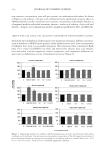
JOURNAL OF COSMETIC SCIENCE 374 results can be due to the fact that there is not always a perfect correspondence between these values because mushroom tyrosinase and human tyrosinase are different in some aspects (7,16). Also, when evaluating melanin synthesis inhibition, we are using cells, which are a more complex system than an in vitro enzymatic assay, and thus other mecha- nisms of action performed by these inhibitors might infl uence in the fi nal melanin con- tent. Arbutin + kojic acid combination exerted an additive effect on melanin inhibition in human melanocytes, as the combination value is higher than both individual values but not enough to produce synergy (33% vs. 27% and 16%). Besides, a slight potentia- tion effect can be seen in the arbutin + α-lipoic acid combination, as there is not inhibi- tion of arbutin at 500 μg/ml, and its combination with α-lipoic acid has a greater effect than the individual inhibition of α-lipoic acid (35% vs. 27%). A similar potentiation effect is observed in the kojic acid + azelaic acid combination, where azelaic acid barely inhibits individually melanin synthesis, but the combination with kojic acid is higher than the individual inhibition by kojic acid (22% vs. 16%). This effect can be explained because arbutin and azelaic acid are probably facilitating α-lipoic acid and kojic acid in- hibition, respectively, and thus increasing the melanin inhibition. Despite the fact that arbutin, kojic acid, azelaic acid, and α-lipoic acid have different inhibition mechanism over tyrosinase and melanin synthesis, it does not seem to be strong enough to produce a synergistic effect on melanin inhibition when combining them. It may be possible that the fact some of them act by themselves at different steps in the melanin pathway makes it diffi cult to cause or to observe a synergistic effect, that is, α-lipoic acid is an inhibitor of tyrosinase and the expression of MITF. To sum up, kinetic analysis on mushroom tyrosinase was done to study the type of inhibi- tion of these agents, and afterward see if differences in this inhibition were able to cause synergistic effects on tyrosinase inhibition and melanin synthesis. Interestingly, kojic acid + α-lipoic acid combination induced a synergistic effect on mushroom tyrosinase, whereas kojic acid + arbutin and kojic acid + azelaic acid combination showed to be antagonistic. When evaluating these combinations on human melanocytes, arbutin + kojic acid had an additive effect on melanin synthesis, and a potentiation effect was observed in the arbutin + α-lipoic acid and kojic acid + azelaic acid combination. However, the most effective com- bination was kojic acid + α-lipoic acid (47% of inhibition on melanin synthesis). Kojic acid + α-lipoic acid might be a good approach as treatment for hyperpigmentation disorders. Further research in this project will include the measurement of human tyrosinase inhibi- tion and the impact on other proteins involved in the melanin pathway by these agents to confi rm that they are acting on different levels of melanogenesis. Besides, it will in- clude the research of other agents that are acting on other steps of melanin synthesis. so it can be combined to produce a synergistic effect and so a greater depigmenting effect. Furthermore, combinations of three or more different inhibitors will be performed. REFERENCES (1) J. P. Ebanks, R. Wickett, and R. Boissy, Mechanisms regulating skin pigmentation: The rise and fall of complexion coloration, Int. J. Mol. Sci., 10, 4066–4087 (2009). (2) J. M. Gillbro and M. J. Olsson, The melanogenesis and mechanisms of skin-lightening agents—existing and new approaches, Int. J. Cosmet. Sci., 33, 210–221 (2011). (3) H. Kim, H. Choi, D. Kim, and K. Park, Topical hypopigmenting agents for pigmentary disorders and their mechanisms of action, Ann. Dermatol., 24, 1–6 (2012).
Purchased for the exclusive use of nofirst nolast (unknown)
From: SCC Media Library & Resource Center (library.scconline.org)