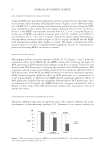
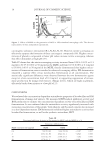
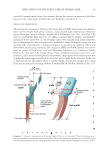
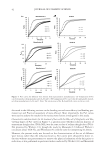
JOURNAL OF COSMETIC SCIENCE 50 Figure 9. Relationship between the wave effi cacy measured by a hairdresser and the set in an extensional permanent treatment. (A) Wave effi cacy map reported by a hairdresser. (B) Relationship between the wave effi cacy and the set Sℓ(ext) at 5 min on the Pa/t curves for each wave lotion (See Table IV) correlation: y = 0.263X + 42.491, r = 0.911. (C) Relationship between Pa and the observed set(l) values listed in Table II for the determination of the Sl values shown in (B) correlation: y = 1.158X – 11.662, r = 0.996. described in Characteristic reduction kinetics for the treatment of hair with the NH4 salt of thioglycolic acid. Figure 10 (p. 22). While Ero (f/Fo) can be measured in the laboratory, it is impossible to determine a cus- tomer’s Fo, i.e., the Young’s modulus of the customer’s virgin hair, in a beauty parlor. Fortunately, it was also found in the present study that the 20% index values in water at 30°C for all individual virgin hair samples remained constant at 61.6 ± 0.8%, as shown in

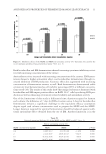
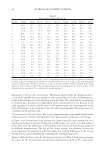
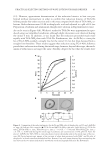
PRACTICAL SELECTING METHOD OF WAVE LOTION FOR HAIR DRESSER 51 Table V. Since it was found that all the virgin hairs show the constant 20% index value in water at 30°C, it is expected that to estimate hair damage (Ero) by measuring only 20% index of the given hairs, if there is a correlation between 20% index and Ero. To determine the effect of perm treatment on the Ero(100%) and 20% index (61.6%) values, Ero(100%) and 20% index (61.6%) for the same virgin hair sample were measured during extensional permanent treatment under three conditions of different virgin hair samples, three types of wave lotions (A–S, A–N, and S–W), and various reduction times. The results are presented in Table VI and Figure 11, which show the plot of the 20% index values against the Ero values. Notably, the 20% index values fell on the line H when the Ero values were above 80%. However, for Ero values less than 80%, the 20% index values for the abruptly in- creased following line L, forming a V shape. As importantly, the graph shown in Figure 11 can be generally applied for anyone whose Fo is unknown. However, it must be noted that this fi gure has a signifi cant weak point, because the H and L lines were obtained with virgin hair that was treated for the fi rst time. Accordingly, these lines cannot be directly applied for hair that has been repeatedly treated, such as is the case for most customers that visit beauty parlors. Therefore, to predict hair damage after repeated permanent treatments, line R was obtained by plotting the 20% index values vs. Ero after repeating the treatment four times (5 min of reduction corresponds to the reduction time of a practical treatment see Practical assessment of wave effi cacy on wave effi cacy) using wave lotions A–S and A–N. Line R shifted to the left of line L by approximately 20%, indicating that severe damage results owing to repetitive treatment. Table VI Experiment for Estimating Hair Damage (Ero) by 20% Index Exp.No Wave lotion Hair Pa(%) Ero (%) 20% Index (%) 0 — Virgin 0 100 61.6 (Av.) 1 A–S Standard 26.5 92.9 59.9 2 A–S School girl-1 31 91.6 59.2 3 A–N School girl-2 40.3 86.7 57.7 4 A–S Standard 61.1 90 57.4 5 A–S Standard 71.2 81.8 56.4 6 C–W School girl-3 84.9 79.2 56.1 7 A–S Standard 77.1 73.1 56.9 8 A–S Standard 80.1 71.5 55.1 9 A–S Standard 87 64.6 58.8 10 A–S Standard 90 50.4 61.2 11 A–S Standard 91.4 49.9 62.9 12 A–S Standard 91.4 39.6 63.6 13 A–S Standard 95.8 30.8 66.6 14 A–S Standard 93.7 28.5 66.3 15 A–S × 4 times Standard 84.5 25.8 63 16 A–N × 4 times Standard 76.6 50.3 57.1 aStandard: donated by beauty parlor “BOY”: school girls (-1, -2, and -3) were picked hairs donated from Tokyo Metropolitan Toyama High school, Tokyo, Japan.
Purchased for the exclusive use of nofirst nolast (unknown)
From: SCC Media Library & Resource Center (library.scconline.org)