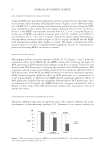
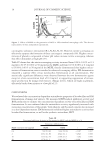
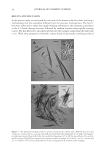
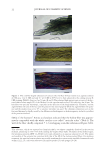
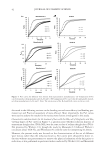
JOURNAL OF COSMETIC SCIENCE 52 Figure 10. Relationship between Pa and hair damage (Ero) (abrupt decrease in Ero). (A) Plot of Pa vs. Ero using the values listed in Table II. The symbols are the same as those in Figure 4. Note: An abrupt decrease in the Ero value is observed at Pa = 80%. (B) Confi rmation of the results shown in (A) using the A–S, A–N, and C–W lotions: ( ), A–S (×), A–N and (▲), C–W. Note: The results shown in (A) are reproducible for the different types of wave lotions from different grade and manufacturers. On the other hand, the shape of the hysteresis curves changed in the order H then L then R, as shown in Figures 12(B), 12(C), and 12(D), respectively. Figure 12(A) shows the hysteresis curve for the virgin hair. The curve for line H marked with an arrow has an obvious shoulder, while that for line L has much less of a shoulder, and that for line R is even smoother. However, although the differences in the curvatures of the curves for L and R appear to be small as observed by the eye, geometric measurement of the curvatures revealed values of 0.76 × 10⁻², 7.1 × 10⁻², 4.3 × 10⁻², and 3.1 × 10⁻² for the curves for the virgin hair, and lines H, L, and R, respectively. Accordingly, the use of the graph shown in Figure 11 for estimation of hair damage is limited. The graph can only be directly applied for virgin hair that is to be treated for the fi rst time. To estimate the damage to hair that has received repeated permanent treat- ments, it is possible to approximately estimate the damage to a customer’s hair. If the 20% index value is 61.6% and a line R hysteresis curve is obtained, hard damage (Ero 50%) can be expected. If the 20% index value is 61.6% and a line H hysteresis curve is obtained, then low damage (Ero 80%) can be expected. On the other hand, if the

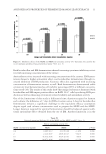
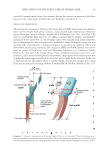
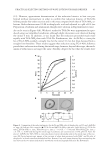
PRACTICAL SELECTING METHOD OF WAVE LOTION FOR HAIR DRESSER 53 20% index value is 61.6% and a line L or R hysteresis curve is obtained, medium to hard damage (Ero 50%) can be expected. Summarizing the above, only the 20% index value can be used to estimate hair damage if virgin hair is to be treated, but it is insuffi cient for estimating the damage to hair that has previously been repeatedly permed. The relationship between the values for Ero and the 20% index for repeated permanent treatments must be further investigated. Mechanism of the abrupt decrease in Ero at Pa = 80%. We speculate that the steep decrease in the value of Ero can be interpreted by the two-phase concept (19) hair fi ber consists of continuous linear and elastic fi laments (phase C) embedded in an amorphous matrix (phase M). To substantiate whether the steep decrease in Ero is related to only phase C or both phases C and M, both values for Ero and the 20% index were obtained for various values of Pa using the same hair fi ber, because the large increase in the 20% index value at Pa = 80% might be related with the abrupt variation in the value of Ero. As can be seen in Figure 13, a steep increase in the 20% value coincided with a rapid decrease in the value of Ero at approximately Pa = 80%. These results indicate that the steep decrease in Ero is related not only to phase C but also to phase M, because a steep increase in the 20% index indicates initiation of entanglement of the fi laments in the microstructure of the hair. This entanglement of the fi laments in phase C and M occurs by disorganization of the microstructure of hair, then the fi laments in both phases are liberated from the originally restrictive structure loosened and entangled. Consequently, the locations of SH residues produced in the crystalline fi laments are no longer located near one another where they can be readily reoxidized using an aqueous Figure 11. Estimation of hair damage (Ero) using the 20% index. Plot of Ero vs. the 20% index values listed in Table VI (the number affi xed to each plot indicates the Exp. No. in Table VI). With increasing hair damage, the 20% index decreased up to Ero = 80% along line H and then increased along line L forming a V shape. Line R: results for four repeated permanent treatments. Note: The 20% index value for virgin hair was constant in water at 30 °C (See Table V).
Purchased for the exclusive use of nofirst nolast (unknown)
From: SCC Media Library & Resource Center (library.scconline.org)