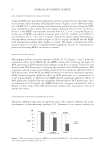
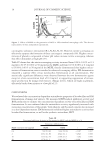
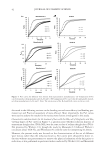
JOURNAL OF COSMETIC SCIENCE 54 Figure 12. Changes in the hysteresis curves with an increase in hair damage. Hysteresis curves obtained for the 20% index values (A),(B),(C), and (D) were determined under the conditions listed in Table VI (Exp. Nos. 0, 3, 9, and 16). (A) Virgin hair, (B) a little damaged hair (on line H), (C) hard damaged hair (on line L), and (D) hard damaged hair by repeated treatments (on line R). Note: The curvatures indicated with arrows de- creased as the hair damage increased. 0.03g/100g H2O2 solution (21). The entanglement of the fi laments therefore prevents the reformation of the original closed paired SH residues between the crystalline fi la- ments and only a few closed SH residues remain that can, upon reoxidation, form S–S bonds between the crystalline fi laments. In initiation of disorganization, it is speculated that cleavage of the crosslinks that join phase C with phase M are reduced at this point, because they seemed to be the most resistant to reduction and correspond to approxi- mately 11.9% of the internal fi laments in phase M, as estimated by Naito and Arai. The overall result would be a steep decline in the value of the Young’s modulus at Pa = 80%. If this proposed mechanism is correct, then avoidance of the disorganization caused by the fi ssion of the crosslinks between phases C and M would be critical. A study of the

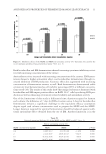
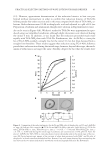
PRACTICAL SELECTING METHOD OF WAVE LOTION FOR HAIR DRESSER 55 characteristics of these crosslinks may therefore lead to the development of new wave lo- tions that result in a reduced level of hair damage. ACKNOWLEDGMENTS The authors thank Drs. K. Murakami, H. Oikawa, K. Arai, and K. Kawamura for assis- tance with this manuscript. We also acknowledge the kind support of our colleagues at formerly named Mitsui Petrochemical Industries Ltd, prior to the merger with Mitsui Chemical Ltd. Moreover, we thank the young female students at Toyama Senior High School for agreeing to donate virgin hair samples, and Dr. S. Roeper for providing the German lady’s virgin hair. We also gratefully acknowledge the cooperation of the beauty parlors, BOY and ADOMI. Finally, the authors thank Enago (www.enago.jp) for the Eng- lish review. REFERENCES (1) K. Arai, “Physical and chemical properties of wool and human hair” in Newest Hair Science, 1st Ed T. Matsuzaki, K. Arai, K. Jookoo, M. Hosokawa, and K. Nakamura. Eds. (Fragrance Journal LTD., Tokyo, 2003), 1st Ed., pp. 59–153. (2) C. R. Robbins, Chemical and Physical Behaviour of Human Hair, 4th Ed. (Springer, New York, 2002), pp.225–288. (3) D. E. Deem and M. M. Rieger, Mechanical hysteresis of chemically modifi ed hair, J. Cosmet Sci., 19, 395–410 (1968). (4) F.-J. Wortmann and I. Souren, Extensional properties of human hair and permanent waving, J. Cosmet Sci.,38, 125–140 (March/April 1987). (5) A. V. Tobolsky, Mechanische Eigenschaften und Struktur von Polymeren (Berliner Union, Stuttgart, 1967). (6) G. A. Etlmann, Die modenen Dauerwellsysteme, Parfumerie und Kometik, 64, 541–544 (1983). (7) J. Y. Dai, K. Li, P. F. Lee, X. Zhao, and S. Redkar, STEM study of interfacial reaction at HfxAl1-xOy/Si, Thin Solid Films, 462–463, 114–117 (2004). (8) E. F. Denby, A note on the interconversion of creep, relaxation and recovery, Reol Acta, 14, 591–593 (1975). Figure 13. Relationship between Pa and both the Ero and the 20% index during extensional permanent treatment using the same hairs (●) Ero (left axis) and ( ) 20% index (right axis). Note: Both the Ero and 20% index values simultaneously changed at approximately 80% of Pa.
Purchased for the exclusive use of nofirst nolast (unknown)
From: SCC Media Library & Resource Center (library.scconline.org)