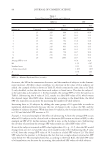
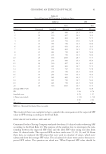
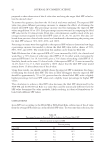
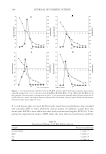
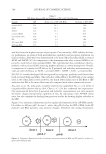
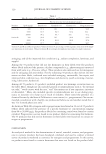
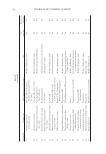
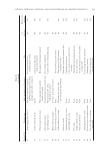
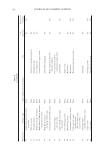
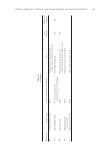
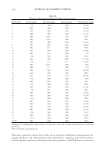
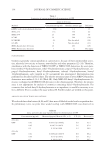
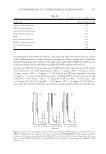
JOURNAL OF COSMETIC SCIENCE 126 Table III Hormone Concentrations Found in Products Surveyed (μg/g)a Product ID Estriol (μg/g) Estradiol (μg/g) Estrone (μg/g) Progesterone (μg/g) 1 747 86.0 99.0 18,200 2 NDb ND ND 14,600 3 ND ND ND 11,030 4 ND ND ND 12,700 5 ND 1120 ND ND 6 ND 1030 ND ND 7 ND ND ND 16,200 8 ND ND ND 14,800 9 ND 863 ND ND 10 ND ND ND 16,400 11 ND 429 ND 257 12 388 ND ND ND 13 ND ND ND 14,500 14 709 110 138 17,800 15 ND 1300 ND 1050 16 ND 172 ND 264 17 ND ND ND 14,200 18 2620 ND ND ND 19 ND ND ND 18,600 20 651 ND ND 5030 21 ND 1280 ND ND 22 905 ND ND ND 23 ND ND ND 17,050 24 796 282 ND ND 25 ND ND ND 19,200 26 ND ND ND 17,800 27 564 ND ND ND 28 ND ND ND 14,400 29 ND ND ND 15,500 30 ND ND ND 23,300 31 ND ND ND 14,500 32 696 ND ND ND 33 ND ND ND 26,800 34 554 ND ND ND 35–70 ND ND ND ND a Average of two independent samples taken of each product, extracted, and then analyzed with two injections per extract. b Below the limit of quantifi cation. This survey provides current data on the use of estrogenic hormones in moisturizers, an- tiaging products, and other product types marketed as cosmetics and will be used to evaluate human exposure to hormones from these products. The FDA does not allow the

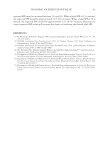
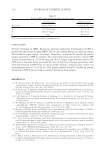
ESTRIOL, ESTRADIOL, ESTRONE, AND PROGESTERONE IN COSMETIC PRODUCTS 127 use of therapeutically signifi cant levels (3%) of estrogen and related substances in cos- metic products. The agency is continuing to evaluate new data on this complicated issue to monitor the safety of these products, but to date, has found no convincing evidence that the ingredients used in such products pose a health risk to consumers. REFERENCES (1) M. A. Farage, S. Neill, and A. B. MacLean, Physiological changes associated with the menstrual cycle, A review, Obstet. Gynecol. Surv., 64, 58–72 (2009). (2) H. A. Zacur, Hormonal changes throughout life in women, Headache, 46 (Suppl), S50–S55 (2006). (3) F. Z. Stanczyk, J. P. Hapgood, S. Winer, and D. R. Mishell, Progestogens used in postmenopausal hor- mone therapy: Differences in their pharmacological properties, intracellular actions, and clinical effects, Endocr. Rev., 34, 171–208 (2013). (4) G. Hall, T. and J. Philips, Estrogen and skin: The effects of estrogen, menopause, and hormone replace- ment therapy on the skin, J. Am. Acad. Dermatol., 53, 555–568 (2005). (5) N. J. Raine-Fenning, M. P. Brincat, and Y. Muscat-Baron, Skin aging and menopause, Am. J. Clin. Dermatol., 4, 371–378 (2003). (6) P. G. Sator, J. B. Schmidt, T. Rabe, and C. C. Zouboulis, Skin aging and sex hormones in women— clinical perspectives for intervention by hormone replacement therapy, Exp. Dermatol., 13 (Suppl 4), 36–40 (2004). (7) S. Verdier-Sevrain, Effect of estrogens on skin aging and the potential of selective estrogen receptor modulators, Climacteric, 10, 289–297 (2007). (8) M. P. Brincat, Y. M. Baron, and R. Galea, Estrogens and the skin, Climacteric, 8, 110–123 (2005). (9) A. V. D. Sauerbronn, A. M. Fonseca, V. R. Bagnoli, P.H. Saldiva, and J. A. Pinotti, The effects of sys- temic hormone replacement therapy on the skin of postmenopausal women, Int. J. Gynecol. Obstet., 68, 35–41 (2000). (10) P. G. Sator, J. B. Schmidt, M. O. Sator, J. C. Huber, and H. Honigsmann, The infl uence of hormone replacement therapy on skin aging: A pilot study, Maturitas, 39, 43–55 (2001). (11) M. G. Shah and H. I. Maibach, Estrogen and the skin: an overview, Am. J. Clin. Dermatol., 2, 143–150 (2001). (12) J. F. Rossouw, G. L. Anderson, and R. L. Prentice, Risks and benefi ts of estrogen plus progestin in healthy post menopausal women: Principal results from the Women’s Health Initiative randomized controlled trial, JAMA, 288, 321–333 (2002). (13) D. Grady, D. Herrington, V. Bittner, Cardiovascular disease outcomes during 6.8 years of hormone therapy: heart and estrogen/progestin replacement study follow-up, JAMA, 288, 49–57 (2002). (14) M. Donovan, C. M. Tiwary, D. Axelrod, A. J. Sasco, L. Jones, R. Hajek, E. Sauber, J. Kuo, and D. L. Davis, Personal care products that contain estrogens or xenoestrogens may increase breast cancer risk, Med. Hypotheses, 68, 756–766 (2007). (15) P. D. Darbre, Environmental estrogens, cosmetics and breast cancer, Best Pract. Res, Clin. Endocrinol. Metab., 20, 121–143 (2006). (16) A. C. Hermann, A. N. Nafziger, J. Victory, R. Kulaway, M. L. Rocci, and J. S. Bertino, Over-the- counter progesterone cream produces signifi cant drug exposure compared to a Food and Drug Admin- istration approved oral progesterone product, J. Clin. Pharmacol., 45, 614–619 (2005). (17) A. C. Olson, J. S. Link, and T. C. Kupiee, Breast cancer patients unknowingly dosing themselves with estrogen using topical moisturizers, Cancer Res., 69 (Suppl 2), 4087–4088 (2009). (18) A. C. Olson, J. S. Link, J. R. Waisman, and T. C. Kupiee, Breast cancer patients unknowingly dosing themselves with estrogen using topical moisturizers, J. Clin. Oncol., 27, e103–e104 (2009). (19) S. Komori, Y. Ito, Y. Nakamura, M. Aoki, T. Takashi, T. Kinuta, H. Tanaka, and K. Koyama, A long- term user of cosmetic cream containing estrogen developed breast cancer and endometrial hyperplasia, Menopause, 15, 1191–1192 (2008). (20) Food and Drug Administration, Topically applied hormone-containing drug products for over-the- counter human use Final Rule, Federal Register, 58, 47608 (1993). (21) Food and Drug Administration, Summary of Regulatory Requirements for Labeling of Cosmetics Marketed in the United States: Cosmetics That Are Also Drugs (from the Cosmetic Labeling Manual, October 1991), http://www.cfsan.fda.gov/~dms/cos-lab1.html.
Purchased for the exclusive use of nofirst nolast (unknown)
From: SCC Media Library & Resource Center (library.scconline.org)