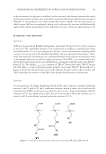
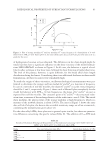
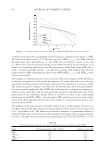
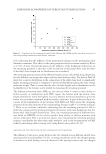
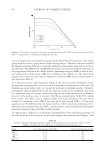
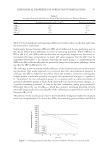
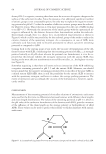
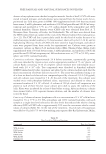
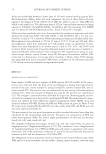
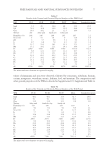
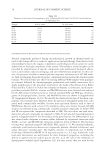
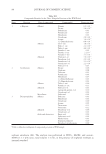
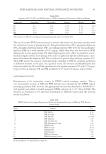
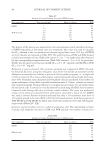
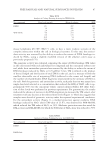
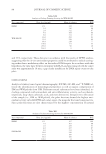
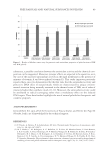
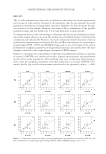
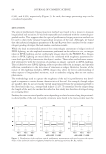
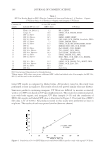
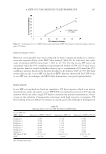
JOURNAL OF COSMETIC SCIENCE 68 about pH 6.5 is negative, meaning that there must be an excess of negative charges at the surface of the surfactant micelles. Since the presence of an additional signifi cant number of anionic groups is not a reasonable option, the only way to explain the negative stream- ing potential at pH of 7 is that the number of effective cationic groups must be reduced, for whatever reason. This reduction is even more pronounced in the case of AEB, leading to an IEP 3.5. Obviously, the interaction of the amide group with the quaternized ni- trogen is infl uenced by the distance between these functionalities within the molecule. Interestingly enough, there is a chance for a six-membered ring formation as shown in Figure 8, which could be one possibility for the carbonyl group of the amide to reduce the cationic character of the quaternary nitrogen. As a consequence, in case of AEB, more carboxylic acid functions need to become protonated to obtain a positive streaming potential as compared to APB. Coming back to the starting point of our study, the viscosity of formulations of the dif- ferent betaines with SLES, considering that the streaming potential of AB12/14 is strongly positive basically at all pH values relevant for personal care formulations, it is to be ex- pected that this betaine exhibits the strongest interaction with the anionic SLES, thus leading to the most effi cient transformation to rod-like micelles, i.e., the highest viscosity (see Figure 6). Somewhat surprising is that there still seems to be an interaction of the AEB exhibiting a negative streaming potential at pH 5.5 and the anionic SLES. However, one should keep in mind that the negative streaming potential refers to micelles of the pure AEB in a mixed system SLES/AEB, there is still the possibility for the anionic SLES to interact with the quaternary nitrogen, and hence to reduce the average packing parameter. The extent of interaction and accordingly the viscosity of the formulation is, however, signifi - cantly smaller. CONCLUSION Measurements of the streaming potential of micellar solutions of zwitterionic surfactants were used for the fi rst time to differentiate between betaines with different chain lengths and chain length distributions. The values of the streaming potential at pH 5.5, which is the pH value of the surfactant formulations of the betaines with SLES, provide a measure of the infl uence of the chain length on the average polarity or hydrophilicity of alkyl APBs. These values can be used to predict their ability to thicken mixtures with anionic surfactants. Figure 8. A six-membered ring formed between the quaternary nitrogen and the amide carbonyl in alkyl AEB.

RHEOLOGICAL PROPERTIES OF SURFACTANT FORMULATIONS 69 Also, the infl uence of the headgroup structure of the betaines on the streaming potential can provide valuable insight into the intra or intermolecular interaction of the betaines, which in turn determines their ability to interact with anionic surfactants in formula- tions. Although AEB shows only a negative streaming potential due to the strong inter- action of the amide group with the quaternary nitrogen, there is still some—but limited—interaction with SLES, thus leading to the lowest viscosity of all betaines stud- ied. Increasing the distance between the quaternary nitrogen and the amide group re- duces their interaction, and hence yields both a more positive streaming potential and a higher viscosity in the mixture with SLES. In the AB without an amide group, the cat- ionic charge of the quaternary nitrogen is unaffected, and hence, the streaming potential is positive at all relevant pH values. Therefore, the interaction with SLES is most effi - cient, resulting in the highest viscosity of all systems studied. ACKNOWLEDGMENTS The authors are thankful to Dominik Schuch and Uwe Begoihn for their help in the syn- thesis of different betaines and for fruitful discussions and also acknowledge the help of Karin Fürch, Luca Supovec, and Meike Buchholz for performing the physicochemical measurements. REFERENCES (1) U. Kortemeier, J. Venzmer, A. Howe, B. Grüning, and S. Herrwerth, Thickening agents for surfactant systems, SOFW J., 136 (3), 30–38 (2010). (2) T. E. Mezger, The Rheology Handbook, 4th Ed. (Vincentz Network, Hannover, Germany, 2014), pp. 135–210. (3) E. Lomax, “Amphoteric Surfactants,” in Surfactant Science Series. (Marcel Dekker, New York, 1996), Vol. 59, pp. 273–311. (4) S. Herrwerth, H. Leidreiter, H. H. Wenk, M. Farwick, I. Ulrich-Brehm, and B. Grüning, Highly con- centrated cocamidopropyl betaine—The latest developments for improved sustainability and enhanced skin care, Tenside Surfact. Det., 45, 304–308 (2008). (5) N. C. Christov, N. D. Denkov, P. A. Kralchevsky, K. P. Ananthapadmanabhan, and A. Lips, Synergistic sphere-to-rod micelles transition in mixed solutions of sodium dodecyl sulfate and cocamidopropyl be- taine, Langmuir, 20, 565–571 (2004). (6) Z. Mitrinova, S. Tcholakova, Z. Popova, N. Denkov, B. R. Dasgupta, and K. P. Ananthapadmanabhan, Effi cient control of the rheological and surface properties of surfactant solutions containing C8-C18 fatty acids as cosurfactants, Langmuir, 29, 8255–8265 (2013). (7) D. A. Kuryashov, O. E. Phillippova, V. S. Molchanov, N. Y. Bashkirtseva, and I. N. Diyarov, Tempera- ture effects on the viscoelastic properties of solutions of cylindrical mixed micelles of zwitterionic and anionic surfactants, Colloid J., 72, 230–235 (2010). (8) L. A. Hough, D. Bendejacq, and T. J. Fütterer, Characterization of multilamellar vesicles for cleansing applications, Cosmet. Toiletries, 123 (11), 59–66 (2008). (9) H. Hoffmann, A. Rauscher, M. Gradzielski, and S. F. Schulz, Infl uence of ionic surfactants on the visco- elastic properties of zwitterionic surfactant solutions, Langmuir, 8, 2140–2146 (1992). (10) T. Iwasaki, M. Ogawa, K. Esumi, and K. Meguro, Interactions between betaine-type zwitterionic and anionic surfactants in mixed micelles, Langmuir, 7, 30–35 (1991). (11) J. N. Israelachvili, D. J. Mitchell, and B. W. Ninham, Theory of self-assembly of hydrocarbon amphi- philes into micelles and bilayers, J. Chem. Soc. Faraday Trans. II, 72, 1525–1568 (1976). (12) M. E. Cates, Reptation of living polymers: Dynamics of entangled polymers in the presence of reversible chain-scission reactions, Macromolecules, 20, 2289–2296 (1987). (13) C. A. Baker, D. Saul, G. J. T. Tiddy, B. A. Wheeler, and E. Willis, Phase structure, nuclear magnetic resonance and rheological properties of viscoelastic sodium dodecyl sulphate and trimethylammonium bromide mixtures, J. Chem. Soc. Faraday Trans. I, 70, 154–162 (1974).
Purchased for the exclusive use of nofirst nolast (unknown)
From: SCC Media Library & Resource Center (library.scconline.org)