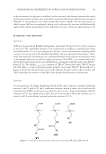
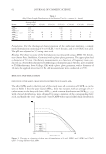
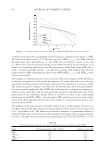
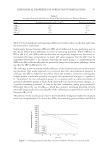
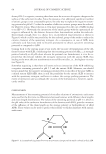
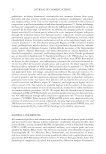
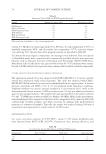
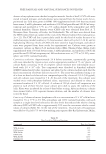
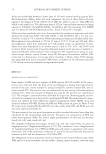
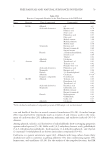
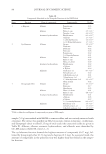
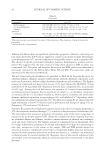
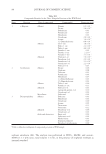
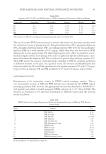
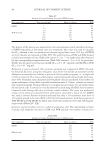
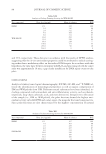
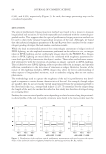
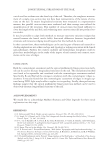
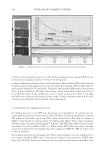
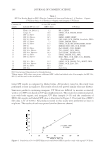
JOURNAL OF COSMETIC SCIENCE 66 sites was longer than 10 methylene groups (20,26). However, the interaction of an amide group with the cationic group has not been investigated yet. Therefore, we have modifi ed the headgroups of the betaines to study the infl uence of the amide group and its position. In addition to the APBs based on DMAPA discussed so far, betaines with an ethyl instead of a propyl spacer between the amide and the quaternary nitrogen (AEB) as well as beta- ines without the amide group (AB) were synthesized (see Figure 1). The alkyl chain lengths were chosen to allow direct comparisons with the APBs used in the fi rst part of this study (see Table I). As it becomes obvious when looking at Figure 6, the structure of the hydrophilic head- group has an enormous effect on the viscosity of formulations with anionic surfactant. All formulations again behave like it is typical for networks of rod-like micelles. However, reducing the spacer length between the two nitrogen atoms by one methylene unit leads to a signifi cant drop in viscosity, whereas leaving out the amide group leads to dramatic increase in the plateau value of viscosity. Oscillatory measurements (Table IV) confi rm these results. The AB12/14 has a slightly higher structural relaxation time and initial modulus as compared to the APB of the same alkyl chain length APB12/14. Even more signifi cant are the differences for the betaine with an ethyl instead of a propyl spacer be- tween the two nitrogen atoms the AEBcoco has the lowest initial modulus and the highest structural relaxation time of all the betaines studied. To explain these differences in rheology, measurements of the streaming potential of micellar solutions of the betaines were performed again the results shown in Figure 7 and Table IV Results of Oscillatory Rheological Measurements of Formulations Containing 9 wt% SLES, 3 wt% of APB/2 wt% NaCl (pH 5.5) for Betaines with Different Headgroup Structures Name Structural relaxation time (Hz) Initial shear modulus G′ (Pa) APBcoco 0.50 160 AEBcoco 1.15 110 APB12/14 0.35 220 AB12/14 0.46 245 Figure 6. Viscosity as a function of shear rate of formulations of 9 wt% SLES/3 wt% betaine/2 wt% NaCl (pH 5.5) using betaines with different headgroup structures.

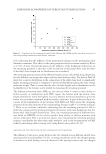
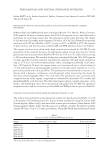
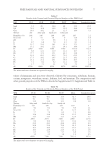
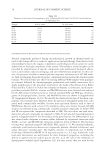
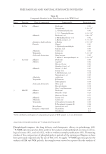
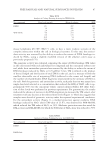
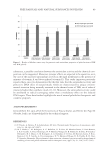
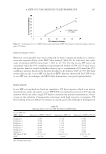
RHEOLOGICAL PROPERTIES OF SURFACTANT FORMULATIONS 67 Table V Streaming Potential and Isoelectric Point of Micellar Solutions of Different Betaines Name Streaming potential at pH 5.5 (mV) Isoelectric point (pH) APBcoco 232 6.25 AEBcoco -887 3.5 APB12/14 400 6.78 AB12/14 510 9 Figure 7. Streaming potential of micellar solutions of different betaines as a function of pH. Table V reveal signifi cant and surprising differences between these on the fi rst sight sim- ilar zwitterionic surfactants. Surprisingly, the two betaines APB and AEB, which differ only by one methylene unit in the spacer, behave quite differently in terms of streaming potential. While APB has its IEP at pH 6.25, the AEB yields micelles that are negatively charged over the entire in- vestigated pH range extrapolation to lower pH values suggests that the IEP must be somewhere below pH 3.5. In contrast, removing the amide group, i.e., transforming the APB to an AB, yields micelles that are positively charged over the entire pH range, mean- ing that the IEP of AB must be 9. The challenge is now to understand this infl uence of the chemical structure on the stream- ing potential. One useful approach is to envision how this electrochemical property is achieved. The IEP is defi ned as the pH at which the numbers of positive and negative charges within a molecular assembly are equal each quaternized nitrogen is “equalized” or “neutralized” by one carboxylate group. In a situation with an identical number of quat and carboxylate groups to begin with, there will be an excess of cationic charges, i.e., a positive streaming potential, as soon as the fi rst carboxylate group gets protonated. Obviously, this is the case for AB12/14, which has a positive streaming potential over the entire pH range studied, because the pKa of the carboxylate is reported to be as low as 1.8 [for pure AB12 (19)]. The presence of the amide group close to the hydrophilic headgroup makes the situation much less straightforward. In case of the APBs, the streaming potential above the IEP at
Purchased for the exclusive use of nofirst nolast (unknown)
From: SCC Media Library & Resource Center (library.scconline.org)