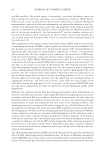
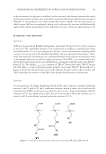
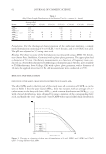
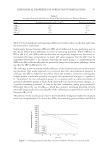
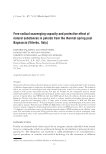
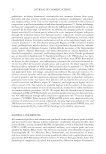
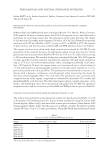
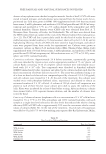
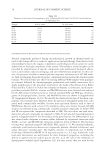
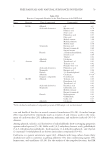
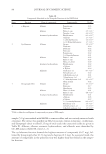
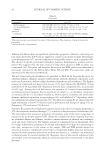
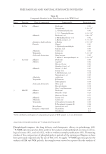
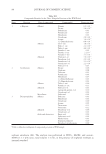
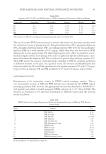
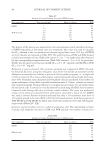
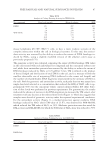
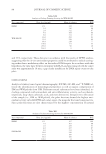
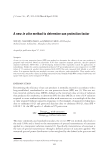
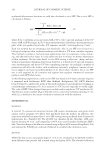
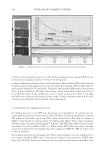
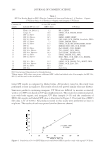
JOURNAL OF COSMETIC SCIENCE 78 DETERMINATION OF BIOACTIVE COMPOUNDS IN DM AND WM PELOIDS Natural compounds produced during microbiological growth in thermal muds are used in the benign effects in cosmetic applications and pelotherapy. Structural activity relationships between the organic composition and biological effects cannot be easily defi ned due to the high complexity of the system. Nevertheless, useful insights can be provided by identifi cation of specifi c compounds with well-known biological effects, such as antioxidant, radical scavenging, and anti-infl ammatory properties. In this con- text, the presence of sulfur in natural peloids originates interferences in GC-MS analy- sis, fully overlapping the peaks of organic compounds and increasing the chromatogram baseline. We avoided this side effect by treating DM and WM samples with appropri- ate solvents followed by chromatographic purifi cation and soxhlet extractions, by a slight modifi cation of the procedure reported for the muds of San Diego de los Baños (Pinar del Rio, Cuba) (14). Sulfur-free nonpolar (n-heptane, cyclohexane, and diisopro- pyl ether) and polar (EtOAc, acetone, and MeOH) fractions were obtained and analyzed by GC-MS using 6-methoxy purine as internal standard (DM and WM gas chromato- grams of diisopropyl ether, acetone, and MeOH fractions are shown in Supplemental #4, Supplemental Figures 14–19). To identify the chemical structure of the main com- ponents, two strategies were followed. First, the spectra of identifi able peaks were com- pared with commercially available electron mass spectrum libraries such as that of NIST-Fison. Spectra with at least 97% similarity index were chosen. Second, GC-MS analysis was repeated using commercially available standard compounds. In Tables VIII and IX are reported the compounds identifi ed in DM. The m/z values and peak abun- dances for selected compounds are reported in Table X and selected mass-fragmentation spectra in Supplemental #5. For the analysis of the polar fraction, the DM sample (5.0 g) was treated with n-heptane to remove sulfur, followed by sequential extraction with EtOAc, acetone, and MeOH (the extraction yields are given in Table I). The fractions (10 mg) were analyzed using GC-MS (Table VIII, entries 1–3). We identifi ed alkanols, carboxylic acids (and ester derivatives), terpenoids, phenols, alkaloid (colchicine), and sulfur derivative (octathiocane). The highest amount of compounds was in EtOAc (8.98 mg), followed by MeOH (0.59 mg) and acetone (c.a. 0.2 mg). Carboxylic acids (and ester derivatives) are well known for their biological properties, including the ability to quench reactive radical species (23,24), as in the case of the inhibition of lipoxygenase-catalyzed lipid degradation (25). For this reason, they are used for the Table VII Diameter of the Grains Corresponding to 60% of Passing (D 60%) and 10% (D 10%) and Coeffi cient of Uniformity (U) Sample D 60% (mm) D 10% (mm) U FS I 0.011 0.002 7 FS II 0.125 0.002 83 FS III 0.04 0.002 27 FS IV 0.08 0.002 53 FC II 0.18 0.002 120 FC III 0.18 0.002 120 FC IV 0.018 0.002 12

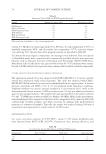
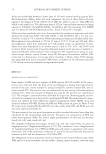
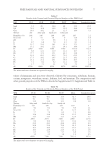
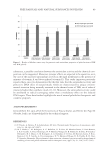
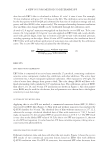
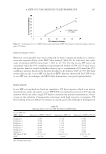
FREE RADICALS AND NATURAL SUBSTANCES IN PELOIDS 79 Table VIII Bioactive Compounds Identifi ed in the Polar Fractions of the DM Peloid Entry Fraction Class of compounds Compound(s) Yielda 1 EtOAc Alkanols n.d. n.d. Acids and derivatives Myristic acid 0.78 Palmitic acid 0.90 Stearic acid 0.62 Palmitoleic acid 0.57 Oleic acid 0.60 Methyl stearate 1.68 Methyl palmitate 2.23 Methyl oleate 0.38 Terpenoids Retinoic acid 0.46 Retinol (vitamin A) 0.40 Retinol acetate 0.14 Phenols 2-Hydroxybenzaldhyde 0.02 Salicylic acid 0.04 Thymol 0.02 Alkaloids Colchicine 0.02 2 Acetone Alkanols Tetradecan-1-ol 0.01 Tridecan-1-ol 0.02 Hexadec-9-en-1-ol 0.06 Acids and derivatives Palmitoleic acid 0.37 Terpenoids Retinoic acid 0.06 Phenols 2,4-Dimethylphenol 0.02 Alkaloids Colchicine 6 × 10⁻³ Inorganic compounds Octathiocane 0.01 3 MeOH Alkanols Tridecan-1-ol 0.05 Pentadecan-1-ol 0.25 Tetradecan-1-ol 0.03 Acids and derivatives Ricinoleic acid 0.02 Terpenoids Gibberellic acid 0.05 Methyl retinoate 0.04 Retinol (vitamin A) 0.21 Phenols Hydroquinone 0.01 Gallaldehyde 0.20 Gallic acid 0.27 Alkaloids Colchicine 0.01 a Yield is defi ned as milligram of compounds per gram of DM sample. n.d. not determined care and health of the skin in several cosmetic formulations (26–28). A similar benign effect was observed for terpenoids (such as vitamin A and retinoic acid) in the treat- ment of cardiovascular (29), infl ammatory, melanoma, and oxidative-induced (30–34) diseases. Among phenols, salicylic acid derivatives of salicylaldehyde show scavenging properties against radical species (35–38). Gallic acid (3,4,5-trihydroxy benzoic acid), gallaldehyde (3,4,5-trihydroxybenzaldehyde), hydroquinone (1,4-dihydroxyphenol), and thymol (2-isopropyl-5-methylphenol) are known antioxidant compounds (39–41). Colchicine is a potent antimitotic agent (42). Alkanols with long carbon chains (fatty alcohols) are used in cosmetics as gelling additives (43), skin conditioning agents (44), humectants, and emollients (45,46). For the analysis of the nonpolar fractions, the DM
Purchased for the exclusive use of nofirst nolast (unknown)
From: SCC Media Library & Resource Center (library.scconline.org)