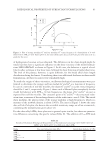
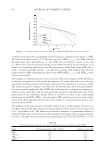
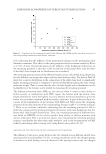
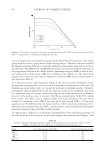
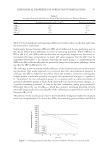
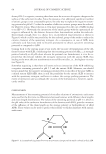
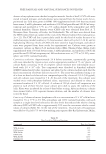
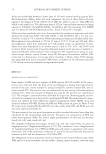
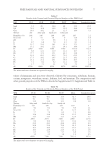
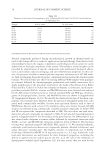
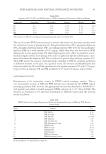
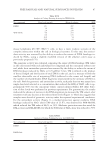
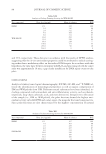
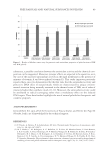
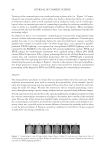
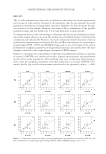
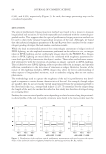
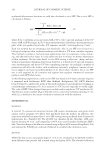
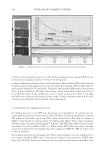
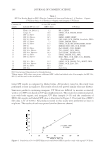
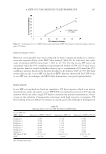
JOURNAL OF COSMETIC SCIENCE 98 0.963, and 0.956, respectively (Figure 3). As such, the image processing step can be considered repeatable. DISCUSSION The optical profi lometry fringe projection method was found to be a means to measure longitudinal nail striations. It was both repeatable and correlated with the cosmetologist- graded results. This suggests that the optical profi lometry fringe projection method can be used to objectively measure longitudinal striations of the nail. Although, we found that the industrial roughness parameters of Ra and Rq were best correlated to the cosme- tologist grading of ridges, Rz had similar correlation results. While the fi nal recommended protocol for cosmetologist assessment of ridges involved PPOL lighting, we also explored assessments performed on the subject in vivo, on images taken in XPOL lighting, and on visible-light images taken by the PRIMOS Pico. Images taken in PPOL lighting are most likely to be correlated with roughness parameters be- cause both specifi cally characterize the object’s surface. These other methods were reason- able alternatives with the exception of grading on images captured in XPOL lighting. This is likely because XPOL lighting reduces specular refl ection in images, and specular refl ection contributes to the detection of striations or ridges. However, because of the nature of this lighting modality, XPOL images may allow for better understanding of other aspects of longitudinal striations, such as underface ridging that are not surface phenomena. The methodology used to capture the roughness of the nail via profi lometry was devel- oped in response to certain known characteristics of the nail. For example, though ridges are parallel, they do not necessarily extend uninterrupted from the proximal nail fold to the distal nail edge (e.g., sausage-link ridges) (2,4,5). To normalize for the ridges along the length of the nail, the method described in this study was therefore developed using an averaging fi lter. Further, the cross-sectional profi le varies depending on their location along the proximal- to-distal profi le of the nail. Generally, striations were found to be more evident near the Figure 3. Distribution of the triplicate optical profi lometry measurement trials used to assess the repeat- ability of the industrial surface roughness parameters for measuring striations Ra, Rq, and Rz.

LONGITUDINAL STRIATIONS OF THE NAIL 99 cuticle and less evident near the distal tip of the nail. Therefore, the roughness measure- ment of a single cross-section may not have been representative of the nature of stria- tions on the nail. To ensure longitudinal striations were measured in a representative manner, fi ve parallel cross-sections were evaluated and their average was utilized for quantifi cation of the striations. This number of cross-sections was found suffi cient to cover the length of the nail bed, and evaluating more cross-sections did not produce bet- ter results. It may be possible to adapt both methods to measure transverse striations (ridges that extend between the lateral cuticle folds). Structural differences between longitudinal striations and transverse ridging would require that the methods be revised. In their current form, these methodologies can be used as part of future nail research in- cluding explorations into ethnic and age nail typology or ridging association with clinical nail pathologies. Further, the cosmetic industry and dermatologic disciplines could ex- ploit these methodologies in the study of the impact of nail enamels and cosmetic treat- ments on the state of ridges. CONCLUSION Both the cosmetologist assessment and the optical profi lometry fringe projection meth- ods can be used to measure longitudinal striations on the nail. The instrumental method was found to be repeatable and correlated with the cosmetologist assessment method. Specifi cally, Ra and Rq had the strongest correlation with the cosmetologists’ ridges as- sessment. It was also found that the cosmetologists’ assessment of ridges in images cap- tured using PPOL light may be able to replace in vivo grading. Finally, these preliminary fi ndings suggest that the optical profi lometry fringe projection method can be used to objectively measure longitudinal striations of the nail. ACKNOWLEDGMENTS We would like to acknowledge Madhuri Shamana and Chloe Legendre for their initial exploration into this topic. REFERENCES (1) J. Jefferson and P. Rich, Update on nail cosmetics, Dermatol. Ther., 25, 481–490 (2012). (2) G. Singh, N. S. Haneef, and A. Uday, Nail changes and disorders among the elderly, Indian J. Dermatol. Venereol. Leprol., 71, 386–392 (2005). (3) P. C. van de Kerkhov, M. C. Pasch, R. K. Scher, M. Kerscher, U. Gieler, E. Haneke, and P. Fleckman, Brittle nail syndrome: A pathogenesis-based approach with a proposed grading system, J. Am. Acad. Dermatol., 53(4), 644–651 (2005). (4) R. Baran, The nail in the elderly. Clin. Dermatol., 29, 54–60 (2011). (5) G. E. Pierard, and C. Pierard-Franchimont, “Nail Surface Topography and Onychochoronobiology,” in Non Invasive Diagnostic Techniques in Clinical Dermatology, E. Berardesca, H. Maibach, and K. P. Wilhelm. Eds. Springer, Berlin, Germany (2014), pp. 443–450. (6) C. Pierard-Franchimont and G. Pierard, “Image Analysis of the Nail Surface,” in Handbook of Non-Invasive Methods and the Skin. J. Serup, G. B. E. Jemec and G. L. Grove. Eds. Taylor and Francis, Boca Raton, FL (2005), pp. 925–927.
Purchased for the exclusive use of nofirst nolast (unknown)
From: SCC Media Library & Resource Center (library.scconline.org)