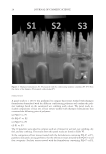
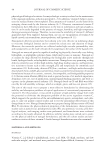
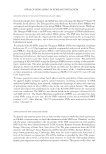
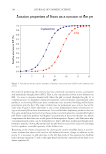
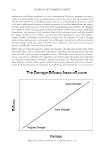
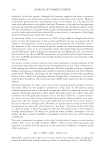
JOURNAL OF COSMETIC SCIENCE 106 a rather slow and tedious approach, and moreover, yields an overall change in total cystine content (it will be recalled that specifi cally we are interested in cystine contained within the alpha-helical keratin protein that makes up the microfi brils within the hair cortex). An interesting proposition for a potentially more useful method involves monitoring the tensile properties of hair while immersed in the perm solution. The crystalline protein that comprises the microfi brils is responsible for the wet-state tensile strength of hair, and so breakage of cystine bonds in this structure would be expected to produce a progressive decrease in mechanical properties. In short, the change in tensile properties is used as a proxy for the reaction progression. The inception of this idea dates back to the 1950s and the work of Reese and Eyring (14). A similar approach was used by Kubu (15,16) in the textile industry, although the method was subsequently popularized in perm research by the work of Wickett (17–22) during the 1980s and 1990s, who also coined the phrase single-fi ber tensile kinetics (SFTK). There are a number of assumptions that must be made in directly equating changes in tensile properties to the reaction progression, and in actuality, many of these appear dis- tinctly dubious. However, the results shown herein will demonstrate that the method nevertheless yields predicted outcomes in validation studies while producing remarkably reproducible results. However, before discussing these assumptions, there is the need for a brief overview of the relationship between hair structure and the tensile properties. The acquisition of mechanical data necessitates some form of sample perturbation. This is generally performed by one of two different approaches—either one precisely applies a given deformation (i.e., strain) to the test specimen and measures the generated force (i.e., a strain-controlled experiment) or conversely, one applies a force/stress and measures the con- comitant deformation (i.e., a stress-controlled experiment). Figure 4 shows a stress–strain curve that was generated by stretching dry hair at a constant extension rate using a strain- controlled instrument. When viewing these curves, it is convenient to consider the mechanical properties of hair in terms of deforming a spring (i.e., the alpha-helical keratin structure). A spring can be stretched within a given range whereupon removal of the applied deformation allows for complete recovery of the initial structure. This is termed elastic or Hookean behavior and is represented by a linear relationship between the stress and the strain. From Figure 4, it is seen that hair fi bers approximate this behavior up to around 2% extension. The slope of this portion of the curve represents an indication of the spring strength and is termed Young’s modulus. The application of deformations above this point causes the spring-like structure to unfurl, and in doing so, internal forces are dissipated via molecular motion. This threshold condition is termed the yield point, and extension beyond this limit dis- torts the spring to a point where it no longer returns to its original conformation on re- moval of the stimulus. The stress–strain curve remains relatively fl at during extension through the yield region, but ultimately, at still greater extensions, the protein chains themselves become strained and internal forces again build until breakage even- tually occurs. The objective of SFTK experiments is to monitor the tensile properties of hair as a function of time while the test specimen undergoes reaction with a perm solution. Accordingly, it is imperative that experiments be carried out under deformation condi- tions that reside within the linear-like region. That is, under these conditions, the decrease in tensile properties is representative of cleaving strength-supporting disulfi de bonds and

PERMANENT WAVING AND PERM CHEMISTRY 107 not simply the result of molecular relaxation (plastic fl ow) within the fi ber structure. The yield point for healthy hair is typically found to occur at around 2% extension, which sub- sequently led Wickett to initially perform his experiments using a 2% static strain. The measurement of a progressively lower stress within the hair as a function of exposure time to a perm solution has led some to describe these as stress relaxation experiments. How- ever, this can be a source of confusion because this terminology is generally used in the mechanical testing world to describe an approach for separating the elastic and viscous components of viscoelastic materials. In principle at least, the measurement of a force at a consistent extension, which is itself within the “Hookean region,” equates to the evalu- ation of Young’s modulus. Therefore, strictly speaking, the SFTK approach evaluates a progressive decrease in this parameter as a function of time while the hair structure is attacked by a reducing solution. This introduces a major assumption of the method and indeed possibly one of the main contentions, namely, it is recognized that hair is not a truly elastic material but is instead viscoelastic in nature (23). Therefore, application of a strain below the “yield point” will still result in some decrease in stress over time due to relaxation associated with the viscous portion of the hair structure. In an attempt to circumvent this issue, Wickett used a “pre- conditioning step” where the hair was fi rst cycled through a strain regimen in water with the intention of inducing (and consequently eliminating) this viscous relaxation before Figure 4. Typical stress–strain curve for hair.
Purchased for the exclusive use of nofirst nolast (unknown)
From: SCC Media Library & Resource Center (library.scconline.org)