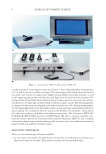
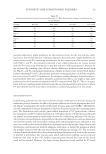
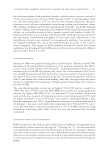
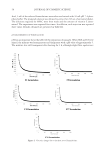
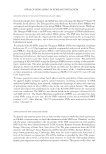
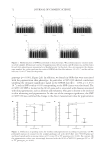
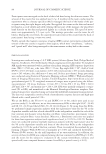
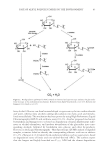
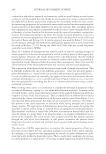
JOURNAL OF COSMETIC SCIENCE 110 hook located in the base of the cell. The upper hook is then attached to the Instron load cell by means of pneumatic jaws. The cell is fi lled to a mark with deionized water, and the fi ber is allowed to sit for 5 min. Using a fi ne adjust dial, the Instron cross-head is raised to take up the slack in the hair fi ber until a very slight static force is recorded by the load cell. At this point, the load cell and the gauge length of the device are tarred. Unless otherwise stated, experiments were performed by cycling a 2% intermittent strain at 30-s intervals. Initially, this strain profi le is imposed on fi bers suspended in deionized water and, as described earlier, is intended to remove/minimize viscous relaxation. An exponen- tial decrease in stress occurs during this cycling in water, with a stable baseline typically being obtained within around 10 min. At this point, the water is rapidly drained from the cell via the tap shown on the front of the cell. The test chamber is quickly refi lled to the same level with the test solution, and the experiment is ready to begin. The strain profi le is restarted, and tensile properties of the hair are recorded as a function of time. Figure 6 gives an example of a typical experimental output which shows the progressive decrease in tensile properties over time on exposure to a perm solution. In actuality, the previous graph shows a normalized decrease in force in which the scale has been adjusted such that the initial force becomes unity and the decrease in tensile properties can then be equated to a percentage. Therefore, if we accept all the assumptions described earlier, this y axis is taken to represent the progression of the perm reaction. Figure 6. Typical output from an SFTK experiment.

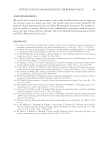
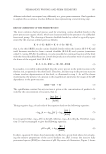
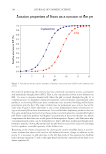
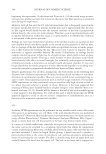
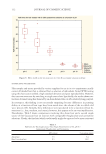
PERMANENT WAVING AND PERM CHEMISTRY 111 A quick indication of the reaction rate can be obtained by borrowing a concept from the fi eld of heterogeneous reaction kinetics (25), that is, we evaluate a halftime (t0.5) which equates to the period during which the initial stress is reduced by 50%. Figure 6 illus- trates a halftime of around 3 min for this specifi c sample under these particular condi- tions. Figure 7 shows a Box and Whisker plot for halftimes associated with the reaction of single-source hair fi bers with 0.42 M, pH 9.2 solutions of both ATG and cysteamine. Results indicate the presence of signifi cantly faster reaction rates (i.e., shorter halftimes) for reduction with thioglycolate. This outcome is consistent with the aforementioned theory (and indeed real-life observations), whereby thioglycolate is recognized to be a stronger reducing agent. Continuing with the theories outlined earlier, manipulating the pH of a perm solu- tion changes the concentration of the active thiolate ion species [RS-] and would therefore also be expected to infl uence the rate of transformation. Figure 8 shows SFTK results for single-source hair in contact with 0.42 M cysteamine solutions of varying pH and indicates the presence of faster rates with increasing solution pH. These fi ndings are again in line with expectations and consequently help build con- fi dence in the method. Similar experiments involving changes in the thiol concentra- tion also gave rise to predicted responses. As such, despite various concerns outlined earlier pertaining to questionable underlying assumptions, the SFTK method does indeed hold up to validation studies, in that predicted outcomes are obtained from systematic variations in perm solution properties. Figure 7. Halftimes for hair exposed to 0.42 M, pH 9.2 ATG and cysteamine.
Purchased for the exclusive use of nofirst nolast (unknown)
From: SCC Media Library & Resource Center (library.scconline.org)