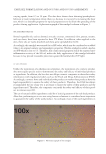
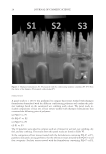
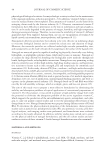
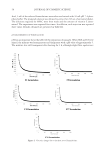
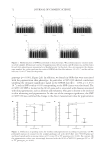
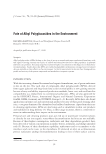
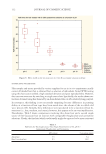
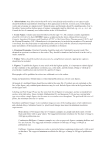
JOURNAL OF COSMETIC SCIENCE 116 and yi elds the following equation: In 1 kt α (16) In i den tify ing the applicability of various mechanisms, we borrow from the reduced time method of Sharp et al. (29). In this particular instance, we again use the aforementioned Figure 11. Absence of reaction front in hair treated with 0.42M, pH 9.2 cysteamine.

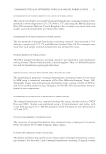
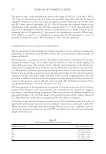
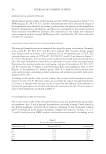
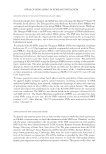
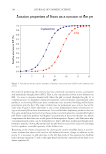
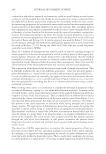
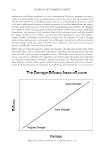
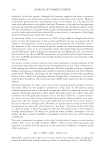
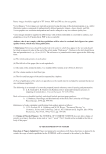
PERMANENT WAVING AND PERM CHEMISTRY 117 halftime (t0.5) as a normalizing condition, that is, at α = 0.5, the previous equation re- duces to the followin g equation: 0.5 0.693 . kt (17) Normaliza tion then involves dividing the integral equation by this specifi c condition: 0.5 In 1 , 0.693 kt kt α (18) which r edu ces to the following form: 0.5 In 1 0.693 . t t α (19) In short, t ime units cancel out (i.e., t/t0.5) and we are left with a means of creating a time- independent, theoretical master plot of α versus t/t0.5 for this fi rst-order expression. Fig- ure 12 shows master plots for both the fi rst-order mechanism and Wickett’s moving boundary model. Therefore, the applicability of a given model can be identifi ed by treat- ing experimental data in this same manner and comparing the shape of the resulting plots with those for theoretical models. To illustrate th is process, Figure 13 shows experimental data from eight separate SFTK experiments involving the interaction of single-source Asian hair with a 0.42 M, Figure 12. Reduced time plots for the theoretical fi rst-order and moving boundary models.
Purchased for the exclusive use of nofirst nolast (unknown)
From: SCC Media Library & Resource Center (library.scconline.org)