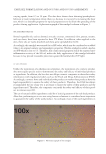
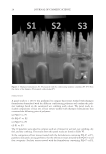
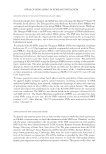
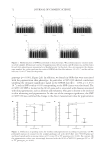
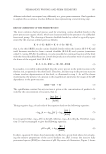
JOURNAL OF COSMETIC SCIENCE 114 A DDITIONAL ANALYSIS OF SFTK DATA F urther analysis of SFTK data can be performed to examine the mechanism (i.e., the mathematical expression or model) that describes the progression of the process. When performing this modeling, it is again recalled that progress is dependent on two dis- tinctly different steps: the fi rst involves the rate of the chemical reaction between the re- actants, but the second comprises the readiness by which the perm active can diffuse throughout the hair and allow the reactants to come together. The slower of these two processes will become a bottleneck to the overall transformation, which can only proceed at a rate commensurate with this limiting condition. If the reaction rate is fast, but dif- fusion is slow (i.e., diffusion-limited conditions), an advancing reaction “front” would be anticipated within hair fi bers, whereupon unreacted cystine bonds lie ahead of the inter- face, although reduced bonds would be present behind. Conversely, fast diffusion and slow reaction (i.e., reaction-limited conditions) allow the active to readily penetrate throughout the hair before appreciable reaction occurs. In this case, there would be no well-defi ned interface. Visualization of these behaviors can be attained through micro- scopic means in combination with staining techniques, that is, freshly permed hair is treated with reagents that specifi cally adhere to free thiol sites (27,28) and indicate where the disulfi de bonds have been broken. Figures 10 and 11 show examples of these two oc- currences as identifi ed by fl uorescence microscopy (24). In these specifi c experiments, treatment with a 0.42 M, pH 9.2 ATG solution resulted in an advancing front (i.e., dif- fusion-controlled behavior), whereas treatment with a cysteamine solution under the same conditions did not (i.e., reaction-controlled behavior). T hese two conditions become central in deriving mathematical expressions for describing the progression of the perm reaction. Reese and Eyring (14) proposed a pseudo–fi rst-order mechanism to describe the reaction-controlled condition see equation (11), and Wickett (17) later derived a diffusion-based expression that describes a moving boundary advanc- ing through a cylinder see equation (12). 0 exp o F t F kC t (11) ¬ t3 ® 2 0 2KC 0 exp 3T F t F (12) It is again noted that chapters on reaction kinetics in chemistry textbooks tend to deal with homogeneous gaseous and liquid systems, but there is a less well-known literature dealing with the rates of heterogeneous reactions (25) (i.e., solid–solid, solid–gas, and solid–liquid interactions). In this section, we borrow well-established ideas from this fi eld and adapt them to studying the perm process. The rate of a heterogeneous process is given by the following equation: ( ) ( ), = . dα k T f dt α (1 3) wher e α is the fraction of transformation (in our case, the percentage of bonds broken at any time, t), k (T) is the temperature-dependent specifi c reaction rate constant, and f (α) is the mathematical expression that describes the overall progression. The sim- plest reaction mechanism is a conventional fi rst order equation, where the rate is

PERMANENT WAVING AND PERM CHEMISTRY 115 proportional to the amount of the process still remaining, that is, (1-α). As such, our basic kinetic equation becomes as follows: 1 dα k dt α (14) It is des irable to eliminate the differential term hence, the previous expression is integrated: ¨ ¨ 1 0 0 1 t t t dα k dt α α α (15) Figure 10. Identifi cation of reaction front in hair treated with 0.42M, pH 9.2 ATG.
Purchased for the exclusive use of nofirst nolast (unknown)
From: SCC Media Library & Resource Center (library.scconline.org)