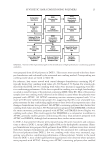
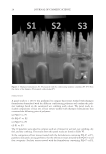
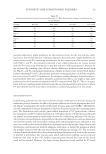
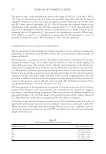
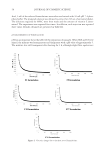
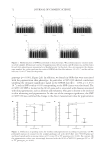
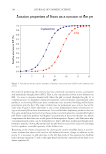
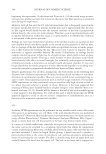
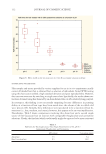
JOURNAL OF COSMETIC SCIENCE 120 Figure 16. Reduced time plots for single-source Asian hair reacting with 0.42 M, pH 9.3 cysteamine and ATG solutions. derive expressions that better describe the progression of the perm reaction with time. Until then, curve-fi tting software (TableCurve® by Systat Software, Inc., San Jose, CA) has been used to record shapes of experimental reduced time plots in Figure 16. Confi dence in these experimentally observed relationships (and indeed the SFTK approach itself) is strengthened by both the reproducibility of the data and the fre- quency with which they are found. To further illustrate this point, Figure 17 shows the result of performing reduced time analyses on the previously mentioned experi- mental data for 0.42 M cysteamine solutions as a function of pH (see Figure 8). In Figure 17, the solid and dashed lines represent the two experimental behaviors described earlier. Accordingly, it is seen how experiments involving cysteamine solu- tions with pH 6–9 all appear to abide by the same mechanism identifi ed earlier however, a change is evident when the pH is raised to 10. Moreover, this new behav- ior corresponds exactly to that identifi ed previously for the 0.42 M, pH 9 ATG solu- tion. Therefore, the reduced time method provides a simple and useful means for identifying these different mechanisms, and without this approach, the previously mentioned conclusions would not be evident.

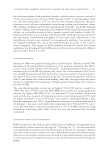
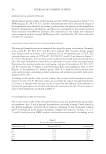
PERMANENT WAVING AND PERM CHEMISTRY 121 DISCUSSION The previously mentioned fi ndings clearly lead to more questions than answers. Wickett frequently referred to “reaction-controlled” and “diffusion-controlled” conditions—with this designation primarily relating to the linear response of plots involving experimental data to the two mathematical mechanisms. Staining experiments apparently provide a clearer designation based on the presence (or absence) of reaction “fronts” within fi bers as a function of different treatment conditions. Yet, our reduced time analysis of data from an experimental situation that did not yield such a front (and therefore indicates “reac- tion-controlled” conditions) did not abide by the fi rst-order mechanism. Similarly, data from circumstances that yielded a reaction front (and therefore suggest “diffusion-con- trolled” conditions) did not abide by Wickett’s moving boundary model. It is theorized that rather than being specifi c mechanisms, the descriptors “diffusion controlled” and “reaction controlled” represent a fi rst line of classifi cation for a variety of mathematical models that fall under each category. Again, there is clearly the need for additional math- ematical modeling work to derive new mechanisms that adequately describe the experi- mental data. It should be noted that other curve shapes have been obtained during performing this reduced time analysis on experimental SFTK data. The behaviors outlined earlier Figure 17. Reduced time plots for single-source Asian hair reacting with 0.42 M cysteamine as a function of pH.
Purchased for the exclusive use of nofirst nolast (unknown)
From: SCC Media Library & Resource Center (library.scconline.org)