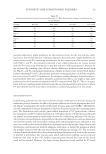
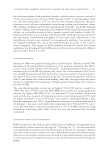
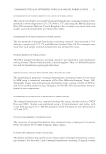
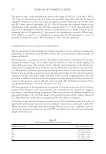
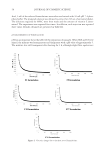
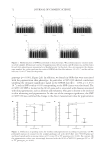
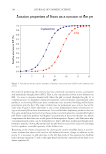
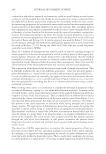
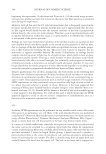
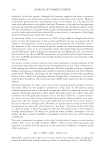
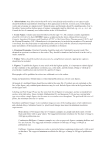
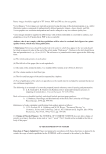
JOURNAL OF COSMETIC SCIENCE 122 (experimental and theoretical) all have their highest rate of transformation (at or near to) to the beginning of the process. In solid-state kinetics, these are termed decelera- tion mechanisms because the rate decreases over most of the process. However, it is not uncommon to fi nd experimental reduced time curves with a distinctly sigmoidal behavior (see Figure 18). This implies that there is some induction period during which the rate of transformation progressively builds, but then another factor would appear to gradually dominate and the rate subsequently decreases. It is again noted that the analysis approach described herein is commonly used in the fi eld of heterogeneous kinetics, where a variety of mathematical models have already been de- rived based on underlying conditions such as diffusion, order, and/or geometric con- straints (25,29). Some examples of reduced time curves derived from diffusion- and geometry-based equations are shown in Figures 19 and 20. As an aside, this author has also used the same kinetic approach in modeling the rate of water adsorption by hair as a function of changing humidity conditions, wherein the applicability of these same fi rst- order and diffusion-based models has been identifi ed (30). ADDITIONAL VARIABLES IN SFTK EXPERIMENTS This section began by highlighting a number of concerns and seemingly questionable assumptions pertaining to the SFTK approach. Despite these issues, it is observed that Figure 18. Example of experimentally derived sigmoidal reduced time plot.

PERMANENT WAVING AND PERM CHEMISTRY 123 Figure 19. Reduced time plots for theoretical mechanisms derived from diffusion based assumptions. Figure 20. Reduced time plots for theoretical mechanisms derived from geometric based assumptions. the method holds up to validation studies by producing expected results for systematic changes in conditions. However, with this said, there are several method-related variables that can infl uence the absolute value of the rate.
Purchased for the exclusive use of nofirst nolast (unknown)
From: SCC Media Library & Resource Center (library.scconline.org)