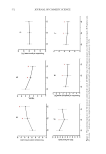
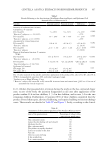
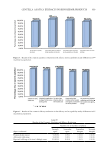
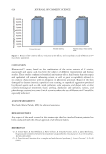
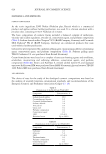
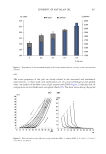
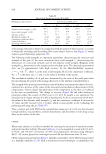
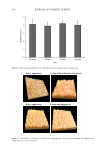
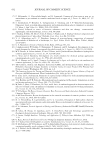
601 FATIGUE STRENGTH OF PANELIST HAIR Tensile testing measures the mechanical behavior of extended hair by obtaining a stress/ strain curve (where stress is defined as average force/unit area). This measure of fiber damage is well established and accepted in the cosmetic industry (3). Fatigue testing is a more recent addition to single-fiber testing that instead measures hair exposed to a repetitive force until failure occurs. Failure occurs due to the creation of flaws that propagate, ultimately fail, and lead to breakage. Evans has proposed that this method is relevant to a consumer where repeated stimuli received simulates repeated grooming (4). Data can be generated in two ways. The first is at constant load (i.e., stress will vary according to fiber diameter) to generate an S–N plot where stress is plotted against the log of number of cycles to failure. The second is at constant stress (i.e., load is altered according to fiber diameter) to generate a survival distribution where survival probability is plotted against cycles to failure. The survival data are fitted to a cumulative Weibull distribution (see Equation 1) where f(x) is the probability of the fiber breaking in x cycles, α is the characteristic life at which 63.2% of fibers have broken, and β is the shape factor (i.e., the shape of the curve). The failure rate is constant when β = 1 and shows early life failures when β 1. f ( x) -e x/α)β = ( 1 - (1) As shown by Evans and Park (4), chemical damage from bleaching decreases fatigue cycles to break, likely due to flaws created during the coloring/bleaching process and/or the resistance of these flaws to propagate under fatigue conditions. This chemical damage can be due to changes in the protein matrix (e.g., disulfide bond breakage) or from changes in the cell membrane lipid structure (5). In previous studies, hair fatigue breakage has been compared between samples created in a controlled lab environment however, limited fatigue studies have measured panelist hair samples and no studies have compared root versus tip breakage. The objective of this work was to study fatigue breakage of panelist hair samples and to compare fatigue masurements with other relevant measures of hair damage. EXPERIMENTAL HAIR SOURCE To allow for root and tip measurements, hair samples of ∼500 fibers were cut a few mm from the scalp’s of 41 Caucasian panelists (age 18–35) with hair 30 cm long. The samples were wrapped in aluminum foil and refrigerated for lipid analysis. The hair was equilibrated for 48 h at room temperature and 50% relative humidity before measurement. Hair samples were also taken from nine Asian panelists (age 18–40) with hair 30 cm. Both sets of panelists were asked about their habits and practices (wash frequency, color and bleach use, etc.). FOURIER TRANSFORM INFRARED SPECTROSCOPY MEASUREMENTS A Perkin Elmer Fourier transform infrared (FTIR) system equipped with a single-bounce diamond attenuated total internal reflection (ATR) accessory was used to measure the

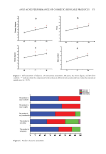
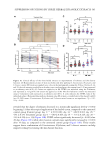
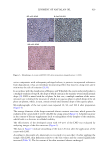
602 JOURNAL OF COSMETIC SCIENCE cysteic acid level on the first few microns of the hair surface. Approximately 30–50 fibers per panelist were bundled and measured at different locations from root to tip. Each measurement was conducted with eight scans from 600–4,000 cm-1 and 4 cm-1 resolutions. Due to the specificity of cysteic acid peaks, ATR-FTIR has been used as an industrial method for assessing the level of chemical damage present on hair surface. In the conventional method (6), the second derivative of the cysteic acid peak at 1,040 cm-1 (normalized to the 1,450 cm-1 protein CH 2 stretch peak) was taken as the relative chemical damage on clean hair. Silicone is commonly used in most hair care products and can easily be deposited on human hair. The cysteic acid and silicone peaks appear at the same region (1,000–1,250 cm-1) and may interfere with one another. Chemometric approaches are used to measure cysteic acid level in the presence of silicone. The classical least square method was the first used to estimate silicone in hair, based on pure component spectrums that can be measured separately (i.e., silicone, hair keratin, and cysteic acid). Then the silicone value, together with hair spectrums (700–1,800 cm-1) at different damage levels with corresponding mass spectrometry data (the range was normalized from 0 to 1), were used as a calibration data set to build a partial least square (PLS) model using PLS Toolbox 8.61 (Eigenvector Research Inc., Wenatche, WA, USA). The spectrum preprocessing and analysis was done in MATLAB 2018b environment. The root means square error cross validation of the PLS model for both cysteic acid and silicone are 0.0068 and 0.00134 with R2 values of 0.99 and 0.97, respectively. FATIGUE MEASUREMENTS Fibers were cut for fatigue strength measurements from the root and tip end of the panelist samples (7–10 cm long) and crimped at 30 mm using a Dia-Stron Auto-Assembly System (AAS 1600) (Andover, Hampshire, UK). The average cross-sectional area along each fiber was analyzed using a Dia-Stron Fiber Dimensional Analysis System (FDAS 770), which incorporates a Mitutoyo laser micrometer (LSM-6200) (Malborough, MA, USA). The average cross-sectional area was calculated from three diameter measurement points along each 30 mm crimped fiber. The average cross-sectional values for each of the fibers were then used to set the Dia-Stron Cyclic Tester (CYC801) in controlled stress mode. Stress was 140 MPa with a speed 40 mm/s. Data were analyzed by Weibull statistical tools (JMP Pro 12.1.0, SAS Cary, NC). Fit with the Weibull distribution was confirmed for each data set. Fibers with break cycles less than 10 were omitted from the analysis due to premature breakage and were mostly between 2–4 fibers. Fifty fibers per sample were measured and all measurements were made at a relative humidity of 50% and temperature of 23°C. CUTICLE MEASUREMENTS For the Caucasian panelists, 25 fibers from either the hair mids or tips (less than 5 cm from the fiber distal end) were mounted for scanning electron microscopy (SEM) analysis. Each fiber was graded at 750× magnification according to the scale on a Hitachi S-3000N (Krefeld, Germany). Low damage: cuticle aligned and spaced regularly but some irregularity or slight lifting of the cuticle is observed (up to ∼15% lifting). Mid damage: cuticle is irregularly spaced due to missing cuticle edges, but all cuticle is present tightly packed cuticle with lifted cuticle
Purchased for the exclusive use of nofirst nolast (unknown)
From: SCC Media Library & Resource Center (library.scconline.org)