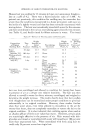
ANALYSIS OF PSYCHOLOGICAL PROPERTIES OF COSMETICS 89 promote shorter total shaving time, closer shaves of greater permanence, less discomfort during and after shaving, less trouble for the shaver and more stable quality than a poor shaving cream. From such a schematic series, the experimenter can readily list his pa- rameters, designing in advance his test matrix. Also, he knows in advance how many subjects, observers, shaving and measuring instruments will be required. Since the standardization of procedure and statistical treatment of results is effected before beginning work, the postexperimental regrets are reduced. In addition to the laboratory work, the field testing is out- lined in advance. If it is necessary to learn how long a given package of shaving cream lasts when used at home, whether or not it is confused with other toilet goods, the different uses to which it is put, and the like the supplementary field explorations are outlined at the time of starting the more rapid and thorough laboratory work. FRo• MaNy We have found it essential to approach each problem from many different angles. For example, it is highly desirable to standardize and control all physical variables with the greatest precision. As a possible experimental procedure, one may elect to have each shaver prepare his face on one side with Cream L and on the other side with Cream J, and report which is su- perior in regard to the several criteria. Alternately, a trained barber would split the faces of the panel of subjects along an imaginary, vertical line, prepare each, and shave them. Possibly a third group would use Cream L on one day and J on another. The psychologist makes certain that the little clues of identification, along with distractions or other influences, are minimized. Then, and only then, can we confidently restrict ourselves to the reactions of small groups of consumers, analyze the results, and extra- polate to the total population. SELECT PANELS OF TRAINED OBSERVERS While the consumer work is in progress or before it starts, our practice is to subject the products under observation to the controlled scrutiny of panels of trained observers. From these groups come the valuable analytic data which completes the picture. Often the responses of the trained observers are directly predictive of the results to be found when larger groups of untrained or naive observers are called in. When one lipstick was compared with another on the basis of physical data only, the two products were essentially equivalent in per- manence or indelibility, smear resistance, and hue. Trained observers employed in a flavor analysis which was conducted under reduced illum- ination found that one was sweeter and more floral, while the other was dominantly fruity. The two could be differentiated visually in the stick

90 JOURNAL OF THE SOCIETY OF COSMETIC CHEMISTS and differences were apparent in tactual or feeling properties according to the panel. This finding was substantiated by the consumers as preference for one over the other. One appeared to be very light and orange in stick form, but when applied produced the same dark cherry color as the com- petitive stick. The latter had no such objectionable inconsistency between stick and applied color. FIELD TESTING To supplement a laboratory consumer study, a number of samples (ac- companied by instructions and questionnaire) may be sent to the homes of another group of respondents. Usually the field tests are much slower than the laboratory tests and must necessarily be more simple in design and ex- ecution. Since the conditions of use cannot be controlled, one can never be sure what physical insult the samples will receive, nor can the influences of time lapse, distraction, and discussion be measured. Consequently, larger numbers of respondents must be employed so that assumptions about randomness of influence are more justified. Most crucial, however, in any psychometric study, be it laboratory or field type, is the motivation of the participant. - The reward of a free sample is frequently insufficient to inspire a complete and reliable response. In the laboratory the interest of the observer can be better maintained and measured than it can be at home. Many different means of motivation are utilized in our laboratory, including subtle competitive devices. In one test the background information is slightly exaggerated, in another a judgment is forced, in another a choice situation is arranged, and on occa- sion, actual purchasing of the same priced items is utilized. The danger is that a motivating circumstance may be inexpertly designed so that it operates counter to experimental intention. INSTRUMENTATION It is frequently necessary to devise special instrumentation for the meas- urement of psychological properties. The use of a colgesthedonoscope, a proportional odor mixture, and a tachistoscope have proved invaluable in obtaining objective and reproducible reactions. All three are adaptations of standard apparatus commonplace in university laboratories of experimen- tal psychology. The principle of the colgesthedonoscope can be applied to cosmetic prob- lems when one wishes to change the color of label background or foreground independently. The same principle applies to facial components when one wishes to vary, say, lip color, hair color, or facial tones one at a time. The tachistoscope is designed to simplify and quantify study of package attention value, label legibility, apparent size, and recognition potential of packages and other display materials. Packages are presented singly or in
Purchased for the exclusive use of nofirst nolast (unknown)
From: SCC Media Library & Resource Center (library.scconline.org)