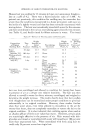
PROPERTIES OF ZIRCONIUM SIGNIFICANT TO TECHNOLOGIST 73 Acute Topical Toxicity, Abraded and Unabraded Skin Three normal, healthy female rabbits, weighing from 2.5 to 3 kg. were used. They were maintained on a regular pellet diet. The hair on the backs and sides of each animal was removed by means of a clipper. The animals were placed into individual stocks and removed only for feeding and watering (15). Each animal's back was demarcated into two areas, of which one was scarified with a sharp knife. The test solution was applied to the animal's back with an atomizer, each animal receiving 100 squirts, measuring 1.6 cc. After the application, a gauze pad 2 in. square was used to cover both the scarified and unscarified areas. The pads were removed after 24 hours and the underlying areas examined. The animals were kept under observation for 72 hours following the application. Results: Throughout the 72-hour observation period no changes could be observed in the scarified or unscarified areas. There was no edema in the patch test areas nor any retardation of healing (16). Chronic Topical Toxicity Five normal, healthy female albino rabbits weighing approximately 3 kg. were used. The animals were maintained on a regular pellet diet. The hair on the backs and sides of each animal was removed with a clipper. The area clipped was approximately 18 X 24 sq. cm., and was more than 10 per cent of the total surface of the rabbits. They were placed in indi- vidual stocks every afternoon and maintained in this position until the following morning (15). Each animal received daily 10 squirts of the test solution, measuring 0.16 cc., from an atomizer. The applications were made each afternoon for thirty days, and the animals remained in their stocks until the following morning, at which time they were returned to their cages for food a•nd water. After the last application, the animals were sacrificed and potrio.ns of the skin removed. The tissues were fixed in Bouin's solution, and after sectioning were stained with Harris's hema- toxylin and eosin. A macroscopic examination of the internal organs was also made. Results: The animals ate well throughout the experiment and showed normal gain in weight. No discomfort was shown alter the applications, as evidenced by scratching or crying out. The skin remained normal and showed no increase of blood supply or edema. Microscopic examination of the internal organs, including the lungs, liver, kidney, and small and large intestines showed no abnormalities. Microscopic examina- tion of the treated skin showed a normal histology. There was no increase in leukocytes (which would indicate increased irritation). The blood supply below the epidermis was normal, and the skin did not appear to be edematous (17).

74 JOURNAL OF THE SOCIETY OF COSMETIC CHEMISTS Sensitization Eight normal, healthy, white male guinea pigs weighing 300 to 400 gm. each were used. They were maintained on a diet of rabbit pellets, supple- mented by spinach and kale. As much hair as possible was removed from the sides and back of each guinea pig with an electric clipper. An aqueous solution was made up containing 0.1 per cent of the test lotion, and injec- tions of this solution were made subcutaneously with a 0.25-cc. syringe and a 26-gauge needle •/• inch long. Each animal received ten injections, one every other day. The first was 0.05 cc. and the subsequent injections 0.1 cc., and all were applied within a test area of about three to four square centimeters however, the first injection was given slightly below the sen- sitization area. Two weeks after the last injection, an additional injection of 0.05 cc. of a freshly prepared 0.1 per cent aqueous solution was made. Reaction readings were made 24 hours after the initial 0.05-cc. injection and after the final 0.05-cc. injection. Results: Twenty-four hours after the first 0.05-cc. injection, small raised areas were observed. They showed a slightly increased redness when compared to the surrounding area. These swellings were approximately 4 to 5 mm. in diameter and up to 1 ram. in height. Fourteen days after the last sensitizing injections were given, the additional 0.05 cc. of solution caused no greater reaction than did the original injection. It was concluded that guinea pigs subjected to sensitizing treatments such as described do not become sensitized (18). These studies lead to the same conclusion as those previously reported, i.e., that zirconium compounds are harmless when applied topically. OTHER PRoposE•) UsEs Cosmetic applications of zirconium which have not been examined up to this time are readily envisioned. New zirconium pigments, embracing almost all shades, have been described in the literattire in recent years (19, 20), and they have an obvious potential use as cosmetic colorants. Zir- conium compounds might prove useful in lipsticks and other cosmetic colorants to eliminate the irritating effects of certain dyes. CONCLUSION It may be concluded from the data and from the theoretical chemistry reported above that certain zirconlure compounds have properties which are of value for cosmetic and pharmaceutical applications, and that they have no toxic or other physiologically undesirable effects. Applications specifically indicated are as antipruritics and body deodorants. •lcknowledgment: The author wishes to acknowledge his indebtedness to Lawrence W. Carter of Ogilvie Sisters Laboratories for important con- tributions to the data presented in this paper on the formulation and toxicity studies of zirconlure deodorants.
Purchased for the exclusive use of nofirst nolast (unknown)
From: SCC Media Library & Resource Center (library.scconline.org)