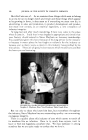
118 JOURNAL OF THE SOCIETY OF COSMETIC CHEMISTS Ironically enough, this information appears in an article devoted to chloro- phyll and its derivatives. This is peculiar because certain of the claims made for chlorophyll are contradictory to certain claims made for hexa- chlorophene. The theory that perspiration odor can be reduced by inges- tion of an internal deodorant is mutually exclusive with the theory that perspiration odor is caused by bacterial decomposition. The information in the Killian paper on germicidal soap is rather meager, it being only incidental to a much more complete study of chlorophyll. For that reason, the KillJan publication can hardly be considered a serious work on the study of the deodorant effectiveness of a bactericidal soap. The only factual data on germicidal deodorants appearing in the work of KillJan consists of information about an experiment in which it was demonstrated that when plain soap was used, it took 12 out of 15 subjects from 8 to 11 consecutive days of bathing to acquire "satisfactory protection against the development of perspiration odors," and that this same pro- tection was attained within a period of four days by all 15 subjects using a germicidal soap. Without going into a complete analysis of this small-scale experiment, it is interesting to note that it indicates that the germicidal soap has no prac- tical value as a deodorant. According to this study, daily washing with ordinary soap is as effective in protecting against the development of per- spiration odors as daily washing with germicidal soap, except that the point of greatest effectiveness is reached after fewer days with the germicidal than with the ordinary soap. Therefore, a soap containing hexachloro- phene, we are forced to conclude, would have deodorant value (over and above ordinary soap) only for people who have not been bathing in the past but who are going to start bathing from this point on and then such a soap containing the germicide would give better deodorant protection than the ordinary soap only for the first 8 to 11 days. A more devastating refu- tation of the pro-hexachlorophene argument is difficult to imagine. Why is the work on the testing of deodorants of such low caliber ? The reasons are twofold. First, some companies seem to have taken a short- sighted viewpoint. They feel that the claims, even if untrue and un- founded, will not do anyone a•y harm and may even do some good in promoting more hygienic habits. These companies do not understand that the public cynicism that must inevitably arise as a result of false claims and exaggerated advertising will cost them far more in dollars and cents than can be gained by ephemeral successes. A second source for the poor work is found in the inherent difficulty of verifying results. It is virtually impossible to repeat an experiment in the manner utilized in other scientific disciplines. As a result of confusion over method and disagreement over results, prod- ucts are now being marketed about which even the most enthusiastic

TESTING THE EFFICIENCY OF DEODORANTS 119 supporters of deodorant claims are expressing their skepticism. It is in line with the foregoing that Milton Lesser, who believes that "it is evident that the claims for the deodorizing action of some chlorophyll-containing products are based on sound evidence"--a statement which I cannot en- dorse-can go on to admit that "the same cannot be said for all products," there being other claims which "if not dangerous, are often exaggerated to the point of being ridiculous" (4). In order to work out acceptable procedures for testing the efficiency of a deodorant, the scientific men in this industry must first find the answers to three questions. The answers to these questions will, in fact, determine whether there is any need even to go through the motions of working out acceptable test procedures. These questions are: First, are the cosmetic research men going to be placed in a position where they will tell their advertising colleagues what their findings actually are, or are the advertising men going to continue to tell the research men what the findings shall be? Secondly, are the claims for the efficiency of deodorants to be made with the responsibility governing other cosmetic claims, or are they to be con- sidered in the same light as the advertisements for Tabu or Voodoo per- fume, not meant by anyone to be interpreted literally? Thirdly, will the cosmetic industry recognize as the highest biological, chemical, and medical authority the body of scientific literature, or will it pay homage to a greater, a supreme authority, that oft-quoted paragon of scientific impartiality, the Reader's Digest? REFERENCES (1) Killian, John A., "Evaluation ooeIn-IZitro and In-IZivo Methods of Testing Deodorants with Particular Reoeerence to Chlorophyll and Its Derivatives," J. Soc. CosME'nC 3, 30 (1952). (2) Montgomery, Royal M., and Nachtigall, Henry B., "Oral Administration of Chlorophyll Fractions for Body Deodorization," Postgraduate Medicine, 8, 401, November, (1950). (3) Killian, op. cit. (4) Lesser, Milton A., "Pros and Cons of Chlorophyll as a Deodorant," Drug •9 Cosm. Ind., 71, 30, July (1952).
Purchased for the exclusive use of nofirst nolast (unknown)
From: SCC Media Library & Resource Center (library.scconline.org)