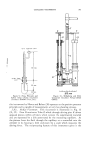
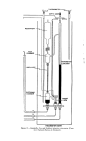
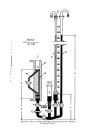
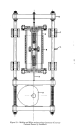
CAPILLARY VISCOMETRY 367 same capability for repeated measurements mentioned for the Willenberg and Fritz viscometer. By using various capillaries and drives viscosities of one to several million poises may be measured with this instrument over a wide range of shearing stresses and rates of shear depending on the vis- cosity. Materials as viscous as raw synthetic rubbers are easily investi- gated in this viscometer. 6. RELATIVE MERITS OF CAPILLARY VISCOMETRY TECHNIQUES The initial advantage of capillary viscometers over other types lies in their potential extreme simplicity of construction and operation, as ex- emplified by the rising column viscometer. As is often the case this advantage is detracted from by the attendant lack of simplicity of inter- pretation of the observed results. The complications stem partly from the several corrections which must be applied as mentioned in a preceding section. These cannot always all i be made reliably and in any case an undesirably large number of oppor- tunities for the entrance of error is thereby furnished. In comparison, however, most other types of viscometry are also subject to an objection- ably large number of errors. Therefore capillary viscometry is not in a relatively bad position in this respect. When the precision desired in ' measurements is low the above disadvantages are correspondingly less ' critical. A second source of complication is the fact that the rate of shear in a capillary varies with the radial position. The raw experimental results ! .. therefore are governed by the theological behavior of the fluid over a signifi- l cant range of rate of shear. These results can therefbre not be used directly " to characterize the behavior of a theologically complex material at any one rate of shear. In compensation, if a non-Newtonian material does have some functional relation between shearing stress and rate of shear, though it may be unknown and complicated, the theological behavior of the material at the maximum rate of shear in the capillary (that adjacent to the capillary wall) can be extracted relatively simply by analysis using the differentiation method of reduction, f'or which equation 15 is the working relation. The use of this method is appreciably simpler for capillary viscometry than for many other types of viscometry (33) and especially for Couette rotational viscometry (34) in which it requires either the use of rotors of different sizes or analysis by series. The above advantage is sometimes of considerable importance. The claim is sometimes made for rotational viscometry that if the separation between the inner and the outer rotor is minimized the variation of shear rate within the instrument can be neglected. Although this claim is valid in many cases it is not always so. If the experimental material is

368 JOURNAL OF THE SOCIETY OF COSMETIC CHEMISTS extremely non-Newtonian (extremely non-linear) even small deviations from a uniform shearing field can have significant effects on the observed results, and if they are neglected fallacious conclusions can result. In such cases it is more satisfactory to use the differentiation method where it is applicable and obtain a reliable characterization of the behavior at a single rate of shear. When this is done capillary viscometry is more : convenient than rotational. For materials for which no unique functional relation exists between shearing stress and rate of shear the differentiation method of reducing ' observed experimental data is not valid. Examples of such materials are those exhibiting thixotropy, work hardening, permanent degradation or certain other types of viscoelastic behavior under certain experimental .: conditions. Important information about these complicating factors can be obtained by capillary viscometry. However, if one desires to measure the basic theological quantities for such materials, methods other than capillary may be preferable. For the satisfactory characterization of non-Newtonian materials it is usually necessary to measure viscosities over a wide range of rates of I shear. In connection with this requirement capillary viscometry has a , decided advantage over most other types. Capillary techniques can be used for measurements over significantly larger ranges than can other techniques. The range available to capillary viscometers extends to values as low as those available to most other types of viscometers. Capil- lary viscometers are especially advantageous at high rates of shear, being capable of reaching much higher values than possible in most other types of viscometers. A specific advantage of capillary viscometers over many rotational instruments lies in their avoiding certain manifestations of the normal stress or Weissenberg effect. Materials exhibiting this effect to an appreci- able extent will often rise on the rotor of a rotational viscometer. This behavior removes part of the material from the shearing field thus com- plicating the geometry of the field and yielding fallacious results. For instance a false indication of thixotropy or hysteresis can be obtained. Such a manifestation cannot occur with capillary viscometers. 7. CoNcLusioN Capillary viscometry is perhaps the oldest, experimentally simplest and most versatile type of quantitative viscometry. The experimental simplicity is in some cases accompanied by numerous and uncertain corrections and by complicated reduction of observed results for theologically complex fluids. Subsequent types of viscometry have been developed which eliminate some of these dit•iculties. Possibly because of its versa- tility, however, capillary viscomerry has not been and probably will not
Purchased for the exclusive use of nofirst nolast (unknown)
From: SCC Media Library & Resource Center (library.scconline.org)