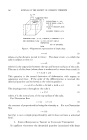
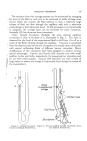
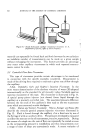
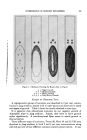
CAPILLARY VISCOMETRY 347 iI P, PRESSURE DROP THROUGH CAPILLARY SURFACE OF SMALL CYLINDER, F, = NORMAL FORCE ON END .•.• SURFACE Of CYLINDER= TTr2p •__• •-• • AREA OF LATERA=OFF/A2TTrLrP/2L=STRESS,S,= SURFA CYLINDER,A,= SHEARING ' .r2p/2rrrL Figure 2.--Diagrammatic representation for deriving shearing stress in a right circular cylindrical capillary tube. .' stress) actually measured or calculated directly is the pressure, P, forcing the fluid through the capillary, i.e., the pressure drop between the entrance and the exit ends of the capillary. The corresponding kinematic quantity ß (associated with rate of shear) is the volume rate of flow, •, of fluid through the capillary. To be rheologically useful, these observed quantities must be reduced to the corresponding fundamental theological quantities, shearing stress and rate of shear. The possibility of such reduction by reasonably simple treatment is based on the assumption that, as fluid flows through a capillary, that material immediately adjacent to the capillary wall remains stationary in the macroscopic sense. The material at effectively finite distances from the wall must move in the macroscopic sense however, or there would be no over-all flow. Therefore a velocity gradient is established according to which the farther an element of fluid is from the wall, the faster it moves through the capillary. There then exists a shear field essentially like that pictured in the preceding section. The calculations discussed there can be applied to the right circular cylindrical geometry of a capillary. To calculate the shearing stress at any radial distance, r, in a capillary one considers the cylinder described by all points at that distance, illustrated in Fig. 2. The shearing force acting on the lateral surface of that cylinder is •rr2P, which is the product of P and the area of an end surface of the cylinder (•rr2). The area of the lateral surface of the cylinder is 2rrrL, where L is the length of the capillary. The shearing stress is s = •rrø'•/2rrrL = rP/2L (8) In making this calculation nothing has been said about whether the flow is NewtonJan or non-Newtonian. The result is valid for either case. Mathematically the rate of shear at any radial position is obtained

348 JOURNAL OF THE SOCIETY OF COSMETIC CHEMISTS through a calculation of the volume rate of flow through that cylinder described by all points at that radial position. In practice this volume rate of flow can be experimentally measured only for the entire cross section of the capillary. Therefore the only radial position where the rate of shear can be experimentally determined is that at the capillary wall. Since one can always experimentally determine s also at this radial position, and therewith determine the relation between shearing stress and rate of shear, this limitation is no handicap. If the velocity of flow at a radial position is v, the volume rate of flow, dS, through an incremental cylindrical shell at that position, as illustrated in Fig. 2, is 2•rrvdr since 2•rrdr is the cross-sectional area of the shell. • is obtained by integrating d s above between the limits r - 0 and r -- R, the radius of the capillary. Performance of this integration by parts using the velocity boundary condition v = 0 at r = R eliminates v itself from the integral and introduces its gradient dr/dr, yielding fo R dV dr • -- --•r r s (9) dr So far this development is again independent of whether the flow is NewtonJan or non-Newtonian. If we now specify to NewtonJan flow, sub- stituting s/,1 for dr/dr above and expressing s in terms of r by egn. 8, there results after integration • = •rR4P/8•L. Extracting sw, the shear- ing stress at the capillary wall, via. egn. 8 gives rR a s• (10) •= 4 • Since for Newtonian flow sw/• is equal to the rate of shear at the capillary wall, q •, we have now related this quantity with • by q•o = 4•/•rR a (11) The viscosity is then RP/2L •rR4P • = Sw/q,. = 4•/•rR • -- 8•L (12) For non-Newtonian flow the procedure beyond equation 9 is similar to the above. The functional relation between dr/dr and s will be some- thing other than that expressed in equation 6. If some specific func- tional relation, such as, e.g., a power law, is applicable it is used to sub- stitute for dr/dr in equation 9 in terms of s and therefore of r in view of equation 8. If the function substituted is such as to give an integrable expression, an explicit expression for q • in terms of • will be obtained-- otherwise, not. In cases where no specific functional relation is known between dr/dr and s, equation 9 can also be developed to a usable result. For this purpose both sides of equation 9 are multiplied by 4/•rr 3 to give on the
Purchased for the exclusive use of nofirst nolast (unknown)
From: SCC Media Library & Resource Center (library.scconline.org)