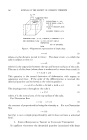
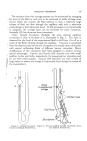
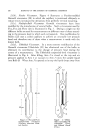
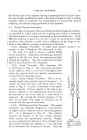
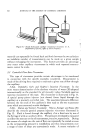
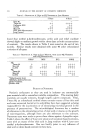
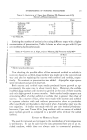
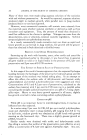
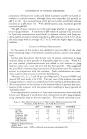
CAPILLARY VISCOMETRY* By A. B. BESTUL National Bureau of Standards, tFashington 25, D.C. 1. INTRODUCTION THis PAPER reviews some principles and applications which are pertinent in attempts to solve rheological problems by capillary viscometry in many material fields including that of cosmetics. Rather than an ex- haustive review of capillary viscometry the paper emphasizes those aspects of the field which are especially pertinent to rheological investiga- tions conducted in the light of current rheological understanding. Some aspects of the field having primarily historical interest may be ignored. References to the literature are not cited in many cases of facts of sufl:iciently long standing to be considered classical. Much of the unreferenced material is thoroughly discussed in several excellent general references (1-3) which may be consulted for further details. For the convenience of the reader the literature references cited in other cases are not always the original references, but rather those likely to be most conveniently available. 2. FUNDAMENTAL RHEOLOGICAL QUANTITIES It is helpful at the outset to review the definition of the fundamental theological quantities involved in capillary and other types of viscometry. These quantities are two in number: (1) a kinematic quantity, the rate of shear, which concerns the state of motion of the experimental material and (2) a dynamical quantity, the shearing stress, which concerns the associated forces on the material. These quantities are defined micro- scopically as well as macroscopically only for laminar as distinct from turbulent flow. Laminar flow is defined as flow in which all the flow lines are parallel. It is only to laminar flow that the following discussion applies. The above quantities are illustrated through the cube shown in Fig. 1. A (tangential) shearing force F acting on the top surface of the cube results in a continuous deformation of the cube into the rhomboid indicated by the dashed lines. The top surface moves to the right with a velocity * Presented at the October 4, 1956, Seminar, New York City. 345

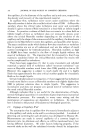
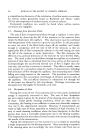
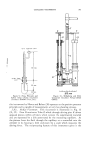
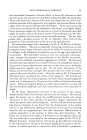
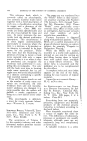
346 JOURNAL OF THE SOCIETY OF COSMETIC CHEMISTS V: a/t OR / / SHEAR STRAIN, ")' -- d/h •' / / /' I / RATE OF SHEAR, = d7/dt =q = / VELOCITY GRADIENT, dV/dh= V/h SHEARING STRESS,S =F/A v = a/t where a is the distance moved in time t. cube is subject at time t is • = a/h NEWTONIAN FLOW : S: n'•, VISCOSITY, n (CONSTANT) = S/"• NON-NEWTONIAN FLOW: S= f (•'), f ("•) NOT SIMPLE PROPORTION. NOT OF UNIVERSAL FORM. Figure l.--Diagrammatic representation of simple shear. (1) The shear strain 7 to which the (2) where h is the separation between the top and bottom surfaces of the cube. The rate q of this shear (where shear is understood to mean shear strain) is q = dr/dr = a/ht (3) This quantity is the second derivative of deformation with respect to separation and time. If the order of the differentiation is reversed this identical quantity can be viewed as the velocity gradient q = d-•/dt = d2a/dtdh = d2a/dhdt = dv/dh = v/h (4) The shearing stress s throughout the cube is s = F/e1 (S) where .4 is the normal area of the top surface of the cube. For Newtonian flow s = .33 . = s/q (6) the constant of proportionality being the viscosity r/. For non-Newtonian flow s = f(q) (7) but f(q) is not a simple proportionality and it does not have a universal form. 3. SIMPLE RHEOLOGIC^L THEORY OF C^P•[L^R¾ V•SCOMETR¾ In capillary viscometry the dynamical quantity (associated with shear
Purchased for the exclusive use of nofirst nolast (unknown)
From: SCC Media Library & Resource Center (library.scconline.org)