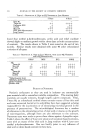
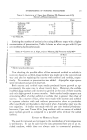
PLASTIC COATED PUSH BUTTON CONTAINERS 387 visibility screen, or with a special chemical, an ultraviolet screen. This coating is usually applied in a somewhat thinner section than that used for the pressurized containers. In the pressurized or aerosol container the main function in addition to the others just mentioned is to prevent violent shattering or fi'agmentation. Since the use of the container and the products contained are beyond the control of the manufacturer, and as is the case with most aerosol bottles, the contract filler will be handling the containers as well as the customer there- fore, to avoid split responsibility the customer should assure himself in conjunction with his contract filler that the container meets his require- ments. In a pressurized container you are concerned with a pressure retention factor as well as a design that will permit coating in a non-pressurized container the concern is only design. Hence, it is possible to have a wider design latitude in a non-pressurized container than in one for aerosol. The ultimate in design for a pressure container is a perfect sphere. The opposite is large fiat areas. Let us assume that a design has been selected, the molds have been made and the job is ready to run. At the start of every job the standards de- partment checks one bottle from each cavity, recording the findings. Any deviations in specifications are then corrected by the operator. Set-outs are then taken at the hot end every hour and checked against the bottle specifications. After annealing, bottles are inspected by the packers who wear gloves and handle only two bottles at a time. This is most important to prevent scratching or abrasion of the glass surface. The visible defects are sorted and discarded at this point. Bottles are also discarded at this point that have been designated as rejects by the standards department's finding on the hot-end set-outs. All checks, breaks or fractures are major defects. Stones and surface blisters are all rejectable. Distribution of the glass must be good. Two further tests are performed by the standards department after the bottles have been annealed. The first is a hydrostatic pressure test using equipment such as is manufactured and sold by Preston Laboratories or its equivalent. Five bottles from each section of equipment are tested at 150- lb. internal pressure every half-hour. Any bottles breaking at 150-lb. pressure require that all bottles produced on that cavity for that half-hour be rejected. Because of the hold down pressure required by certain valves, periodic checks are made on a Dillon Dynamometer for a head compression test of 450 lb. The bottle coating is a specially compounded polyvinyl chloride that is applied by dipping. The coating thickness can be varied within limits to

388 JOURNAL OF THE SOCIETY OF COSMETIC CHEMISTS provide the most economical jacket that the product manufacturer feels will suit his requirements. Always maintaining care to avoid contact of one bottle with another, an operator places the bottles in position for the dipping operation. After the plastic coating has been added, a statistical quality control check is made. Four bottles are taken every hour. The coating is stripped and weighed for a gram weight check. In stripping the coating, , four evenly spaced cuts are made running vertically along the bottle. A , micrometer reading is taken to ascertain the evenness of distribution . of the coating. A visual inspection at this time is made for cosmetic defects such as faulty coating, pock marks, splash back and burn marks. Removable blemishes are wiped off and bottles are then screened or packed. At this point I might digress to discuss the various factors which enter into a determination of jacket weight these are size of container, which in- cludes volume and glass mass, mass of the liquefied propellant portion of the pack and the potential expanded volume of the liquefied gas-pressure, headspace and total mass. Assuming the glass thickness to be constant, the forces required to break a glass container vary inversely but not proportionately with the surface area of the glass. Small cylindrical containers are considerably more resist- ant to breakage than containers of more complicated shape and greater surface area. As sizes and surface areas increase, the contents of the container in- crease, each adding another factor to the determination of the final jacket weight. The liquefied propellent portion of the formula has a direct bearing on the fragmentation pattern of the glass and upon the possibility of rupture of the plastic jacket. This is, of course, related directly to the expanded volume of the gas at atmospheric pressure, and to the pressure of the expanding gas upon the walls of the container and plastic jacket. Headspace plays a relatively obscure but important part in the determi- nation of jacket weight. It has been found experimentally that an opti- mum headspace can be found below which there is no appreciable differ- ence in fragmentation or break pattern, but above which there is considera- ble difference. Unfortunately, this optimum headspace cannot be predicted except on bottles of essentially the same shape. However, in- crease of headspace is advocated only as a last resort in the production of commercial containers. The pressure of the liquefied gases has a bearing on the speed at which the liquid volume becomes a gas and speeds at which stresses are placed on the plastic vary the reaction of the plastic. For instance, it is conceivable that stresses can be placed on a flexible material like rubber with such ve-
Purchased for the exclusive use of nofirst nolast (unknown)
From: SCC Media Library & Resource Center (library.scconline.org)