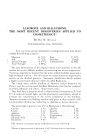
376 JOURNAL OF THE SOCIETY OF COSMETIC CHEMISTS Many of these tests were made using aqueous solutions of the nonionics with and without preservative. As would be expected, aqueous solutions produced slight to medium growth, while parallel tests in Jaag medium produced heavy to very heavy growth. However, most commercial cosmetics will contain trace minerals from the materials used, whether natural, synthetic or derived as well as from containers and equipment. True, the amount of metal thus obtained is small but sufficient to be a factor in spoilage. Nitrogen can come from the alkanolamines, urea or allantoin, common cosmetic ingredients. Sorbitol syrup and glycerin are carbohydrate sources. As a result, commercially made cosmetics may not show as rapid and heavy growth as can be had in Jaag medium, but growth will be greater than that obtained in fresh deionized or distilled water. RESULTS WITH OTHER MICROORGANISMS Summing up the work with bacteria, yeast, other molds and yeast-like organisms, mentioned earlier in this paper, it was found that, in general, all grew readily on solid or in liquid media in the presence of 0.2 per cent preservative and 2 per cent of G-3720 nonionic. THE EFFECT OF SODIUM SALTS OF PRESERVATIVES At this stage of the work it became apparent that the suspected hydrogen bonding between the hydrogen of the preservative hydroxyl group and the ether oxygen of the nonionic was indeed taking place. In an attempt to offset this effect, the sodium salts of dehydroacetic and benzoic acids, 0-phenylphenol and methyl p-hydroxybenzoate were suggested and tried. Concentrations of 0.1 and 0.2 per cent of preservative, calculated as the sodium free material, with 2 per cent G-3720 were run in a parallel series containing the straight sodium-free preservative at a pH of 7.5 using Atsper- gi//us niger. Heavy to very heavy growth appeared in all cases slightly less growth occurred in tubes containing sodium o~phenylphenate. EffECT or pH While pH is an important factor in microbiological tests, it was less an influence here than expected. In a series using 2 per cent G-3720, 0.2 per cent methyl p-hydroxyben- zoate and/Ispergillus niger •n Jaag medium, pH ranging from 4.0 to 7.5, by half' units, medium growth was obtained at all pH levels with growth starting on the fourteenth day. There was a slightly greater growth at pH 6.0, 7.0 and 7.5. Similar results were obtained with sorbic and dehydroacetic acids. One thing is certain that neither of the preservatives were effective at any pH at a concentration of 0.1 per cent against Atspergi//us niger. At a con-

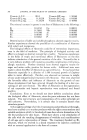
INTERFERENCE OF NONIONIC EMULSIFIERS 377 centration of 0.1 per cent sorbic acid failed to protect at pH 3 to 8, with or without a nonionic present, although there was somewhat less growth at pH 3 to 5.0. At a concentration of 0.2 per cent sorbic acid failed without nonionic at a pH above 5.0. With dehydroacetic acid, maximum growth occurred at pH 6.0. The pH of most nonionics is in the acid range whether in aqueous solu- tion or Jaag medium. A summary of pH values of a group of 22 nonionics in 2 per cent concentration tested both in aqueous solution and Jaag me- dium, before and after autoclaving shows a pH variation of 2.9 to 6.7 all in the acid range with an average of 2.7 to 3.5 with the higher figure in Jaag medium. EFFECT OF OTHER SURFACTANTS In the course of this work it was decided to test the effect of the other three remaining types of surfactants, namely, anionic, cationic and ampho- lyric. Earlier tests had shown that 0.1 per cent of anionic surfactants in Jaag medium failed to show growth of Atspergi//us niger for a year. When 0.1 per cent methyl p-hydroxybenzoate was added to the anionics in Jaag medium, tubes over a year old were still free from growth. This suggested the possibility of preventing inactivation of the preservative by using an anionic in conjunction with the nonionic. Such combinations are some- times used for other reasons in cosmetic formulations. Mixtures of 1, " 2/2, 5 and 10 per cent Duponol C, Nacconol NRSF and Aerosol OT were made in G-3720. Two per cent of the mixture was used in Jaag medium to which was added 0.1 per cent methyl p-hydroxybenzoate. All concentrations of the anionic in the mixture failed to prevent the inter- ference of the nonionic with the preservative resulting in heavy growth of ,4spergillus niger. Four representative nonionics in 2 per cent concentration were used with 0.2 per cent Duponol C and 0.2 per cent of preservative all in Jaag medium using ?lspergillus niger as the test organism. The control contained every- TABLE 5--FIvF. MONTH GROWTH o1• A•. Niger IN JAAG MEmuu CONTAINING 2% No•o•m, 0.2% DUVONOL ^•D 0.2% PR•.S•.RVaT•W MP* SORBICt DHA$ CONTROL G-3720 4- 4-+ 4-4- +-b-b4- Myrj 49 +4- +4- -3-4- -3-+4-+ Tween 60 4-4- 4-4- +4- 4-4-4-4- Carbowax 1540 .... Pluronic L-64 + + -- + + + + GMS 20 ETO ++ ++ ++ ++++ 0.2o-/0 Duponol .... * Methyl p-hydroxybenzoate. t Sorbic Acid. :• Dehydroacetic Acid. GMS = Glyceryl monostearate ethoxylated (20).
Purchased for the exclusive use of nofirst nolast (unknown)
From: SCC Media Library & Resource Center (library.scconline.org)