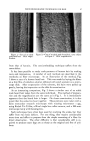
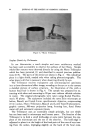
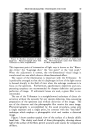
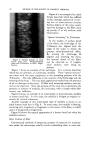
COMMENTS BY MORRIS J. ROOT--AEROSOLS 107 tion of space insecticide aerosols has been adopted by the C.S.M.A. The aerosol is drawn into a wind tunnel so that the individual particles deposit on a rotating microscope slide. The particles on the slide are counted and classified by size. A suitable correction is applied in order to calculate the particle sizes in the original spray. Another method previously described,* which is adaptable to all types of products, is now being checked by the Personal Products Committee of the Scientific Section of the C.S.M.A. and the Aerosol Standard Methods Committee of the Society of Cosmetic Chemists. This method gives a spray pattern rather than a particle size distribution. The method is based on the impingement of the spray on a piece of paper that has been treated with a dye-talc mixture. A 5 per cent mixture of the dye in talc is brushed onto a 60-pound Vellum paper stock. A small, but known, burst of spray is allowed to impinge upon the treated paper. Wherever the particles strike the paper the dye goes into solution and is absorbed'. The size of the dye spots are in direct relation to the size of the liquid particles when they come into contact with the paper. The dye used must be soluble in the spray particles. In the case of alcoholic sprays such as hair lacquers. a water-soluble dye such as DuPont Crystal Violet must be used in the case of oil soluble sprays such as insecticides, an oil soluble dye, for example, DuPont Oil Red Powder, must be used. This spray pattern technique is particularly useful for comparing spray characteristics obtained with differ- ent valves, actuators and formulations. The method is rapid, easily done and a visual record is obtained. 1t z. Spray/Ingle. Of importance in many aerosol products is the angular projection of the spray from the orifice. This may vary with different actuators from an 18 degree angle to one of over 50 degrees. An adaptation of the previously described spray pattern technique is used. Paper treated with dye as described is held against the valve stem directly under the orifice of the button so that the paper forms a 90 ø angle with the valve stem. The valve is activated so that a quick burst of the spray is directed on the paper. The spray forms a triangular pattern from which the angle of spray can be obtained by measuring the angle of the triangle which has the orifice of the button as its vortex. Root, Morns J., Aerosol Spray Patterns," Proc., Sci. Sect., Toilet Goods .4ssoc., Number 24 (December, 1955).

Report on EVALUATING ANTIPERSPIRANT AND DEODORANT PRODUCTS THE FOLLOWINg3 methods are based on methods and techniques tried in several laboratories to determine antiperspirant effect and deo- dorant effect of preparations used in the axilla. For this work, the studies are conducted directly in the axillary areas. (Later if studies in other than axillary areas .or in vitro can be correlated with data obtained directly in axillary areas, consideration will be given to such test methods.) PROCEDURE FOR ANTIPERSPIRANT TEST 1. Subject having used no deodorant or antiperspirant for a week, hav- ing used no deodorant soap for this week (olive oil, castile or Ivory soap permissible in axillary areas) and having shaved the axillary areas is set up for a test beginning on Monday. 2. Monday, 9 a.m. Collect 3 to 6 pieces of control data of weights of perspiration obtained simultaneously in left and right axilla of the subject. This is done by placing rated absorbent pads in the previously dried axillae and having the subject keep the upper arms close to the body to hold the pad in place. Each set of pads is retained in the axillae for from 15 to 30 minutes or until a minimum of 100 mg. of perspiration is collected from the least perspiring axilla. The number of determinations made is governed by the closeness of the check ratios obtained by the following calculation Wt. perspiration from R axilla = ratio (pR) Wt. perspiration from L axilla pR = perspiration ratio. 3. Monday, 12 noon. Apply preparation under test to the axilla which perspires the most. 4. Monday, 1 p.m. Collect 3 to 6 pieces of data of weights of perspira- tion obtained simultaneously in left and right axillae as under collection of control data. CalculatepR. 5. Tuesday, 9 a.m. Apply preparation under test to same treated axilla as on Monday. 6. 10 a.m. Collect 3 to 6 pieces of data of weights of perspiration as before. Calculate pR. 108
Purchased for the exclusive use of nofirst nolast (unknown)
From: SCC Media Library & Resource Center (library.scconline.org)