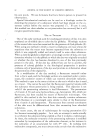
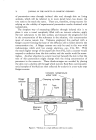
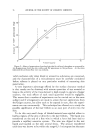
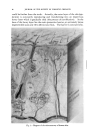
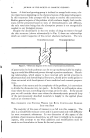
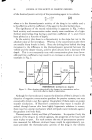
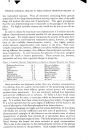
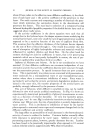
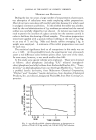
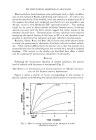
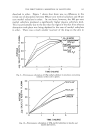
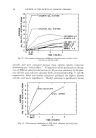
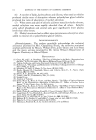
72 JOURNAL OF THE SOCIETY OF COSMETIC CHEMISTS of penetration rates through isolated skin and through skin on living animals, which will be referred to in more detail later, has shown the two rates to be much the same. There are, therefore, strong reasons for relying on the validity of experimental penetration results obtained with isolated skin. The simplest way of measuring diffusion through isolated skin is to place it over a vessel completely filled with an isotonic solution, apply the test substances to the skin surface, and measure the progressive rise in the concentration of the substance in the solution this concentration must of course remain low. Treherne employed this method with a Geiger counter forming the base of the diffusion cell to follow directly the concentration rise. A Geiger counter can only be used in this way with radioisotopes which emit low energy electrons, e.g., C14, S35. With the much higher energy of the S-particles from P32, such a counter would respond to radiation from the skin surface and the results would be mean- ingless. Another objection to a static reservoir beneath the skin is that the rate of skin penetration might change with the rising concentration of penerrant in the reservoir. These disadvantages are avoided by placing the skin over a shallow cell through which isotonic fluid flows continuously serial samples of the fluid are then collected for analysis in a test-tube type Geiger counter. Constant temperature water both Ringer • •J f Clamping cylinder solution • • •t ,••////'• Skin '•uid Magnetic Stirrer Outflow Figure 1.--Section of a single diffusion cell (not to scale).

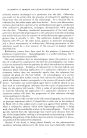
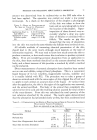
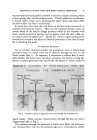
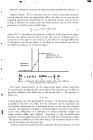
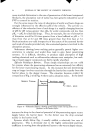
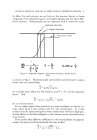
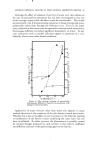
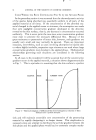
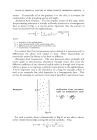
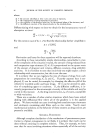
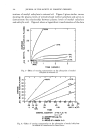
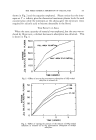
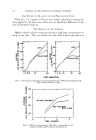
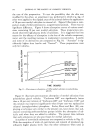
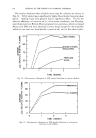
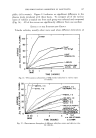
METHODS FOR MEASURING PERCUTANEOUS ABSORPTION 73 One of the big advantages of using isolated skin is that several experi- ments can be carried out on skin from the same animal and even from the same region if the pieces of skin used are not too large. The apparatus we employ has, therefore, been designed in the form of a battery of five diffusion cells which are simply holes in a stainless steel plate. The base of each cell is a concave glass slide cemented to the plate. The skin is placed over the cell and held down by a stainless steel cylinder ordinary rubber bands supply tension and these fit over hooks attached to the cylinder and to the plate. Holes leading into each cell are bored entirely through the width of the plate so that a flow of Ringer solution can be maintained through each cell. The dimensions of the cell have been kept to a workable minimum so that a modest flow of Ringer solution adequately flushes the cell without giving very large serial samples of liquid for sub- sequent analysis. The area of skin used, however, must be large enough to accommodate the spreading of the largest drop of test substance likely to be used in our experiments this is about 0.003 ml. The cell area in the apparatus shown is 3.5 cm. • and its depth 0.6 cm., and its volume is, therefore, about 2 ml. The cell contents are stirred magnetically. The maximum flow rate through the cell is about 5 mi./min., and the Ringer solution is collected in sample tubes which are automatically changed at intervals ranging from 10-60 min. The temperature of the cells is kept at 33øC., by a thermostatically controlled water bath of which the cell base plate is an integral part. In nearly all the experiments freely falling drops of test substance have been used. These have been dispensed by a precision microburette delivering volumes down to 2 X 10 -6 ml. The area of skin covered by the drop is determined by placing a dental x-ray film over the skin at the end of the experiment and taking an autoradio- graph of the region. As a general rule a drop of liquid on the skin spreads rapidly outwards for a minute or two and then changes very little in area over a fairly long period. The results are obtained as an unbroken series of recoveries of the test substance which has penetrated the full thickness of the skin during each relatively short sampling time. Summated and plotted with time, the data fall on a curve giving the total amount of the substance penetrating the skin at any given time. Generally, the shape of the curve can be described by a relation of the form d = kp(t-- d+de- where .4 is the total amount penetrating in a time t. k is a constant depending on the size of the drop, p is a permeability constant corre- sponding to the gradient of the later region of the graph which is linear, and d is a delay period which can be obtained from the graph by extrapola- tion of the linear portion to zero recovery.
Purchased for the exclusive use of nofirst nolast (unknown)
From: SCC Media Library & Resource Center (library.scconline.org)