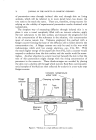
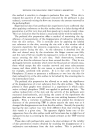
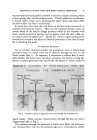
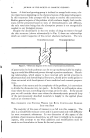
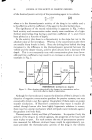
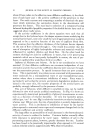
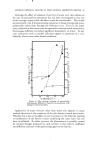
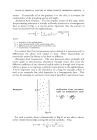
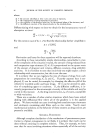
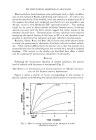
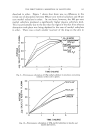
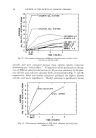
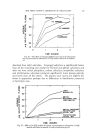
PHYSICAL CHEMICAL ANALYSIS OF PERCUTANEOUS ABSORPTION PROCESS 87 Simplesl Model. If it is assumed that the vehicle containing the pene- trating chemical does not appreciably affect the skin, we can set up the following approximate relationship for an idealized system, such as shown in Fig. 2, between the steady state rate of penetration (dq/dt) and various properties of a fairly water soluble d•ug' dq (P.C.) (Conc. of Drug) dt - L (1) where (P.C.) is the effective distribution coefficient of the penetration agent between the vehicle and the barrier of the skin, (Conc. of Drug), the con- centration of the agent in the vehicle, D, the effective average diffusivity of the agent in the barrier phase, z/, the effective cross section area, and L, the effective thickness of the barrier phase. Penetrant in- Aqueous Vehicle Aqueous Receptor 4'•, : D[PC]A =A-- L •' L Figure 2.--Schematic plot showing simple steady state diffusion across a barrier layer of thickness L. The main characteristics of the penetrating agent which determine its rate of entry through the skin, according to this equation, are its effective partition coefficient and diffusivity in the barrier phase. The product of these two (P.O.) (D) is often spoken of as the permeability constant. If the barrier phase were available in the form of a film, the two constants can be separated and individually determined by a technique known as the lag time method. Actually the important variable in the permeability constant is the (P.C.) factor since diffusivity of a substance of similar molecular weight and shape usually differ only slightly. According to the Stokes-Einstein equation, D varies approximately only as the cube root of molecular weight. The partition coefficient, on the other hand, is an extremely sensitive func- tion of molecular structure and size. Another useful but equivalent form expresses the same equation in terms

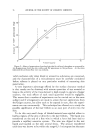
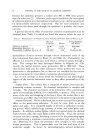
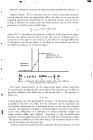
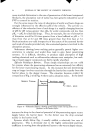
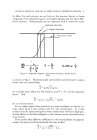
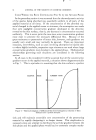
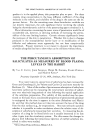
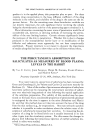
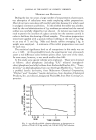
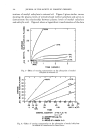
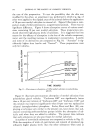
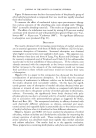
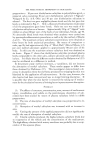
JOURNAL OF THE SOCIETY OF COSMETIC CHEMISTS of the thermodynamic activity of the penetrating agent in its vehicle: dq _ a D•l __ (It •/ L where a is the thermodynamic activity of the drug in its vehicle and • is the effective activity coefficient of the agent in the skin barrier phase. The significance of the second relationship is apparent in Fig. 3 where both activity and concentration under steady state conditions of a hypo- thetical penetrating drug having a partition coefficient of 1/2 and 2 have been plotted as a function of depth. In the activity plot there is a discontinuity in the slope but not in the absolute value at the interphase. Whereas in the concentration plot there are usually sharp breaks in both. Since the driving force behind the drug movement is the difference in the thermodynamic potential between the vehicle and the deeper tissues, activity plots always show a decrease with depth. This is not necessarily true with concentration plots since favor- able partition coefficients may result in an increase as shown in one of the examples in Fig. 3. Conc. ' •oint. I / ibase •arr/er, lower, /2 I tissue9 / = ! oint. I ! base , skin ! lower iI•arr •5 . . Act. PENETI•ATION {effective depth) Figure 3.--Plots showing schematically the changes in concentration and ac- tivity with effective depth of penetration. Although for thermodynamic reasons the direction of flow is always in the direction of negative concentration gradient for passive systems, one may conceivably obtain a net flow against the gradient if there exists an energy transfer mechanism. If Buettner's contention that water is readily ab- sorbed through human skin from highly hypertonic solutions is correct, there must be a pump mechanism which will push water molecules against the gradient into body fluid. Thermodynamic ,4ctivity and Rate of Penetration. In equation 2 only the activity of the drug in its vehicle appears, the properties of the base itself seem to play no part. For such systems the rate of percutaneous penetra- tion measured for different ointment bases would be approximately con- stant provided the thermodynamic activity of the drug in the vehicles
Purchased for the exclusive use of nofirst nolast (unknown)
From: SCC Media Library & Resource Center (library.scconline.org)