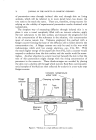
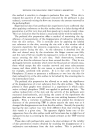
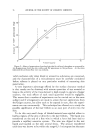
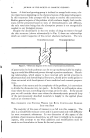
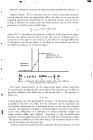
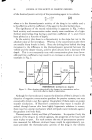
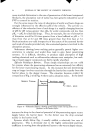
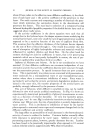
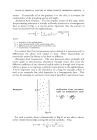
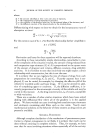
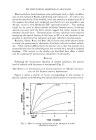
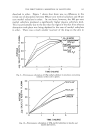
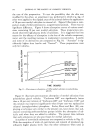
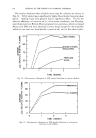
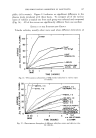
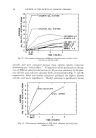
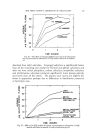
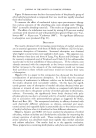
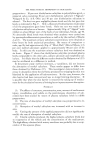
PHYSICAL CHEMICAL ANALYSIS OF PERCUTANEOUS ABSORPTION PROCESS 95 matics. If essentially all ot the gradient is in the skin, it is evident the mathematics of the preceding section will apply. .4bsorptionfrom Solutions. For the simplest system of this type, where the penetrating substance is initially uniformly dissolved in a homogeneous base as shown in Fig. 7, it can be shown rigorously that the amount of material absorbed from the applied phase, 6•. = hCo 1 8 23 1 -D(2md-1)2•r2t'• •'2.m =0 (2m d- 1) • e • J where h = thickness of the applied phase, Co = initial concentration of me penetrating solute, D = diffusion ccnstant of the solute in the base, and t = elapsed time of application. It is evident that if an instantaneous rate is desired it is necessary only to differentiate the above with respect. to time. These relationships are extensively treated by Barter in his book on dif}hsion. dbsorptionfrom Suspensions. The case discussed above probably will rarely apply to percutaneous absorption through intact skin since the dif}hsion coefiqcient of any chemical readily taken in through such a barrier will be so great as to maintain a uniform concentration in the applied phase. A more important case is the absorption of a drug, for example, which is used as an extremely fine solid dispersion in a homogeneous base. This can be, for example, an ointment consisting of pencillin in petrolatum base. Receptor ß o 4, ß o ß ß ß Diffusion from ointment base of suspension type L = h a + Ah 2 %D 2CsD Figure 8. For such a system, shown schematically in Fig. 8, we are able to derive rather simple relationships among the several variables. Thus • Dt E = (2.4- c,) '] + 2(.4 - c.,5/c,

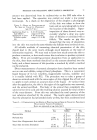
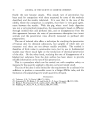
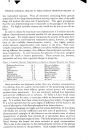
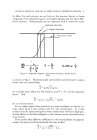
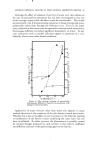
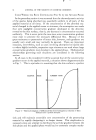
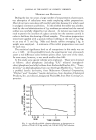
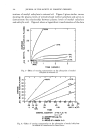
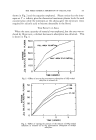
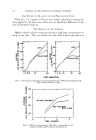
96 JOURNAL OF THE SOCIETY OF COSMETIC CHEMISTS where /• = the amount absorbed at time t per unit area of exposure, •/ = the concentration of drug expressed in unit/cm. a, C8 = the solubility of the drug as units/cm. a in the external phase of the ointment, and D = the diffusion constant of the drug molecule in the external phase. Differentiating with respect to time we obtain for the instantaneous rate of absorption at time t d/• 1/2 (2•/ -- C8) •/ D t dt - 1 +'2(At- For the common case of Cs .4 we find the relationship further simplified to and dt • 2t Derivation and bases Gr these equations will be reported elsewhere. According to these remarkably simple relationships, remarkable in view of the complexity of the situation treated, the amount of drag released from such suspension-type ointment (C• d) is proportional to the square roots of the amount of drug per unit volume, diffusion constant, drug solubility and time. It is of interest to note that intuitively one might expect a direct relationship with concentration, but this is not the case. It is evident that we can regulate the rate of release of drugs from such preparations by controlling d, D, and C•. If partly aqueous base is em- ployed, C• can be varied, Gr example, by changing the effective pH of the vehicle Gr insoluble acidic and basic drugs. Or it can be altered by addi- tion of complexing agent or cosolvent. D, the diffusion coe•cient, is in- versely proportional to the microscopic viscosity of the vehicle and may be varied in this manner. d, the drug concentration, is, of course, susceptible to wide variations. There are a number of other similar situations which have been solved dealing with diffusional flow where all of the gradient is in the applied phase. We have worked out cases involving both emulsion-type ointments and ointments containing solid fillers such as zinc oxide. Nearly exact mathematical solutions to the behavior of these systems as drug sources are presently available. GENERAL D•scvss•os Although complete elucidation of the mechanism of percutaneous pene- tration is of great consequence in our fields, it is evident that much can be done without awaiting its complete solution. Thus, Gr example, we have seen that for cases involving situations where essentially all of the activity
Purchased for the exclusive use of nofirst nolast (unknown)
From: SCC Media Library & Resource Center (library.scconline.org)